The PDF's is the anti-diagonal identity matrix. Write and . Its diagonal Cartan subalgebra consists ofThe defining matrix identity says . The root spaces have the following root vectors, together with their opposites:The negative short root has vector . Hence the root-space decomposition is , each root space is one-dimensional, and the Bn root system isThere are roots and zero-weight dimensions, giving as a check. Upper triangular matrices giveFor , the highest root is . The fundamental weights and Weyl vector areThese weights pair to with the simple coroots; summing the positive roots gives the displayed .
The Dynkin diagram is the chain , with single edges except a double edge between and , whose arrow points to the short root . In the Extended Dynkin diagram, attaches by a single edge to when . For , both long nodes have a double edge to the short node . The Bn Dynkin diagram and affine extension below distinguishes these small-rank cases.
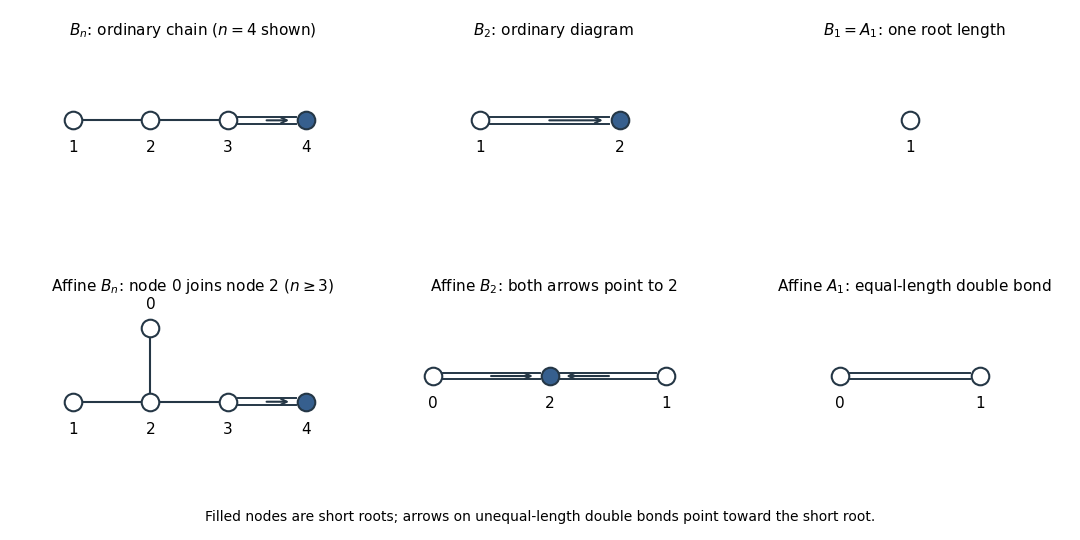
Ordinary and affine Dynkin diagrams of type B
. Details. 
For , the system is : , , . Its ordinary diagram is one node; its affine diagram has two equal-length nodes with the usual affine double bond.
Let be a four-dimensional symplectic vector space. The symplectic contraction of an exterior square splits into its five-dimensional primitive exterior square and the invariant line spanned by the inverse symplectic bivector . Choose . Exterior multiplication defines a symmetric bilinear form on by ; it is symmetric because both degrees are two. In a symplectic basis, , and , so the restriction to is nondegenerate.
The symplectic Lie algebra preserves this form, giving a homomorphism . It is injective: an element acting trivially on also acts trivially on , hence on all of . In a four-vector basis, the identities first force every off-diagonal coefficient of to vanish, then force for every pair. Over these equalities imply .
Both Lie algebras have dimension ten: and . The injective map is therefore an isomorphism, proving the exceptional isomorphism between sp4 and so5:
Identify the diagonal Cartan subalgebra with coordinates . The root reflection is in the standard Euclidean identification. For the Bn root system, this givesAll unlisted coordinates stay fixed, and . These transformations are coordinate permutations and independent sign changes. They generate exactly the signed symmetric group, soHere permutes the factors in the semidirect product.
The PDF uses for ; the TeX incorrectly turns this into a power of two. The crystal of the defining odd-orthogonal representation is the chain with weights . Label its vertices . Its directed edge colors areIn particular the short-root string has two edges of color .
For a full drawing of the tensor product of crystals in any rank, take every ordered pair of chain vertices . Let count incoming edges of color along its string, and let count outgoing ones. We use the conventionomitting an edge when the indicated operator vanishes. This crystal tensor-product rule specifies every vertex and every edge; the raising rule uses for its first-factor branch. The picture shows the chain and all 25 tensor vertices for , with connected components distinguished by node color.
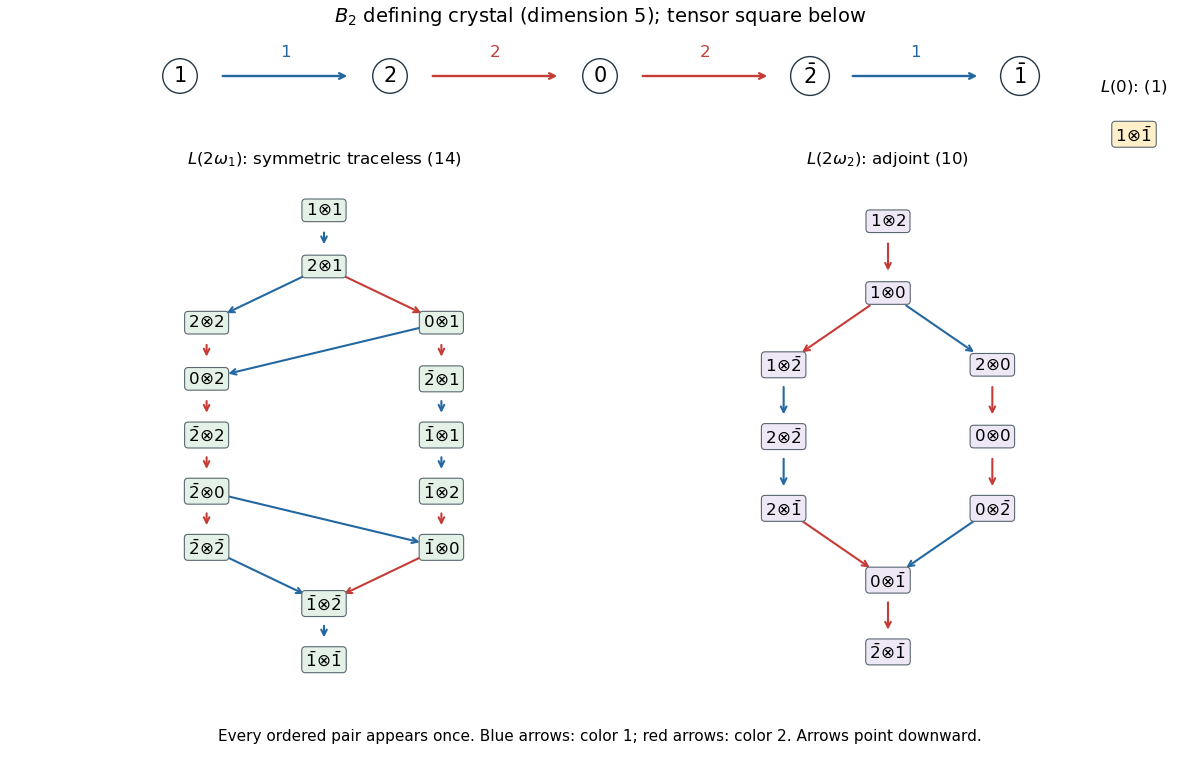
The type-B2 defining crystal and its tensor square
. Details. 
For , the three highest-weight vectors of the tensor crystal are , and . They have weights , and zero. There are no others: a highest tensor vertex must have highest first factor, and the string inequalities then restrict its second factor to these three vertices. ThereforeThe summands are the traceless symmetric square, the exterior square (the Adjoint representation), and the invariant scalar line. Their dimensions are , and one, summing to . For the first two highest weights are ; for they are . For , the three tensor highest vertices are , giving of dimensions .
Articles by others on the same topic
There are currently no matching articles.