For fixed , Mumford's compactness theorem states thatHere is the unmarked moduli space of Riemann surfaces, with its usual topology, and the hyperbolic systole is the shortest nonconstant closed hyperbolic geodesic, in Gaussian curvature . Equivalently, a subset of is relatively compact exactly when its hyperbolic systoles have a common positive lower bound.
We use two standard structural results. The Bers pants decomposition theorem provides a constant such that every closed genus- hyperbolic surface has a pants decomposition with all cuff lengths at most . For a fixed topological pants decomposition, the Fenchel–Nielsen coordinates identify Teichmüller space withThe length coordinates are , and the twist coordinates are measured in length units: a full Dehn twist changes by . Reconstruction from these coordinates is continuous; locally the marked metrics can be chosen to vary smoothly on a fixed reference surface, and the quotient by the mapping class group is the Hausdorff moduli space of Riemann surfaces.
Take any sequence in . The pants decompositions supplied by the Bers pants decomposition theorem have cuff lengths in . There are finitely many topological types of pants decomposition: their dual graphs have vertices and edges, with loops and multiple edges allowed, giving finitely many finite graphs. Choose a subsequence of one type, and choose markings carrying each decomposition to a fixed reference one. Compose these markings with Dehn twists so that . The resulting points of Teichmüller space lie in the compact boxThey therefore have a convergent subsequence inside Teichmüller space; its continuous projection gives a convergent subsequence in the moduli space of Riemann surfaces. If the thick set is empty, which is already compact. Equivalently, using all the finitely many reference decompositions gives a finite union of compact projected boxes containing the whole thick set.
Finally the hyperbolic systole is continuous. Nearby marked hyperbolic surfaces admit metric comparisons with bi-Lipschitz distortion tending to one; the length of every loop, and hence the infimum over all essential loops, obeys the same multiplicative comparison. Therefore is closed in that compact union and is compact. A compact subset has a positive minimum hyperbolic systole, proving the converse characterization of relative compactness. This theorem concerns the unmarked quotient: repeated Dehn twists can give an unbounded sequence in Teichmüller space while leaving the underlying surface and its hyperbolic systole unchanged.
The given is a simple closed curve. Assume it is essential; for a contractible class both infimal lengths are already zero. Write . The collar lemma supplies an embedded annulus with coordinates and , and metricSet . This changes the metric to a positive scalar multiple of , so the conformal modulus of an annulus isThe extremal length of its core curves is . Allowing all curves homotopic to in can only decrease infimal lengths, while the area of a metric on all of is at least its area on the collar. Thus . Use the particular conformal metric , whose area of a quadratic differential is one:This proves the required implication uniformly over all the area-one holomorphic quadratic differentials on these surfaces.
The converse is false. Here is an explicit slit connected sum of translation tori. Start with square flat copies of a torus and , where . Cut a horizontal slit of physical length in each, centred in an interior coordinate disk, and cross-glue the banks by translation. The resulting surface has genus two. Its two slit endpoints have cone angle , so the locally defined extends to a holomorphic one-form with two simple zeros. Its flat area is . Setwhich is a holomorphic quadratic differential of area one. Let be a horizontal generator in the small torus, taken away from the slit and fixed by the marking of this small handle. Then
To verify that its hyperbolic length does not tend to zero, construct a uniform lower bound on extremal length. On the unit square torus choose a disk about the eventual slit centre and a smooth cutoff function equal to one on a smaller disk and supported in . Let denote a local real coordinate on ; in the first term below, is the globally defined torus one-form, while is extended by zero outside . The real closed differential formis globally defined, vanishes on the smaller disk, and has period one on the horizontal generator. Pull it to by the rescaling map , and extend it by zero across the slit and over the other torus. For sufficiently small , the slit is inside the region where the form vanishes. Hence this extension is a smooth closed differential form on the connected sum, with .
Define a nonnegative conformal metric density by the pointwise norm of relative to the flat metric. Two-dimensional scale invariance givesindependently of . For every representative homotopic to ,because the period of a closed differential form is unchanged by homotopy. This is the extremal length lower bound from a closed one-form; therefore . If tended to zero along any subsequence, the collar estimate would force , a contradiction. In fact its hyperbolic lengths are uniformly bounded away from zero. ThusFor every fixed , replace by the area-one translation surface constructed in the polygon argument; its genus is . Cut its slit inside a nonsingular flat coordinate disk. The new connected sum has genus , and the area normalization, small-handle length bound and closed-one-form energy argument are unchanged. Thus the converse fails at every fixed genus .
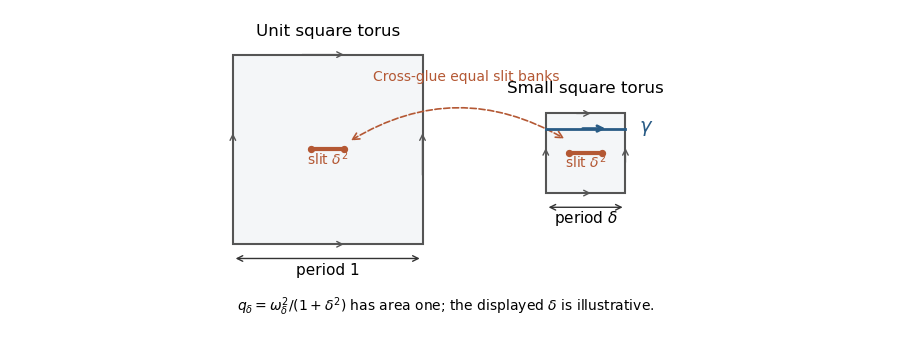
A small translation torus joined by equal slits; its generator is flat-short while retaining a positive extremal-length bound
. Details. 
Articles by others on the same topic
There are currently no matching articles.