Fix . We prove the Riemann mapping theorem in this case by maximizing a normalized derivative. Choose . Since is a simply connected domain and never vanishes, it has a holomorphic square root . This is injective, and is disjoint from : equality up to sign would first force the original points to coincide. Choose and with . The ball is omitted, so is a bounded univalent function. Scaling and composing with an automorphism of the unit disk produces an injective holomorphic function with and .
Let be the family of all such normalized univalent functions. A Cauchy estimate in a small disk about bounds their derivatives, so is finite and positive. Choose a maximizing sequence in this normal family. Montel theorem gives a subsequence converging uniformly on compact subsets to . Its derivative at is . The maximum modulus principle puts its image in , and Hurwitz's theorem implies that a nonconstant limit of injective holomorphic functions is injective. Thus the maximum is attained.
If is omitted, then . Put . A holomorphic square root of exists, is injective, and takes values in . Compose with and a rotation to normalize it. Writing , the new derivative has magnitudea contradiction. Therefore maps onto . The Cayley transform between the half-plane and disk now givesIts inverse is holomorphic by the holomorphic inverse function theorem, so this is a biholomorphism. The proper-subset hypothesis was used to choose ; the whole complex plane cannot be mapped this way, by Liouville theorem.
Interpret the printed congruence entrywise in the integer lattice:It then defines the usual level-two principal congruence subgroup of , despite the PDF's ambient . A literal ideal congruence inside would be vacuous because , and would make the asserted conclusion false. The integer-lattice interpretation is essential.
Pass to , which has exactly the same action. Reduction modulo two maps the modular group onto , a group of order six: the reductions of and generate it. Its kernel is , so the index of a subgroup is six. The standard fundamental domain of the modular group has hyperbolic area , and hence the quotient has hyperbolic area .
There are no nonidentity elliptic Möbius transformations in . An integral matrix representing an elliptic Möbius transformation has trace or . Here the trace is even, excluding ; trace zero would give and , impossible. Thus the effective action is a free properly discontinuous group action, and the quotient is a Riemann surface.
A cusp of a modular group is represented by a rational boundary point. Their orbits correspond towhich has elements. They are represented by , or by the three nonzero parity vectors of a primitive numerator-denominator pair. Each width of a cusp is two. A union of six copies of the standard fundamental domain of the modular group gives a fundamental region for this subgroup. Removing small horocycle neighbourhoods of its cusps leaves a compact core. Adding one point at each cusp of a modular group, using the local parameter after moving that cusp to infinity, gives a compact Riemann surface .
For a finite-area hyperbolic surface of genus with cusps, the Gauss-Bonnet theorem gives area . Thus and . A compact genus-zero Riemann surface is the Riemann sphere, by the uniformization theorem. A Möbius transformation sends the three added points to . Restricting it gives
Use the Gaussian curvature normalizationof the Poincaré half-plane model. This is a complete conformal metric, invariant under real Möbius transformations. Its quotient by the free effective principal congruence subgroup is again complete: a geodesic lifts to the complete covering plane and extends there for all time. Transporting the quotient metric through the biholomorphism supplies the required complete conformal metric.
A nonconstant closed geodesic corresponds to a hyperbolic Möbius transformation of , and its hyperbolic translation length is . Indeed its eigenvalues have magnitudes with , and its axis quotient has length . For in , implies . The odd numbers therefore have the same residue modulo four, andA hyperbolic Möbius transformation must have , so its smallest possible absolute trace is six. It is attained byConsequentlyThis element is primitive: a proper power would have a shorter root represented by a hyperbolic Möbius transformation, contradicting the trace bound. No essential simple closed geodesic exists on the three-punctured sphere, since every essential simple loop is peripheral and corresponds to a parabolic Möbius transformation. The minimizing closed geodesic is therefore nonsimple. Finally, the PDF leaves the numerical Gaussian curvature unspecified: the displayed length uses Gaussian curvature ; for Gaussian curvature , it is divided by .
First use the nonzero loci, as required by the standard SL2R action on differentials. A nonzero holomorphic one-form has, away from its zeros, flat coordinateswhose changes of coordinate are translations. A nonzero holomorphic quadratic differential similarly has local flat coordinates , with and changes of coordinate . These are respectively translation surfaces and half-translation surfaces.
Identify a flat coordinate with a vector in . For , replace every flat coordinate by . Since preserves orientation and commutes with multiplication by , the new changes of coordinate areThey are holomorphic in the new coordinates, and so define a new complex structure. Define or in that structure. The forms glue because translations preserve , and the extra signs preserve .
The zeros also extend. A zero of order of a holomorphic one-form has cone angle ; a zero of order of a holomorphic quadratic differential has cone angle . The real-linear deformation preserves the corresponding winding multiplicity. Filling the cone in a local coordinate gives in the first case, or a local branch of in the second. Thus the resulting forms are constant multiples of or and have the same zero orders. This verifies extension across the missing points, rather than merely producing an atlas on the punctured surface.
An isomorphism preserving the original differential identifies its flat coordinates up to the permitted translations or signs; applying identifies the deformed atlases too. Hence the construction descends to the corresponding moduli spaces. Applying after replaces by , soThe area of a quadratic differential, and the analogous area of a holomorphic one-form, are preserved because .
For , the flat coordinates obtained from already give the required half-translation surface atlas for . The same replacement therefore constructs both deformations, and
The printed sets include identically zero differentials. They have no flat coordinates, so the customary geometric group action is defined on the nonzero loci. One can obtain a set-theoretic action on the displayed entire sets by declaring ; the same equivariance identity then holds at zero. This extension is generally not continuous: as , the deformed underlying surface is the same for every real , and can differ from . Thus a claim about the standard continuous geometric group action requires the nonzero convention.
The analogous flat-coordinate construction does not define a full action on arbitrary cubic differentials. Away from zeros, a nonzero holomorphic cubic differential has flat coordinatesTheir changes of coordinate are with . A branch change is therefore a rotation through , not merely a sign. Applying a real-linear map changes its linear part to , where is that rotation. In general this is not a complex-linear map, so the proposed changes of coordinate are not holomorphic and cannot define the required deformed complex structure.
For example, take and with . Thenwhose off-diagonal entries fail the condition for a complex-linear map. This dependence on the choice of cube-root coordinate is the obstruction even when considering descent from the locus : the three possible roots need not lead to the same deformation of the cubic pair.
The real matrices preserving orientation that normalize the order-three rotations are precisely the matrices of complex-linear maps; intersecting with leaves . Indeed a nonreal rotation determines its complex structure, and conjugation to its inverse would reverse that structure's orientation. Thus there is a natural rotation action,The conclusion concerns the geometric group action analogous to that for translation surfaces and half-translation surfaces; it does not rule out artificial group actions unrelated to these atlases.
Label the polygon vertices cyclically. Translation pairing of opposite sides identifieswith indices modulo . The vertex classes are consequently the cosets of the subgroup generated by in , and their number isThe quotient is a compact Hausdorff space. An interior point has a disk neighbourhood, a paired-side point has two half-disks joined to a disk, and each vertex class has its incident sectors cyclically joined to a cone, topologically a disk. Thus it is a connected closed surface with an orientation. Its Euler characteristic is , since there are paired edges and one face. Hence
The polygon interior and paired-side charts are translation surface charts with . Each corner angle is . For even , all corners meet, giving cone angle ; for odd , each of the two classes contains corners, giving cone angle . Both are integral multiples of . A cone of angle has the local uniformizing coordinate with ; the holomorphic one-form is . Filling the vertices therefore supplies the Riemann surface structure and the holomorphic one-form, withAn order-zero entry denotes a regular point, not an actual zero: for the surface is a torus and the form is nowhere zero. The zero orders otherwise sum to , as a check against the degree of the canonical bundle.
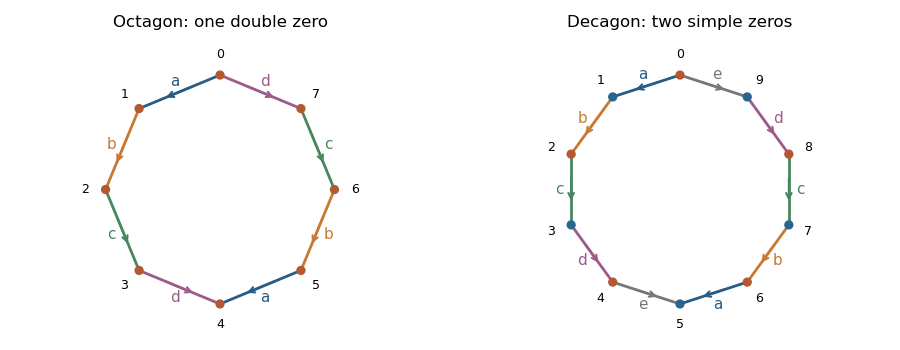

For , the form has one double zero and lies in the stratum of holomorphic one-forms ; for , it has two simple zeros and lies in . The SL2R action on differentials preserves zero multiplicities, as the local cone argument shows. ThereforeTheir equal genus and area do not distinguish the orbits; their different strata of holomorphic one-forms do.
A generalized conformal metric is locally , where is nonnegative and measurable and transforms as a length density under a holomorphic change of coordinate. Its area is . Use the usual convention of using locally rectifiable paths for a path family , and put . ThenThis is extremal length. Zeros and isolated singularities of an admissible density are allowed; requiring a smooth strictly positive Riemannian metric would unnecessarily restrict the definition. Line integrals have their extended nonnegative values; if an arbitrary family is supplied, use its members that are locally rectifiable paths. An empty path family has infinite infimal length, whereas a family containing a constant path has extremal length zero.
Both numerator and denominator scale quadratically when is multiplied by a positive constant. The coordinate transformation of the area element makes the quotient unchanged under conformal equivalence.
The normalization relevant later is worth deriving. On the conformal cylinder , let contain the loops going once around it. For the horizontal loop at height , Cauchy-Schwarz inequality givesIntegrating in shows . The constant density achieves equality, since every winding-one loop has Euclidean length at least one. HenceHere is the height divided by circumference, the conformal modulus of an annulus; the reciprocal is used for the family joining its boundary components.
In local holomorphic coordinates, write the two positive singular values of as . Preservation of orientation gives , and quasiconformality gives .
For an admissible conformal metric on , define a density on by . Along each path,so . The change of variables formula and giveAlso , so . Thus has positive finite area and is admissible, andTaking the supremum over provesApplying the same argument to , which has the same bound on its maximal dilatation, also gives . The inequalities remain valid for extended extremal lengths; no extremizing density need exist.
Use the closed genus version of Teichmüller's uniqueness theorem. Let be a Teichmüller map: for a nonzero holomorphic quadratic differential , normalized by , and ,The value at a zero of is irrelevant to the Beltrami coefficient, which is defined almost everywhere. For every quasiconformal map preserving orientation and homotopic to , the conclusion isThe normalized is also uniquely determined when .
We use the following analytic input, stated with its hypotheses. The Reich–Strebel inequality says that if has the displayed Beltrami coefficient and a competitor has the same target and homotopy class, then, for ,This is the standard fundamental inequality for an integrable holomorphic quadratic differential; it also holds on a finite-type punctured surface with the homotopy fixing the punctures. Its formulation is given in Gardiner and Hu, §5. We quote this analytic inequality as the lecture result used in the proof.
Put . Pointwise, away from the isolated zeros of ,Integrating against the probability density function proves . If , all these inequalities are equalities almost everywhere. The strictly increasing last function forces almost everywhere; equality in the triangle inequality then forces . ThereforeTwo quasiconformal maps with the same Beltrami coefficient differ by postcomposition with a biholomorphism, by the local chain rule for the Beltrami equation. Consequently is a biholomorphism from to itself homotopic to the identity.
For completeness, such a biholomorphism is the identity when . Apply the uniformization theorem and choose the lift of the homotopy to starting at the identity. Its endpoint lift commutes with every deck transformation. It is a real Möbius transformation. The compact quotient has no parabolic Möbius transformations in its deck group, and freeness excludes elliptic Möbius transformations. Two distinct hyperbolic axes exist: a discrete free group preserving just one axis would be cyclic, contradicting the fundamental group of a closed surface of genus at least two. Commutation with two deck transformations represented by hyperbolic Möbius transformations having distinct axes makes it fix their boundary endpoints individually; there are at least three such endpoints. A Möbius transformation fixing three points is the identity. Hence and .
If is another unit-area differential for the same map, then , so is positive real wherever defined. This meromorphic function is constant by the open mapping theorem, and normalization makes the constant one. Without normalization, positive multiples of describe the same map. At , uniqueness of the map still holds in genus at least two, but there is no distinguished . In genus one, translations supply nontrivial biholomorphisms homotopic to the identity, so equality determines the map only up to those biholomorphisms; the genus hypothesis cannot be omitted.
For fixed , Mumford's compactness theorem states thatHere is the unmarked moduli space of Riemann surfaces, with its usual topology, and the hyperbolic systole is the shortest nonconstant closed hyperbolic geodesic, in Gaussian curvature . Equivalently, a subset of is relatively compact exactly when its hyperbolic systoles have a common positive lower bound.
We use two standard structural results. The Bers pants decomposition theorem provides a constant such that every closed genus- hyperbolic surface has a pants decomposition with all cuff lengths at most . For a fixed topological pants decomposition, the Fenchel–Nielsen coordinates identify Teichmüller space withThe length coordinates are , and the twist coordinates are measured in length units: a full Dehn twist changes by . Reconstruction from these coordinates is continuous; locally the marked metrics can be chosen to vary smoothly on a fixed reference surface, and the quotient by the mapping class group is the Hausdorff moduli space of Riemann surfaces.
Take any sequence in . The pants decompositions supplied by the Bers pants decomposition theorem have cuff lengths in . There are finitely many topological types of pants decomposition: their dual graphs have vertices and edges, with loops and multiple edges allowed, giving finitely many finite graphs. Choose a subsequence of one type, and choose markings carrying each decomposition to a fixed reference one. Compose these markings with Dehn twists so that . The resulting points of Teichmüller space lie in the compact boxThey therefore have a convergent subsequence inside Teichmüller space; its continuous projection gives a convergent subsequence in the moduli space of Riemann surfaces. If the thick set is empty, which is already compact. Equivalently, using all the finitely many reference decompositions gives a finite union of compact projected boxes containing the whole thick set.
Finally the hyperbolic systole is continuous. Nearby marked hyperbolic surfaces admit metric comparisons with bi-Lipschitz distortion tending to one; the length of every loop, and hence the infimum over all essential loops, obeys the same multiplicative comparison. Therefore is closed in that compact union and is compact. A compact subset has a positive minimum hyperbolic systole, proving the converse characterization of relative compactness. This theorem concerns the unmarked quotient: repeated Dehn twists can give an unbounded sequence in Teichmüller space while leaving the underlying surface and its hyperbolic systole unchanged.
The given is a simple closed curve. Assume it is essential; for a contractible class both infimal lengths are already zero. Write . The collar lemma supplies an embedded annulus with coordinates and , and metricSet . This changes the metric to a positive scalar multiple of , so the conformal modulus of an annulus isThe extremal length of its core curves is . Allowing all curves homotopic to in can only decrease infimal lengths, while the area of a metric on all of is at least its area on the collar. Thus . Use the particular conformal metric , whose area of a quadratic differential is one:This proves the required implication uniformly over all the area-one holomorphic quadratic differentials on these surfaces.
The converse is false. Here is an explicit slit connected sum of translation tori. Start with square flat copies of a torus and , where . Cut a horizontal slit of physical length in each, centred in an interior coordinate disk, and cross-glue the banks by translation. The resulting surface has genus two. Its two slit endpoints have cone angle , so the locally defined extends to a holomorphic one-form with two simple zeros. Its flat area is . Setwhich is a holomorphic quadratic differential of area one. Let be a horizontal generator in the small torus, taken away from the slit and fixed by the marking of this small handle. Then
To verify that its hyperbolic length does not tend to zero, construct a uniform lower bound on extremal length. On the unit square torus choose a disk about the eventual slit centre and a smooth cutoff function equal to one on a smaller disk and supported in . Let denote a local real coordinate on ; in the first term below, is the globally defined torus one-form, while is extended by zero outside . The real closed differential formis globally defined, vanishes on the smaller disk, and has period one on the horizontal generator. Pull it to by the rescaling map , and extend it by zero across the slit and over the other torus. For sufficiently small , the slit is inside the region where the form vanishes. Hence this extension is a smooth closed differential form on the connected sum, with .
Define a nonnegative conformal metric density by the pointwise norm of relative to the flat metric. Two-dimensional scale invariance givesindependently of . For every representative homotopic to ,because the period of a closed differential form is unchanged by homotopy. This is the extremal length lower bound from a closed one-form; therefore . If tended to zero along any subsequence, the collar estimate would force , a contradiction. In fact its hyperbolic lengths are uniformly bounded away from zero. ThusFor every fixed , replace by the area-one translation surface constructed in the polygon argument; its genus is . Cut its slit inside a nonsingular flat coordinate disk. The new connected sum has genus , and the area normalization, small-handle length bound and closed-one-form energy argument are unchanged. Thus the converse fails at every fixed genus .
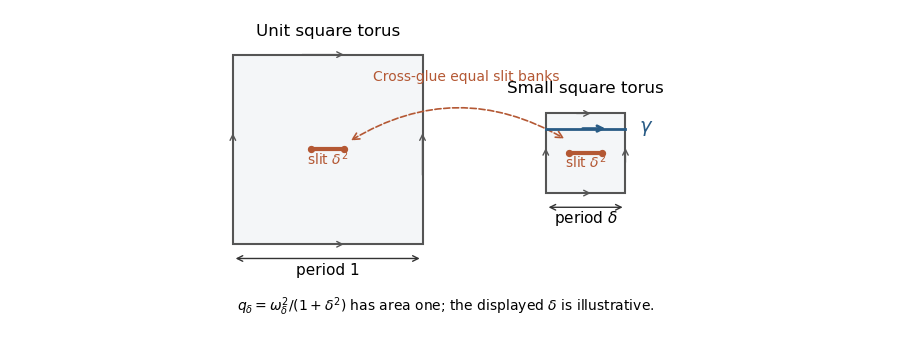
A small translation torus joined by equal slits; its generator is flat-short while retaining a positive extremal-length bound
. Details. 
Articles by others on the same topic
There are currently no matching articles.