The kinetic term fixes the mass dimension of a canonically normalized real scalar field in dimensions to . In six dimensions , and every term in the Lagrangian density has dimension six. Therefore , andFor positive integral , these mean , and , respectively. If is included, its vacuum-energy constant is also relevant. These are classical power counting in quantum field theory classifications of relevant couplings, marginal couplings and irrelevant couplings, not assertions that loop corrections preserve exact marginality. For the remaining parts write , assume and , and define a local quartic coupling by .
For a connected Feynman diagram with cubic vertices with four external legs and one loop, and give . In a one-particle-irreducible Feynman diagram, every internal edge lies on the single cycle. Each of the four cubic vertices therefore has two internal and one external leg, giving a box Feynman diagram. With labelled external momenta there are three inequivalent cyclic orderings, modulo rotation and reversal, represented by , and :
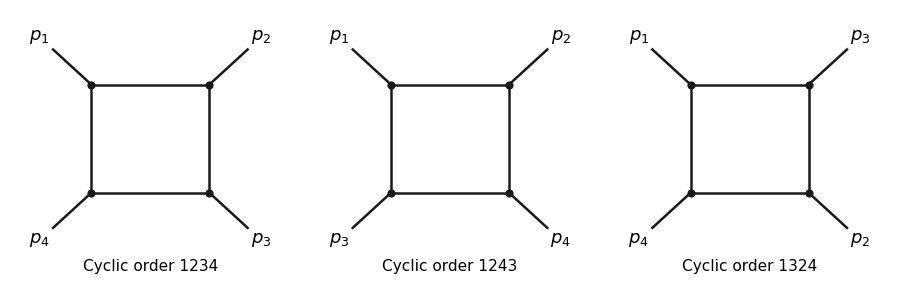
The three labelled cubic-scalar box diagrams
. The three inequivalent external-leg orderings of a box Feynman diagram in a six-dimensional cubic scalar field theory. Each square contains four internal propagators and four cubic vertices. Details.
Take all momenta incoming with . The Feynman rules for the Euclidean action give a propagator and a cubic insertion . For order , the amputated connected insertion iswhere is the high-mode projector for a strict Wilsonian effective action. Each labelled box has Feynman-diagram symmetry factor one. A common fixed-loop-cutoff convention instead restricts only the chosen integration to the shell; both prescriptions give the same zero-external-momentum value. The effective-action vertex has the opposite sign to this connected insertion. Thus
The box has four external fields at all momenta. Its constant term gives ; the momentum-dependent terms describe a derivative expansion of a four-point vertex. With an analytic local-expansion prescription, quadratic momentum terms give operators such as or , equivalent up to integration by parts, followed by four-field operators with more derivatives. The kernel also retains its full momentum dependence as a nonlocal four-field interaction. ThereforeThe latter come from different diagrams. For the strictly sharp projector on every propagator in the preceding part, moving shell boundaries can produce nonanalytic momentum dependence. The usual derivative expansion is consequently a smooth-regulator or fixed-loop-cutoff local expansion; the zero-momentum quartic coefficient calculated next does not depend on that distinction.
Put , the scalar shell integral in six dimensions. Each of the three boxes is as a connected insertion. To fix the effective-action sign and avoid a factorial ambiguity, use the one-loop scalar effective action:For a constant background the fourth-order density is . Thus the cubic scalar box contribution to a quartic coupling is , whose vertex insertion is .
Using the supplied area of the unit five-sphere,where . This follows by substituting and integrating . HenceAs a check, the massless limit at positive is . Both versions have mass dimension minus two, as a six-dimensional local quartic coupling must.
There is an interpretation issue in this clause. A proper quartic vertex, defined as the fourth derivative of the quantum effective action, has no additional tree or reducible contribution in the bare cubic theory: the three boxes exhaust its one-loop diagrams. The strict local zero-momentum vertex of a Wilsonian effective action also has no high-mode exchange bridge, since the momentum carried by that bridge would be zero, outside the shell. Thus
If “other diagrams” means the amputated connected correlation function, there are additional one-particle-reducible Feynman diagrams. Specify full external-propagator amputation and a vacuum with tadpole subtraction. The three tree exchange channels each contribute at zero momentum. At one loop, a triangle Feynman diagram can replace either cubic end of any exchange, giving six diagrams; a bubble diagram can be inserted in the internal exchange line, giving three diagrams with symmetry factor . The proper lower-point vertices at zero momentum, from the same trace-log expansion, areTherefore the reducible part of the connected four-point amplitude isAdding the three boxes gives in this convention. This is the cubic-scalar exchange corrections at zero momentum result, obtained equivalently from .
If the tadpole has not been subtracted, it is an additional one-loop subgraph that must not be forgotten. The proper one-point function is . Its attachment to the internal exchange line gives another three reducible diagrams, contributing ; equivalently the stationary background shifts by and changes the exchanged mass by . A linear counterterm enforcing cancels this contribution. External self-energy or tadpole diagram attachments are removed by the stated full-propagator amputation; using bare external amputation would retain them instead. In that convention the four external-line decorations add to the displayed full-amputated result, with the part absent after tadpole subtraction. If the expansion is expressed in renormalized parameters, also include the corresponding counterterm diagrams: replacing either cubic exchange vertex gives , and a mass insertion on the bridge gives . A linear counterterm adds through the same tadpole attachment and cancels it when . The kinetic counterterm has zero insertion at zero exchanged momentum. At one loop these exhaust the possibilities: the single cycle has length four, three, two or one, corresponding respectively to box, triangle, bubble or tadpole, with tree branches attached.
The mass dimensions are , , . Accordingly , , , and all have dimension . These connected exchanges are generally nonlocal functions of external momentum before taking the zero-momentum value; they should not be silently reclassified as an independent local quartic coupling.
At fixed and , the radial integrands in the scalar shell integral in six dimensions behave as in the ultraviolet. ThusConsequently the proper box quartic vertex is ultraviolet finite. The reducible triangle insertion contains the logarithmic cubic-vertex divergence. The internal bubble contains the mass divergence; its nonzero-momentum expansion additionally has a logarithmic kinetic-term divergence. An unsubtracted tadpole attachment has the quartic one-point divergence and is canceled by tadpole subtraction, or incorporated consistently in the chosen stationary background.
These divergent lower-point subgraphs require counterterms, not a new independent divergent coupling. More generally, cubic graph identities give the superficial degree of divergenceVacuum, one-, two-, and three-point functions need vacuum-energy, linear, mass, wave-function renormalization and cubic-coupling counterterms. Proper higher-point functions have negative superficial degree and are finite after subtraction of divergent subgraphs. Hence the perturbative renormalizability of cubic scalar theory in six dimensions permits a continuum perturbative expansion with finitely many renormalized parameters; induced irrelevant higher-field and derivative interactions are finite predictions at finite scale, not an infinite list of ultraviolet parameters.
This perturbative statement does not establish a nonperturbative real Euclidean measure. For any nonzero real , tends to in one field direction, so even its constant-field integral is divergent. Thus Stability or a specified analytic continuation would be additional input beyond these loop calculations.
Articles by others on the same topic
There are currently no matching articles.