For , the quantum harmonic oscillator has energies , , in units . For positive inverse temperature , taking the trace in the energy basis and summing a geometric series givesThis is the thermal partition function of a quantum harmonic oscillator, including its zero-point energy. The assumptions ensure convergence; at the free particle on the noncompact line instead has an infinite spatial-volume factor.
The trace of the Euclidean evolution kernel identifies its initial and final positions. Thus the Euclidean worldline path integral is over periodic paths , with :The circle has circumference , not an arbitrary unit length. The Euclidean action follows by Wick rotation of the unit-mass oscillator action. Equivalently, integration by parts with periodic boundary conditions gives for . The path integral measure is formal until a regularization and its normalization are specified; the next part supplies a finite-dimensional version.
Use a real orthonormal basis of Fourier modes on the time circle:The eigenvalue of on the constant mode is , and each sine/cosine pair has eigenvalue . Retaining these modes giveswhere can depend on but is independent of . Each real Gaussian integral contributes . Consequently the Fourier-cutoff oscillator functional determinant isA spectral cutoff between successive eigenvalue pairs selects precisely this finite subspace. In comparing two frequencies, the displayed regularization keeps the same number of modes ; holding an absolute spectral threshold fixed need not give the same at finite cutoff.
The frequency-independent measure factor cancels in the ratio:Upon analytic continuation in frequency, this has poles at and zeros at , for , apart from cancellations when numerator and denominator vanish together. They match those of . To justify equality, rather than merely matching this divisor, use the hyperbolic-sine infinite productIt follows from pairing the Weierstrass product for the reciprocal gamma function at opposite imaginary arguments and using the Gamma reflection formula. Normal convergence on compact sets follows from . Thus, for positive real frequencies,The cutoff ratio determines the frequency dependence, agreeing with the thermal partition function of a quantum harmonic oscillator.
The printed assertion about an absolute needs a normalization qualification: independence of from alone does not ensure existence of a nonzero limit. Set . Then , so if , its limit is . The choice gives the required limit. Conversely, is a positive frequency-independent normalization with no absolute limit, though every ratio above still converges. Matching zeros and poles alone also permits nonvanishing entire functions; the convergent normalized product is what rules them out here.
The Faddeev-Popov ghost fields and are spin-zero Grassmann fields in the Adjoint representation of ; their statistics are anticommuting, despite their scalar transformation under spacetime rotations. The Nakanishi-Lautrup field is an auxiliary commuting spin-zero field, also in the Adjoint representation. ThusThese Faddeev-Popov ghost fields are not physical spin-zero fermion states; they represent the gauge-fixing Jacobian, so their scalar spin does not contradict the physical Spin-statistics theorem.
Write and choose the U(1) gauge symmetry convention . Its infinitesimal variation isA formal BRST symmetry construction uses , , , and the gauge-fixing fermion . Acting with the odd differential givesFor a real admissible gauge functional, integration over gives in the Euclidean action, and imposes the gauge condition. Overall constant phases in the Faddeev-Popov determinant can be absorbed in the measure convention. Here nonlinear Abelian gauge fixing makes depend on . The action for the Faddeev-Popov ghost fields contains the interaction , so the Faddeev-Popov ghost fields cannot be discarded as in a linear Abelian gauge, even though the Adjoint representation is trivial.
There is a genuine reality obstruction for a complex Euclidean gauge condition in the source. For a Hermitian gauge field, each Euclidean component is real. The real and imaginary parts of separately require and , hence . For example , with other components zero and , has curvature ; no gauge transformation can put it on this slice because curvature is gauge invariant. Thus the stated condition is not a gauge fixing of general real Euclidean configurations. The boxed action is the intended formal complex-gauge construction. A legitimate complexified contour prescription would be additional data, not an ordinary real delta-functional enforcing this printed condition.
A pair of Faddeev-Popov ghost fields has a Grassmann Gaussian integral, so its functional integral contributes , whereas the effective action is minus the logarithm of the partition weight. Hence its field-dependent contribution isThe second term is a convenient field-independent normalization. Primes indicate removal or separate fixing of residual zero modes in field theory, with identical boundary and regularization conventions. The sign differs from a commuting complex scalar determinant. This is the formal contribution of the Faddeev-Popov ghost fields for the complex quadratic Abelian gauge condition; the real-slice obstruction established in the preceding part still applies.
Choose one free, massless complex scalar field with unit charge magnitude and bosonic statistics, minimally coupled to . To fix the sign, use the conventional gauge covariant derivative and take , so and . Its antiparticle has charge . The matter data areThere is no scalar self-interaction. For real fields before formal continuation, its action is , by integration by parts. The Gaussian functional integral gives the inverse functional determinant and thus , up to normalization.
The key operator identity isOn the formal complex gauge slice, . With matching regulators and omitted zero modes, this gives ghost-scalar determinant cancellation in a complex quadratic gauge, leaving the Maxwell action as the background functional:where gauge-fixing terms and field-independent constants are understood separately. For a fixed background the complex scalar field and Faddeev-Popov ghost field integrals are Gaussian, so this determinant cancellation is exact within the formal construction. It is a cancellation of closed bosonic matter loops against ghost loops in that background functional. It does not prove that physical scalar quantum electrodynamics has no radiative corrections: the printed real Euclidean gauge slice contains only and misses every nonzero-curvature orbit. On that literal slice the equality is trivial; a nontrivial version requires the additional complex-contour interpretation.
The kinetic term fixes the mass dimension of a canonically normalized real scalar field in dimensions to . In six dimensions , and every term in the Lagrangian density has dimension six. Therefore , andFor positive integral , these mean , and , respectively. If is included, its vacuum-energy constant is also relevant. These are classical power counting in quantum field theory classifications of relevant couplings, marginal couplings and irrelevant couplings, not assertions that loop corrections preserve exact marginality. For the remaining parts write , assume and , and define a local quartic coupling by .
For a connected Feynman diagram with cubic vertices with four external legs and one loop, and give . In a one-particle-irreducible Feynman diagram, every internal edge lies on the single cycle. Each of the four cubic vertices therefore has two internal and one external leg, giving a box Feynman diagram. With labelled external momenta there are three inequivalent cyclic orderings, modulo rotation and reversal, represented by , and :
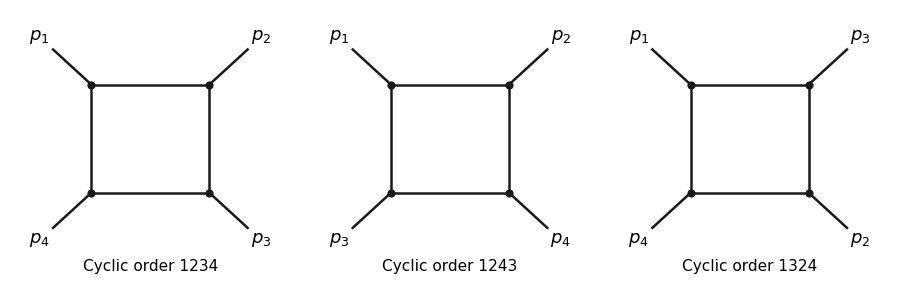
The three labelled cubic-scalar box diagrams
. The three inequivalent external-leg orderings of a box Feynman diagram in a six-dimensional cubic scalar field theory. Each square contains four internal propagators and four cubic vertices. Details.
Take all momenta incoming with . The Feynman rules for the Euclidean action give a propagator and a cubic insertion . For order , the amputated connected insertion iswhere is the high-mode projector for a strict Wilsonian effective action. Each labelled box has Feynman-diagram symmetry factor one. A common fixed-loop-cutoff convention instead restricts only the chosen integration to the shell; both prescriptions give the same zero-external-momentum value. The effective-action vertex has the opposite sign to this connected insertion. Thus
The box has four external fields at all momenta. Its constant term gives ; the momentum-dependent terms describe a derivative expansion of a four-point vertex. With an analytic local-expansion prescription, quadratic momentum terms give operators such as or , equivalent up to integration by parts, followed by four-field operators with more derivatives. The kernel also retains its full momentum dependence as a nonlocal four-field interaction. ThereforeThe latter come from different diagrams. For the strictly sharp projector on every propagator in the preceding part, moving shell boundaries can produce nonanalytic momentum dependence. The usual derivative expansion is consequently a smooth-regulator or fixed-loop-cutoff local expansion; the zero-momentum quartic coefficient calculated next does not depend on that distinction.
Put , the scalar shell integral in six dimensions. Each of the three boxes is as a connected insertion. To fix the effective-action sign and avoid a factorial ambiguity, use the one-loop scalar effective action:For a constant background the fourth-order density is . Thus the cubic scalar box contribution to a quartic coupling is , whose vertex insertion is .
Using the supplied area of the unit five-sphere,where . This follows by substituting and integrating . HenceAs a check, the massless limit at positive is . Both versions have mass dimension minus two, as a six-dimensional local quartic coupling must.
There is an interpretation issue in this clause. A proper quartic vertex, defined as the fourth derivative of the quantum effective action, has no additional tree or reducible contribution in the bare cubic theory: the three boxes exhaust its one-loop diagrams. The strict local zero-momentum vertex of a Wilsonian effective action also has no high-mode exchange bridge, since the momentum carried by that bridge would be zero, outside the shell. Thus
If “other diagrams” means the amputated connected correlation function, there are additional one-particle-reducible Feynman diagrams. Specify full external-propagator amputation and a vacuum with tadpole subtraction. The three tree exchange channels each contribute at zero momentum. At one loop, a triangle Feynman diagram can replace either cubic end of any exchange, giving six diagrams; a bubble diagram can be inserted in the internal exchange line, giving three diagrams with symmetry factor . The proper lower-point vertices at zero momentum, from the same trace-log expansion, areTherefore the reducible part of the connected four-point amplitude isAdding the three boxes gives in this convention. This is the cubic-scalar exchange corrections at zero momentum result, obtained equivalently from .
If the tadpole has not been subtracted, it is an additional one-loop subgraph that must not be forgotten. The proper one-point function is . Its attachment to the internal exchange line gives another three reducible diagrams, contributing ; equivalently the stationary background shifts by and changes the exchanged mass by . A linear counterterm enforcing cancels this contribution. External self-energy or tadpole diagram attachments are removed by the stated full-propagator amputation; using bare external amputation would retain them instead. In that convention the four external-line decorations add to the displayed full-amputated result, with the part absent after tadpole subtraction. If the expansion is expressed in renormalized parameters, also include the corresponding counterterm diagrams: replacing either cubic exchange vertex gives , and a mass insertion on the bridge gives . A linear counterterm adds through the same tadpole attachment and cancels it when . The kinetic counterterm has zero insertion at zero exchanged momentum. At one loop these exhaust the possibilities: the single cycle has length four, three, two or one, corresponding respectively to box, triangle, bubble or tadpole, with tree branches attached.
The mass dimensions are , , . Accordingly , , , and all have dimension . These connected exchanges are generally nonlocal functions of external momentum before taking the zero-momentum value; they should not be silently reclassified as an independent local quartic coupling.
At fixed and , the radial integrands in the scalar shell integral in six dimensions behave as in the ultraviolet. ThusConsequently the proper box quartic vertex is ultraviolet finite. The reducible triangle insertion contains the logarithmic cubic-vertex divergence. The internal bubble contains the mass divergence; its nonzero-momentum expansion additionally has a logarithmic kinetic-term divergence. An unsubtracted tadpole attachment has the quartic one-point divergence and is canceled by tadpole subtraction, or incorporated consistently in the chosen stationary background.
These divergent lower-point subgraphs require counterterms, not a new independent divergent coupling. More generally, cubic graph identities give the superficial degree of divergenceVacuum, one-, two-, and three-point functions need vacuum-energy, linear, mass, wave-function renormalization and cubic-coupling counterterms. Proper higher-point functions have negative superficial degree and are finite after subtraction of divergent subgraphs. Hence the perturbative renormalizability of cubic scalar theory in six dimensions permits a continuum perturbative expansion with finitely many renormalized parameters; induced irrelevant higher-field and derivative interactions are finite predictions at finite scale, not an infinite list of ultraviolet parameters.
This perturbative statement does not establish a nonperturbative real Euclidean measure. For any nonzero real , tends to in one field direction, so even its constant-field integral is divergent. Thus Stability or a specified analytic continuation would be additional input beyond these loop calculations.
Choose Hermitian Lie-algebra generators satisfying , with real totally antisymmetric Lie algebra structure constants in an orthonormal compact-group basis. The Adjoint representation generators are . For a canonically normalized Yang-Mills action, the coupling is in the gauge covariant derivative, rather than an overall kinetic prefactor. The conventions giveEquivalently, for the Lie-algebra-valued spinor, . This is the adjoint covariant derivative with the Hermitian-generator and explicit-coupling convention specified. Changing the sign convention for changes the accompanying gauge-transformation convention consistently.
Take Euclidean gamma matrices with , and independent Grassmann fields . The minimally coupled Dirac action isIts mass term is the Dirac mass term, and the interaction is . With Fourier convention , the free kinetic operator is . The Euclidean adjoint Dirac Feynman rules are thereforeThe vertex sign follows by expanding , not . Momentum conservation supplies the usual Dirac delta function at each vertex. There is only a one-gluon fermion vertex, with no two-gluon seagull because the fermionic covariant derivative is first order. A closed fermion loop has the usual fermionic sign . The identity checks the Dirac propagator.
Write and . The pole term is independent of and external momentum beyond the transverse tensor: , and . The supplied gluon self-energy insertion therefore hasUsing the insertion convention , its cancellation requires the matter contribution to the background gauge-field kinetic factor. One can extract the coupling running from this gauge-invariant matter determinant using the background gauge-field renormalization identity . This is a background-field Ward identity, not a claim that the ordinary quantum-gluon wave-function factor alone always determines the full coupling renormalization. For this one adjoint Dirac spinor,Differentiate at fixed . If and , the order- terms in give . Subtracting as well as the pole in the modified minimal subtraction scheme does not change this one-loop coefficient. Thus the adjoint Dirac contribution to the Yang-Mills beta function isThis is screening. The pure Yang-Mills one-loop beta function coefficient is . With adjoint Dirac spinors, the total renormalization-group beta function is consequentlyFor a non-Abelian simple factor , vanishing of the nontrivial one-loop coefficient would require . It cannot be a nonnegative integer, proving the integer obstruction to one-loop marginality with adjoint Dirac fermions. For a product group the same argument applies to every non-Abelian factor; the statement concerns the beta-function coefficient, not the trivial fixed point . The modified minimal subtraction scheme is mass independent, so a massive spinor has this ultraviolet contribution; decoupling below its mass instead requires effective-theory threshold matching.
Articles by others on the same topic
There are currently no matching articles.