For Darcy-Bénard convection, the dimensionless Darcy law is , with incompressibility and a heat equation about . Here is a Darcy thermal-time Rayleigh number, with permeability replacing the squared-depth dependence in the fluid-layer Rayleigh number. The stated stream function convention gives , so . The vertical-plane curl of Darcy law gives ; omitting the quadratic perturbation advection from the heat equation gives .
On the impermeable connected square boundary, zero normal velocity makes constant along the boundary; choose that constant as zero. The prescribed conductive boundary temperature fixes on all four sides. Thus the perfect-conductor wording is interpreted through the supplied homogeneous perturbation data: the side temperatures retain the background vertical profile, rather than imposing a different isothermal side state.
At marginal stability put and . The two coupled equations implyThe gauge transformation for conducting-square Darcy onset removes the first derivative:The square's Dirichlet Laplacian eigenfunctions are , with eigenvalues of equal to , . The first marginal value is thereforeIt is genuinely the first instability threshold, not just an isolated neutral value. Eliminating gives the temperature linear operator , where is the Dirichlet realization of an elliptic operator for the Laplacian. Integration by parts shows the second term is self-adjoint and nonnegative, since its quadratic form is . Thus the spectrum is real, starts negative at , and its leading eigenvalue cannot cross into growth without a zero eigenvalue. The smallest zero value is the one found above.
Let , and . Multiplying the lowest real by independent real and imaginary constants gives two real physical eigenfunctions:The subscripts indicate even and odd parity about . Because is even in , the first has even and odd , while the second reverses those parities. They are linearly independent and satisfy all four Dirichlet boundary conditions. The lowest complex eigenfunction is simple over the complex numbers, but its arbitrary complex multiplier supplies two independent real pairs; this explains the physical degeneracy.
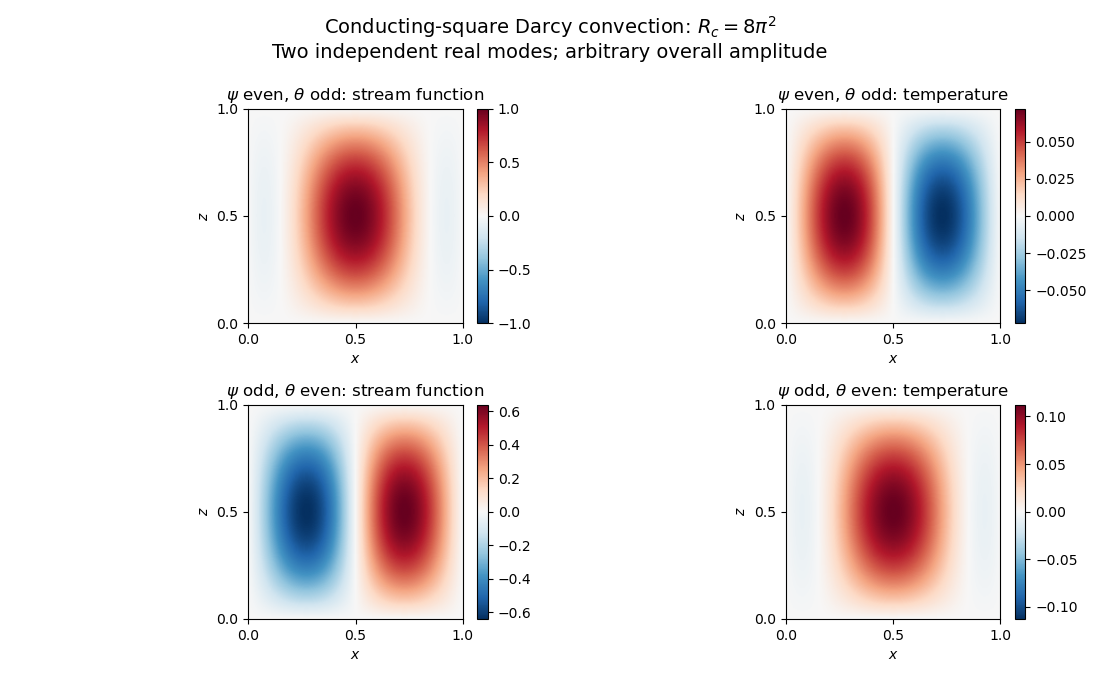
Neutral and oscillatory modes in porous convection
. Details. 
For homogeneous corrections at the square boundary, integration by parts gives and . The first-derivative cross terms give and . Using and , these four contributions cancel in pairs. This proves exactly the supplied solvability condition, including the weight on its second row. Equivalently is the relevant adjoint eigenfunction for this coupled system.
At first order in the detuning, the inhomogeneous equations areInsert these right-hand sides into the verified solvability condition. One obtainsA further integration by parts, using the leading heat equation, givesHence the growth-rate solvability for conducting-square Darcy convection yieldsThe PDF prints the reciprocal of the required integral ratio. With its declared , the displayed reciprocal does not follow and is false for . Both integrals are positive for these nonzero modes. The square's Poincaré inequality gives their ratio at least , so it cannot equal its reciprocal. For , the two explicit parities give approximately for odd and for even ; the printed expression instead gives about and . These values provide direct mode-based counterexamples.
The corrected growth rate is positive for and negative for , as expected at a convection threshold. Because the critical eigenspace is two-dimensional, an arbitrary superposition generally splits into two different first-order growth rates. The specified parity modes remain independent under the detuning: the temperature linear operator preserves reflection parity, so the cross-parity projection vanishes. This justifies applying the scalar solvability condition to either listed eigenfunction; it should not be applied as a single common eigenvalue to an arbitrary mixture.
Articles by others on the same topic
There are currently no matching articles.