Use azimuth measured from north toward west, and positive hour angle westward. These conventions are forced by the signs in the coordinate formulae. In the diagram the observer is at , the local vertical meets the celestial sphere at the zenith , and the north celestial pole is . The astronomical horizon is perpendicular to ; the celestial equator is perpendicular to . Their intersections with the celestial meridian give the north horizon point and the upper equatorial meridian point.
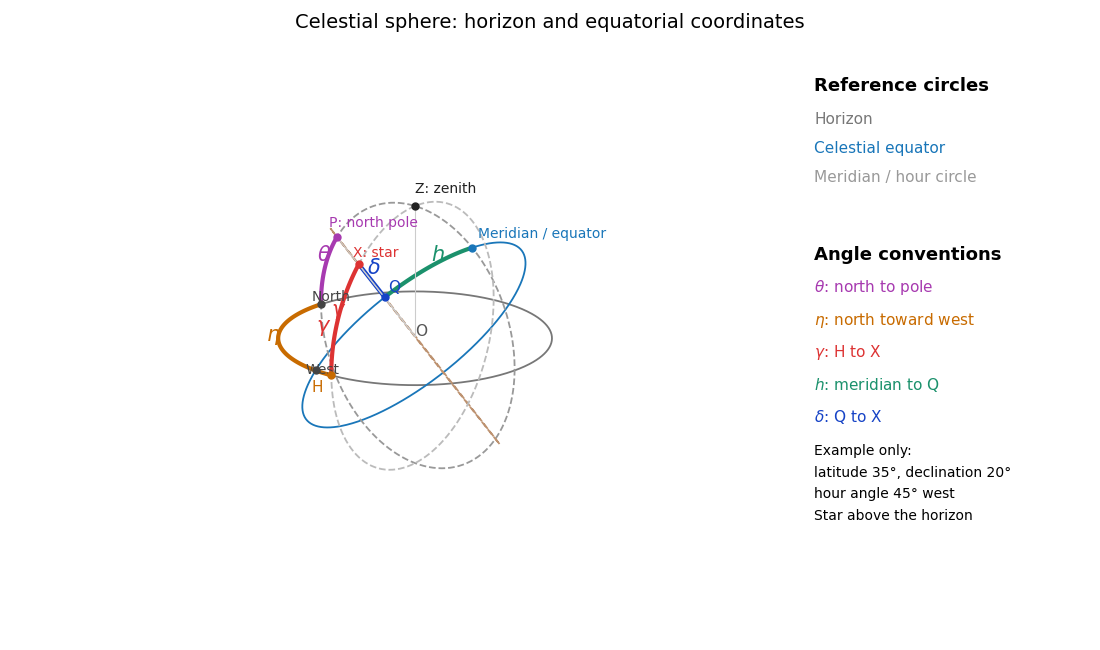
The celestial sphere with horizon and equatorial coordinates
. Details. 
The north celestial pole has altitude ; thus the angle between and is . Project along its vertical great circle onto the astronomical horizon at : the arc is the altitude , and the westward horizon arc from north to is the azimuth . Project along its hour circle onto the celestial equator at : the arc is the declination , and the westward equatorial arc from the upper celestial meridian to is the hour angle . Equivalently the triangle on the celestial sphere has sides , and . All five angles refer to arcs on their specified reference circles, not arbitrary angles in the projected drawing.
Let be orthonormal unit vectors north, west and upward. A direction of altitude and westward azimuth isThe north celestial pole and the upper equatorial meridian direction areIn the equatorial coordinate system, the same unit vector is . Taking dot products with respectively givesThis is an orthogonal transformation between two bases, so it preserves the length of the direction vector. Recover from both its sine and cosine to keep the correct quadrant. At the zenith, azimuth itself is undefined; the vector equations remain meaningful by continuity. Using the more usual eastward azimuth changes the sign of the second equation.
Local sidereal time is the right ascension on the upper celestial meridian. Since right ascension increases eastward while hour angle increases westward, their difference isOne hour of either coordinate is . For a fixed stellar direction, increases at the sidereal rotation rate. Mean sidereal time should be used with mean right ascension, or apparent sidereal time with apparent right ascension, for the same reference equinox.
Articles by others on the same topic
There are currently no matching articles.