Use azimuth measured from north toward west, and positive hour angle westward. These conventions are forced by the signs in the coordinate formulae. In the diagram the observer is at , the local vertical meets the celestial sphere at the zenith , and the north celestial pole is . The astronomical horizon is perpendicular to ; the celestial equator is perpendicular to . Their intersections with the celestial meridian give the north horizon point and the upper equatorial meridian point.
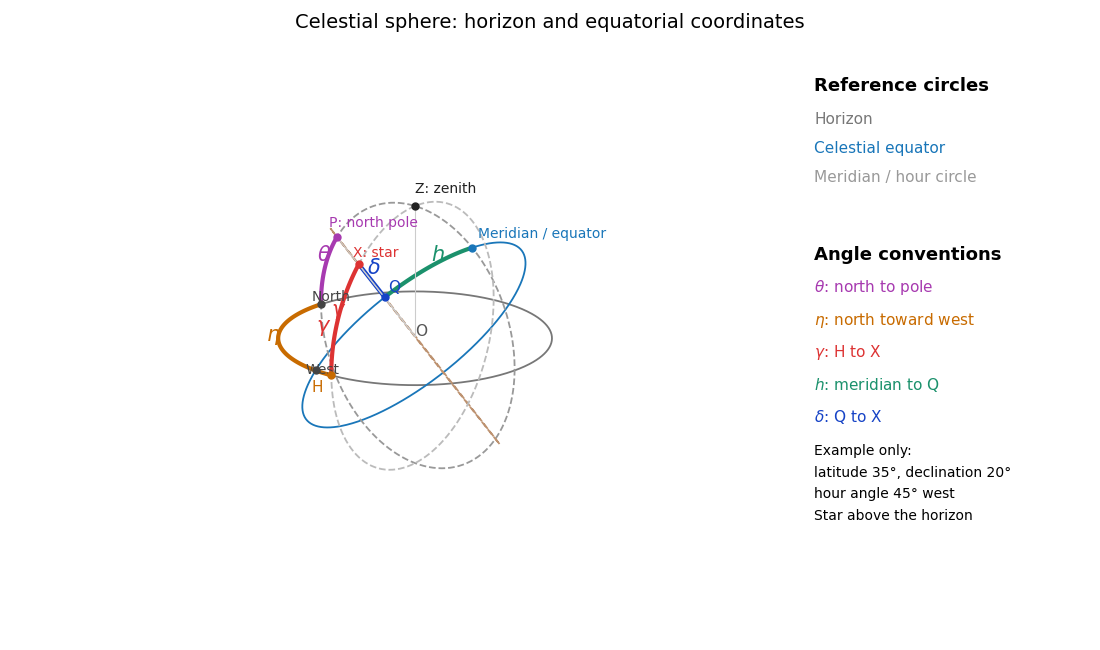
The celestial sphere with horizon and equatorial coordinates
. Details. 
The north celestial pole has altitude ; thus the angle between and is . Project along its vertical great circle onto the astronomical horizon at : the arc is the altitude , and the westward horizon arc from north to is the azimuth . Project along its hour circle onto the celestial equator at : the arc is the declination , and the westward equatorial arc from the upper celestial meridian to is the hour angle . Equivalently the triangle on the celestial sphere has sides , and . All five angles refer to arcs on their specified reference circles, not arbitrary angles in the projected drawing.
Let be orthonormal unit vectors north, west and upward. A direction of altitude and westward azimuth isThe north celestial pole and the upper equatorial meridian direction areIn the equatorial coordinate system, the same unit vector is . Taking dot products with respectively givesThis is an orthogonal transformation between two bases, so it preserves the length of the direction vector. Recover from both its sine and cosine to keep the correct quadrant. At the zenith, azimuth itself is undefined; the vector equations remain meaningful by continuity. Using the more usual eastward azimuth changes the sign of the second equation.
Local sidereal time is the right ascension on the upper celestial meridian. Since right ascension increases eastward while hour angle increases westward, their difference isOne hour of either coordinate is . For a fixed stellar direction, increases at the sidereal rotation rate. Mean sidereal time should be used with mean right ascension, or apparent sidereal time with apparent right ascension, for the same reference equinox.
Write for one sidereal day in minutes and . An equatorial star at an equatorial site rises along a vertical great circle, passes through the zenith, and descends on the opposite side. Its azimuth changes by at the crossing. The restricted altitude travel prevents following it continuously by rotating over the zenith.
The maximum azimuth rate is radians per minute, so the shortest half-turn takes minutes. During that lost-track interval the star moves throughFor minutes this is approximately ; using a 24-hour day gives . If the quoted zenith blind spot size means the angular radius of a symmetrically placed crossing gap, it is , approximately .
This derives the ideal crossing-gap size with instantaneous acceleration and an available altitude drive. It does not uniquely define a circular forbidden region for all nearby trajectories. For example, at an equatorial site a star of small nonzero declination has maximum azimuth rate at transit: its minimum offset is constrained by . That rate contour and the half-turn crossing gap are different definitions of a zenith blind spot. Actual tracking footprints also depend on acceleration and the reacquisition strategy, as discussed in the telescope designers' tracking discussion.
A star of declination crosses the zenith. Its direction rotates around the celestial pole at , but its actual angular velocity on the celestial sphere is . Consequently the small-angle crossing-gap estimate becomesFor clarity, the factor is the radius of the star's daily circle on a unit celestial sphere; it does not modify the sidereal hour angle rate.
The estimate assumes the required slew is nearly . A more exact ideal symmetric reacquisition calculation is possible. Let the endpoints have hour angles and suppose , small enough that both endpoints are above the astronomical horizon. The horizontal direction components are and . Their shortest azimuth separation isThe minimum ideal gap satisfies ; its angular separation is . Expanding for a fast drive gives the boxed expression. At an equatorial site exactly. At a geographic pole the direction with is stationary, so the crossing argument is inapplicable and the limit is zero. A full near-zenith rate-limited footprint still requires specifying the trajectory and drive model.
For thin contacting components, optical powers add. At wavelength the total optical power is . An achromatic lens has , henceFor normally dispersive optical glasses, both index differences are positive, so the two components have opposite curvature factors and opposite optical powers. This uses the thin Lensmaker's equation; finite thickness and separated principal planes require a more detailed design. If the denominator vanishes, use the undivided power-balance equation rather than this ratio. Two-wavelength correction alone does not eliminate the residual chromatic aberration at every intermediate wavelength.
At the line, the focal lengths obey . ThusRearranging givesThe last equality uses the Abbe number definition. The minus sign signifies a converging and a diverging component, with the normal optical glass convention and nonzero finite focal lengths.
Set and . The achromatic doublet power balance gives two linear equations:For distinct nonzero Abbe numbers, solving yields and , and thereforeEqual Abbe numbers force the total optical power to vanish under the achromatic condition; they cannot give a nonzero-power thin achromatic lens. Closely matched Abbe numbers require large opposing component powers and are generally unattractive because of the resulting sensitivity and other optical aberrations.
is the Abbe number, a dimensionless inverse measure of optical dispersion. Large means weak dispersion. The Abbe diagram below spans a representative visible-light optical glass range, roughly and . The shaded families are schematic, not exact catalogue boundaries; modern compositions overlap and include high-index crown glasses.
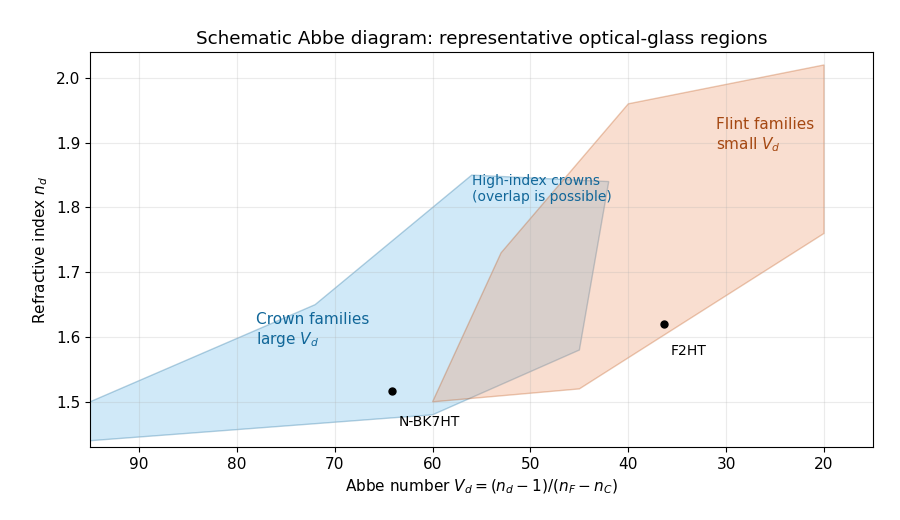
An Abbe diagram of representative optical glasses
. Details. 
For a usual positive objective, choose component 1 as a higher- crown glass and component 2 as a lower- flint glass. Then , , and : the crown glass is converging, the flint glass diverging, and their dispersive powers cancel while leaving positive net power. The Abbe numbers alone do not set their absolute focal lengths; the specified total focal length does. As a representative pair, , gives , . Representative index and dispersion data are given in SCHOTT's optical-glass data.
Articles by others on the same topic
There are currently no matching articles.