Use azimuth measured from north toward west, and positive hour angle westward. These conventions are forced by the signs in the coordinate formulae. In the diagram the observer is at , the local vertical meets the celestial sphere at the zenith , and the north celestial pole is . The astronomical horizon is perpendicular to ; the celestial equator is perpendicular to . Their intersections with the celestial meridian give the north horizon point and the upper equatorial meridian point.
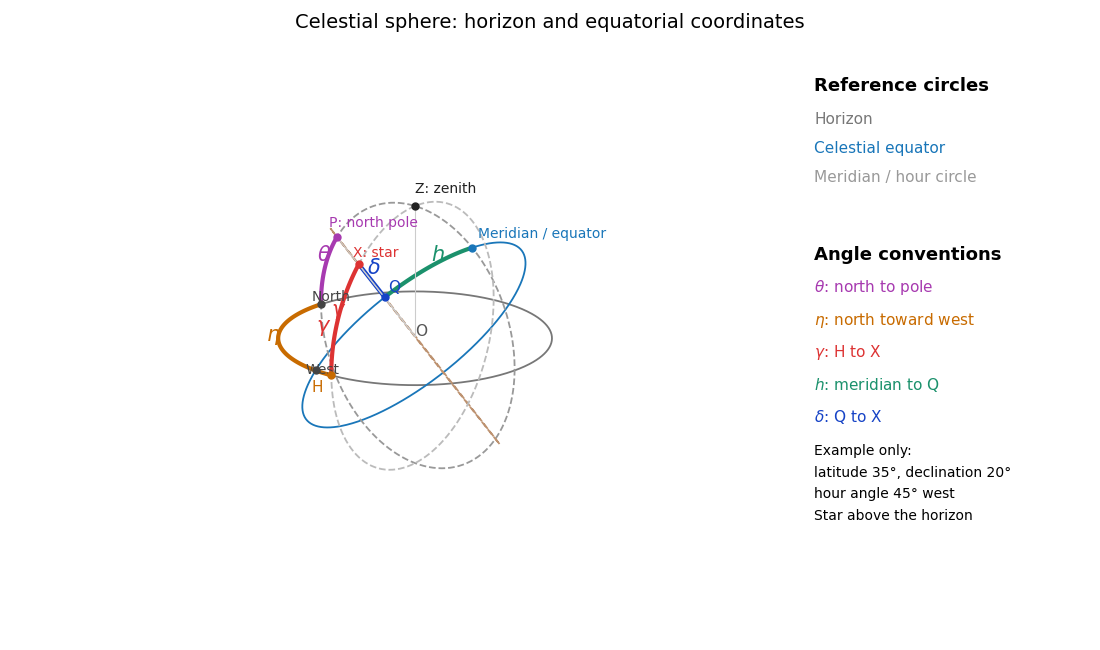
The celestial sphere with horizon and equatorial coordinates
. Details. 
The north celestial pole has altitude ; thus the angle between and is . Project along its vertical great circle onto the astronomical horizon at : the arc is the altitude , and the westward horizon arc from north to is the azimuth . Project along its hour circle onto the celestial equator at : the arc is the declination , and the westward equatorial arc from the upper celestial meridian to is the hour angle . Equivalently the triangle on the celestial sphere has sides , and . All five angles refer to arcs on their specified reference circles, not arbitrary angles in the projected drawing.
Articles by others on the same topic
There are currently no matching articles.