For thin contacting components, optical powers add. At wavelength the total optical power is . An achromatic lens has , henceFor normally dispersive optical glasses, both index differences are positive, so the two components have opposite curvature factors and opposite optical powers. This uses the thin Lensmaker's equation; finite thickness and separated principal planes require a more detailed design. If the denominator vanishes, use the undivided power-balance equation rather than this ratio. Two-wavelength correction alone does not eliminate the residual chromatic aberration at every intermediate wavelength.
At the line, the focal lengths obey . ThusRearranging givesThe last equality uses the Abbe number definition. The minus sign signifies a converging and a diverging component, with the normal optical glass convention and nonzero finite focal lengths.
Set and . The achromatic doublet power balance gives two linear equations:For distinct nonzero Abbe numbers, solving yields and , and thereforeEqual Abbe numbers force the total optical power to vanish under the achromatic condition; they cannot give a nonzero-power thin achromatic lens. Closely matched Abbe numbers require large opposing component powers and are generally unattractive because of the resulting sensitivity and other optical aberrations.
is the Abbe number, a dimensionless inverse measure of optical dispersion. Large means weak dispersion. The Abbe diagram below spans a representative visible-light optical glass range, roughly and . The shaded families are schematic, not exact catalogue boundaries; modern compositions overlap and include high-index crown glasses.
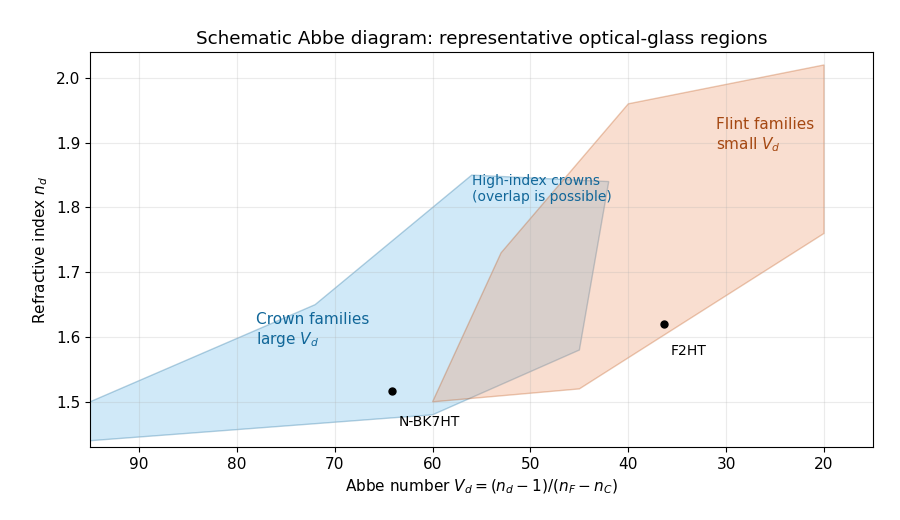
An Abbe diagram of representative optical glasses
. Details. 
For a usual positive objective, choose component 1 as a higher- crown glass and component 2 as a lower- flint glass. Then , , and : the crown glass is converging, the flint glass diverging, and their dispersive powers cancel while leaving positive net power. The Abbe numbers alone do not set their absolute focal lengths; the specified total focal length does. As a representative pair, , gives , . Representative index and dispersion data are given in SCHOTT's optical-glass data.
Articles by others on the same topic
There are currently no matching articles.