The deep inelastic scattering process contains a virtual photon exchanged between the electron and the hadron:
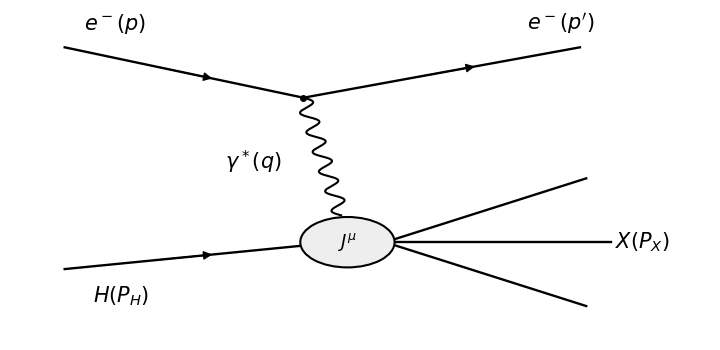

Use an electromagnetic vector current containing the dimensionless quark charges, with the coupling factored out. The scattering amplitude, up to an irrelevant phase, isTo match the printed prefactor, define the leptonic tensor with a spin sum over both electron spins and keep the initial spin average outside it. The gamma-matrix trace givesFor a stationary target and massless electron, the invariant flux factor is . The inclusive final-state Lorentz-invariant phase-space measure and target spin average are contained in . Thus the differential scattering cross-section isHere means . If the initial spin average is instead built into the leptonic tensor, its normalization is and the displayed cross-section prefactor must be doubled. The two conventions give the same observable.
For an unpolarized electromagnetic target, Lorentz covariance and parity symmetry in quantum field theory permit a symmetric hadronic tensor built from , and , where . Its surviving general form isThe totally antisymmetric tensor structure is excluded by electromagnetic parity symmetry in quantum field theory for this unpolarized target. The other possible antisymmetric structure, , cannot be transverse for generic scattering kinematics and hence is excluded by current conservation. Current conservation gives the Ward identities , imposingTwo scalar functions remain. Taking gives the transverse basisThese are the deep-inelastic structure functions; is Bjorken x. At fixed target mass, the two independent Lorentz scalar invariants can equivalently be chosen as . In this paper has dimensions of mass squared, rather than the alternative convention used for energy transfer.
Use the massless collinear parton approximation in a high-energy frame: , , and with . This neglects target-mass corrections to the parton model; it does not literally set a stationary massive target to a massless particle in the earlier flux formula.
For a quark of dimensionless charge , the electromagnetic vector current matrix element is . The spin average and gamma-matrix trace giveIntegrating the three-momentum Dirac delta function in the parton hadronic tensor leavesSince , this isFor the massless electron momenta, and . Substitution into the leptonic tensor givesand likewise . These Ward identities eliminate every term with an exposed index in the contraction. ThereforeHere means equality after contraction with the leptonic tensor. The shortened tensor is not itself conserved; the omitted terms restore current conservation in the full hadronic tensor.
On the physical positive-energy branch, put . The massless outgoing parton obeysSince on the support and , the positive-energy on-shell delta function identity givesInsert this into the parton model sum, and writeThe parton distribution functions are number densities in momentum fraction. The contributing tensor becomesComparing with part (b), under the same leptonic tensor contraction, givesThis is the Callan-Gross relation for massless partons of spin angular momentum at leading order. The longitudinal deep-inelastic structure function is in this approximation. Target-mass effects and radiative Quantum chromodynamics corrections can change the relation. The leading parton model also gives Bjorken scaling: at this level the deep-inelastic structure functions depend on alone.
Articles by others on the same topic
There are currently no matching articles.