Use the Minkowski metric throughout. Taking the Hermitian conjugation of the massive Dirac equation and using the Dirac adjoint givesTaking the matrix transpose and multiplying by the charge conjugation matrix yieldsThus the charge conjugation of a Dirac field preserves the free massive Dirac equation:The unitarity of and also giveConsequentlyHere is the unitary operator acting on the relativistic quantum field, whereas acts on Dirac spinor indices.
The bosonic annihilation operator removes a vector particle of four-momentum and polarization vector . The bosonic creation operator creates its antiparticle with the same four-momentum and polarization label. The polarization vector describes the corresponding spin-one mode expansion of a free field.
Because charge conjugation acts through a unitary operator, it leaves the numerical polarization vector coefficients unchanged. Applying the specified charge conjugation to the operators givesComparison with the Hermitian conjugation of the original expansion therefore givesThe factor is the intrinsic charge-conjugation phase.
For a normal ordering of a fermion bilinear, the result of part (a) and the fermionic sign from interchanging the fields giveFor the Dirac current, . For the axial current, the definition of and the gamma matrix identities implyThus the charge conjugation of fermion bilinears givesThe Dirac current is odd under charge conjugation, and the axial current is even under charge conjugation. The normal ordering specifies the usual treatment of coincident-field contact terms.
For a real vector relativistic quantum field, . Its transformed field must also be a Hermitian operator, so the intrinsic charge-conjugation phase satisfies ; combined with , this givesThe quantum electrodynamics interaction is . Since the Dirac electromagnetic current is odd under charge conjugation, charge conjugation invariance of this interaction requires the photon field to be odd too:
Write for the Dirac current and for the axial current. Under parity symmetry in quantum field theory, the Dirac spinor phases cancel andThe extra sign for the axial current follows from . Combining these transformations with part (c), both currents transform under CP symmetry as . The vector relativistic quantum field transforms as . The two parity matrices cancel in the tensor contraction, givingFor a real vector relativistic quantum field with , the interaction is invariant under CP symmetry. A complex vector relativistic quantum field instead maps to the conjugate-field interaction, which must be compared with its Hermitian conjugation partner.
The flavour-diagonal weak neutral current coupled to the real Z boson has real vector and axial current couplings. With , part (e) shows that this tree-level interaction is invariant under CP symmetry, although the simultaneous presence of the Dirac current and axial current generally violates charge conjugation and parity symmetry in quantum field theory separately. This conclusion concerns the tree-level weak neutral current, rather than every interaction or radiative effect in the Standard Model.
The weak charged current couples distinct quark flavours and involves the Cabibbo-Kobayashi-Maskawa matrix:Here and are left-handed quark fields. A CP symmetry transformation exchanges the two conjugate-field operators; because it acts through a unitary operator, it does not complex-conjugate their numerical coefficients. Equality with the original interaction therefore requires a Cabibbo-Kobayashi-Maskawa matrix that can be made real by quantum field rephasings. With three generations, a physical CP-violating phase remains in general, measured by the Jarlskog invariant. Therefore the W boson interactions can violate CP symmetry. Merely seeing a complex coefficient is insufficient: the phase must survive quantum field rephasing, unlike the real two-generation Cabibbo angle rotation.
The scalar potential can be written asIts vacuum manifold is the sphere . The Adjoint double cover from SU(2) to SO(3) rotates any nonzero vacuum expectation value to , with . A local unitary gauge removes the two angular fluctuations, leaving . This choice holds in a neighbourhood of the nonzero vacuum; a single global rotation cannot align arbitrary position-dependent fields, and topologically nontrivial configurations can obstruct a global unitary gauge.
The generator fixes the vacuum expectation value, while do not. Thus the Higgs mechanism in this SU(2) gauge theory with an adjoint Higgs field givesThe two angular Goldstone bosons become the longitudinal polarizations of two massive gauge bosons. Define physical fieldsThese labels describe the fields of this model; they do not identify it with the Standard Model. With the stated adjoint covariant derivative,To express all Yang-Mills theory terms in physical fields, introduce the gauge field strengthsThen and . Dropping the constant vacuum energy, the Lagrangian density isTaking the positive gauge coupling convention , the canonically normalized mass terms giveThe residual U(1) gauge symmetry makes oppositely charged. The Yang-Mills theory terms supply interactions of with and four-vector interactions. The Higgs mode has cubic and quartic self-interactions, together with and couplings; it is neutral under the surviving U(1) gauge symmetry.
Coupling fermions permits a massless electromagnetic gauge boson and massive charged mediators of the weak interaction; fermion couplings with chirality can produce parity-violating weak charged currents. However, this model has no massive neutral Z boson, and its only charge generator is . A fundamental doublet has opposite charges, so it cannot reproduce the observed doublet charge assignments through an independent hypercharge. The Standard Model instead has , a complex Higgs doublet, three absorbed Goldstone bosons, a massive Z boson and a weak mixing angle.
In the matrix expression, denotes a fundamental generator, whereas the component adjoint covariant derivative uses adjoint generators. With ,Using antisymmetry to write and gives exactly the component mass term. This is the gauge-boson mass matrix from an adjoint scalar.
For , the Gell-Mann matrices commute with . Their gauge bosons are therefore massless. The generators connect the first two eigenspaces to the third; the eigenvalue difference is . Directly taking the matrix trace giveswith all remaining entries zero. ThusThe factor is the canonical real-vector mass term normalization. The unbroken Lie algebra is , giving the usual description SU(2) × U(1). More precisely, the centralizer of the vacuum expectation value inside isThis global quotient refines the adjoint-Higgs breaking of SU(3) to SU(2) and U(1) without changing the local gauge boson spectrum.
A leading short-distance Standard Model contribution to neutral D-meson mixing is a box Feynman diagram with two W bosons and two internal down-type quark lines:
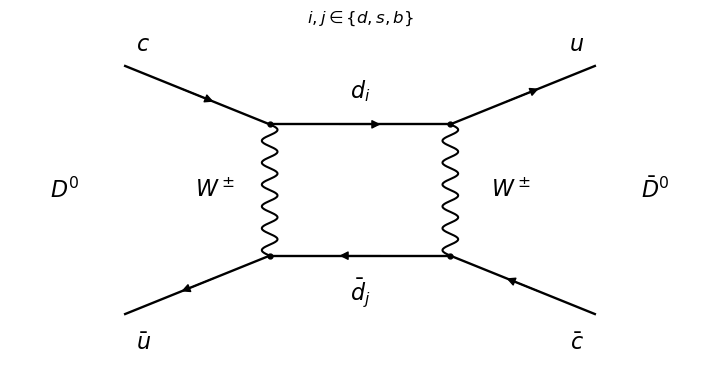
The incoming pair becomes ; the internal labels run over the down quark, strange quark and bottom quark. Each corner is a weak charged current vertex. Four such vertices make the contribution of order . Summing the internal flavours produces Cabibbo-Kobayashi-Maskawa matrix factors and the Glashow-Iliopoulos-Maiani mechanism: the flavour-independent term cancels by . This box Feynman diagram is one contribution; long-distance intermediate hadron states can also contribute to neutral D-meson mixing.
Let , . In the rest frame, the CPT theorem interchanges these states up to irrelevant phases. For the weak Hamiltonian operator , with , and its antiunitary CPT symmetry operator ,Its diagonal matrix elements are real by Hermitian conjugation, soIn the specified phase convention, the CP symmetry operator on this two-state subspace is . If the weak interaction preserves CP symmetry, , givingIndependently, Hermitian conjugation gives for this . Hence CP symmetry makes the off-diagonal element real in this convention; that conjugation relation alone does not imply CP symmetry.
For neutral meson mixing described by the decay-effective Hamiltonian operator , the effective matrix is generally not a Hermitian matrix. The CPT constraints on neutral-meson mixing still give equality of the complex diagonal entries, expressing equal masses and total decay widths, and CP symmetry gives equality of the off-diagonal entries in the specified convention. One must not additionally impose on this decay-effective matrix.
The tree-level Feynman diagrams contain an unchanged spectator quark, of up quark flavour and the two possible weak charged current transitions of the charm antiquark:
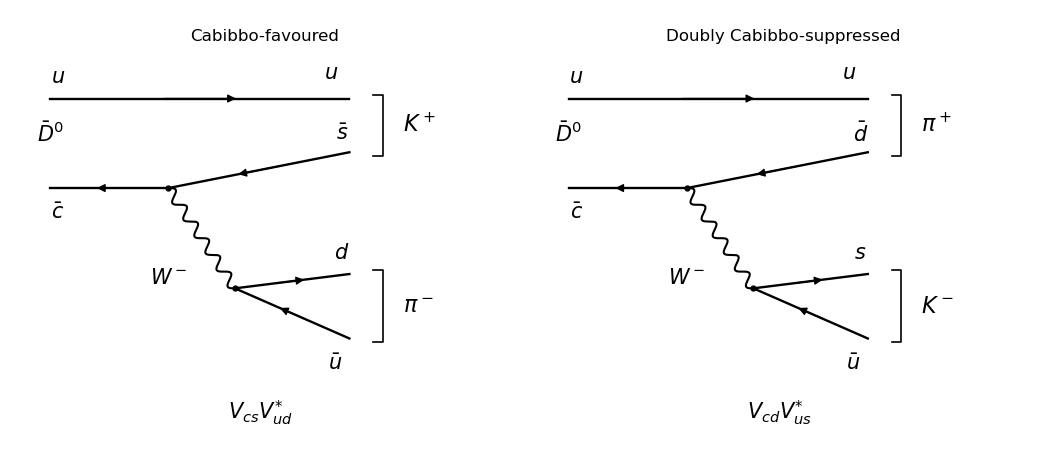
For , and . The spectator quark combines with into the kaon , while forms the pion . The Cabibbo-Kobayashi-Maskawa matrix factor is .
For , and . The spectator quark combines with into the pion , while forms the kaon . The Cabibbo-Kobayashi-Maskawa matrix factor is .
Neglecting neutral D-meson mixing and assuming comparable strong interaction matrix elements, the relative direct decay widths areHere is the Cabibbo angle. The second process is doubly Cabibbo suppressed: it contains two small Cabibbo suppression factors in its amplitude. The Cabibbo angle estimate assumes similar Quantum chromodynamics matrix elements; it is not an exact rate equality.
Both the D meson and kaon are spin-zero pseudoscalars. The strong interaction states obey parity symmetry in quantum field theory. Consequently an axial current matrix element between them would have to be a pseudovector formed from only and , which is impossible: an totally antisymmetric tensor would require more linearly independent vectors. ThusLorentz covariance then leaves two linearly independent vectors for the vector current matrix element, giving the pseudoscalar-to-pseudoscalar form factorsThe vanishing axial current here follows from strong interaction parity symmetry in quantum field theory, not parity symmetry in quantum field theory of the weak interaction.
To obtain the requested decay formula, use naive factorization of a nonleptonic meson decay: approximate the four-quark matrix element by the product of the current matrix element and the vacuum-to-pion matrix element. This is an additional hadronic approximation; tree-level weak vertices alone do not establish it, and nonfactorizable Quantum chromodynamics effects can change the result. The vacuum-to-pion vector current matrix element vanishes by parity symmetry in quantum field theory, while the specified pion decay constant normalization givesThe cancels the in the four-fermion interaction. Up to an irrelevant overall phase, the scattering amplitude is thereforeFor , , so only survives. Integrating the two-body decay phase space in the D meson rest frame givesHenceThis coefficient uses exactly the stated pion decay constant convention and the stated massless-pion approximation.
The deep inelastic scattering process contains a virtual photon exchanged between the electron and the hadron:
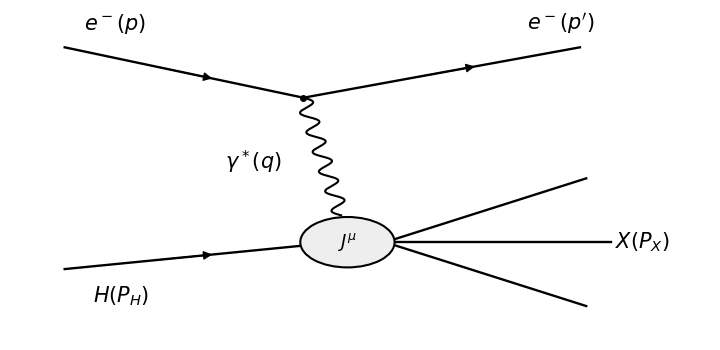


Use an electromagnetic vector current containing the dimensionless quark charges, with the coupling factored out. The scattering amplitude, up to an irrelevant phase, isTo match the printed prefactor, define the leptonic tensor with a spin sum over both electron spins and keep the initial spin average outside it. The gamma-matrix trace givesFor a stationary target and massless electron, the invariant flux factor is . The inclusive final-state Lorentz-invariant phase-space measure and target spin average are contained in . Thus the differential scattering cross-section isHere means . If the initial spin average is instead built into the leptonic tensor, its normalization is and the displayed cross-section prefactor must be doubled. The two conventions give the same observable.
For an unpolarized electromagnetic target, Lorentz covariance and parity symmetry in quantum field theory permit a symmetric hadronic tensor built from , and , where . Its surviving general form isThe totally antisymmetric tensor structure is excluded by electromagnetic parity symmetry in quantum field theory for this unpolarized target. The other possible antisymmetric structure, , cannot be transverse for generic scattering kinematics and hence is excluded by current conservation. Current conservation gives the Ward identities , imposingTwo scalar functions remain. Taking gives the transverse basisThese are the deep-inelastic structure functions; is Bjorken x. At fixed target mass, the two independent Lorentz scalar invariants can equivalently be chosen as . In this paper has dimensions of mass squared, rather than the alternative convention used for energy transfer.
Use the massless collinear parton approximation in a high-energy frame: , , and with . This neglects target-mass corrections to the parton model; it does not literally set a stationary massive target to a massless particle in the earlier flux formula.
For a quark of dimensionless charge , the electromagnetic vector current matrix element is . The spin average and gamma-matrix trace giveIntegrating the three-momentum Dirac delta function in the parton hadronic tensor leavesSince , this isFor the massless electron momenta, and . Substitution into the leptonic tensor givesand likewise . These Ward identities eliminate every term with an exposed index in the contraction. ThereforeHere means equality after contraction with the leptonic tensor. The shortened tensor is not itself conserved; the omitted terms restore current conservation in the full hadronic tensor.
On the physical positive-energy branch, put . The massless outgoing parton obeysSince on the support and , the positive-energy on-shell delta function identity givesInsert this into the parton model sum, and writeThe parton distribution functions are number densities in momentum fraction. The contributing tensor becomesComparing with part (b), under the same leptonic tensor contraction, givesThis is the Callan-Gross relation for massless partons of spin angular momentum at leading order. The longitudinal deep-inelastic structure function is in this approximation. Target-mass effects and radiative Quantum chromodynamics corrections can change the relation. The leading parton model also gives Bjorken scaling: at this level the deep-inelastic structure functions depend on alone.
Articles by others on the same topic
There are currently no matching articles.