Scattering that resolves the constituents of a hadron at large spacelike momentum transfer, with an inclusive sum over final hadron states.
In electron scattering from a proton, write the reaction as : the outgoing electron is measured, while denotes all allowed final hadron states. Large momentum transfer supplies a short-distance probe; a large final invariant mass separates the deep continuum from elastic scattering and individual particle resonances. The useful surprise is that an extended proton can have a response characteristic of much smaller constituents. Deep inelastic scattering turns measurements outside the proton into constraints on its internal parton distribution functions.
The SLAC-MIT deep inelastic electron scattering experiment connects this definition to an actual measurement. Its evidence came from distributions of outgoing electron energies and scattering angles, rather than a photograph of a quark. Bjorken scaling concerns deep-inelastic structure functions after known scattering factors have been accounted for; it does not say that the raw differential scattering cross-section is constant.
In a head-on lepton-proton collision with the proton along , hadronic four-momentum conservation gives and . With , the reconstructed Bjorken scaling variable is . This is useful for charged current events whose final neutrino escapes. Initial-state radiation and unmeasured forward hadrons spoil the ideal closure.
In the operator product expansion for a hard scattering process, twist is operator dimension minus spin. Contributions beyond leading twist describe additional multiparton correlations and are suppressed by powers of the large momentum-transfer scale. A leading-order quark-parton formula omits these power corrections.
For an isoscalar target in the leading massless quark-parton approximation, integrate the two helicity weights over inelasticity: and . Then , where and . Inversion gives the displayed ratio. These are effective weak-flavour momentum fractions; the data do not determine unweighted parton number integrals.
For an isoscalar valence target and massless leading-order scattering, , where . The factor is . With Standard Model quark couplings and , this becomes . Sea quarks and threshold, nuclear and QCD corrections matter beyond this limit.
A nuclear target with equal proton and neutron contributions, or data corrected to that average. Its per-nucleon PDFs are . Charge symmetry gives ; using proton down-quark density alone is not an isoscalar average.
Starting in 1967, a collaboration at the Stanford Linear Accelerator Center and the Massachusetts Institute of Technology directed an electron beam at liquid hydrogen, providing proton targets. Jerome Isaac Friedman, Henry Way Kendall and Richard Edward Taylor participated in this experimental program.[ref]
Deep Inelastic Scattering: Experiments on the Proton and the Observation of Scaling by Henry Way Kendall. 1990 Nobel lecture, section I.A, opening account of the program
The 1969 paper Observed Behavior of Highly Inelastic Electron-Proton Scattering reports inclusive electron spectra at and with incident energies from to . Its scaling comparison estimated under a transverse-virtual photon assumption, finding approximate agreement as a function of for and . These are the paper's conditions, not a claim of exact Bjorken scaling at every momentum transfer.[ref]
A movable magnetic spectrometer selected scattered electrons by momentum and scattering angle. Magnetic fields dispersed momenta at the focal plane. With relativistic electrons, the inferred momentum determines outgoing energy . Commissioning included steering the beam through the spectrometer at zero angle to check its optics and accepted solid angle. Counters sorted events into momentum and angle bins. The acceptance entered the conversion from counts to differential scattering cross-sections.[ref]
Deep Inelastic Scattering: The Early Years by Richard Edward Taylor. 1990 Nobel lecture, Fig. 15, magnet optics; Fig. 33 and adjacent acceptance-calibration account
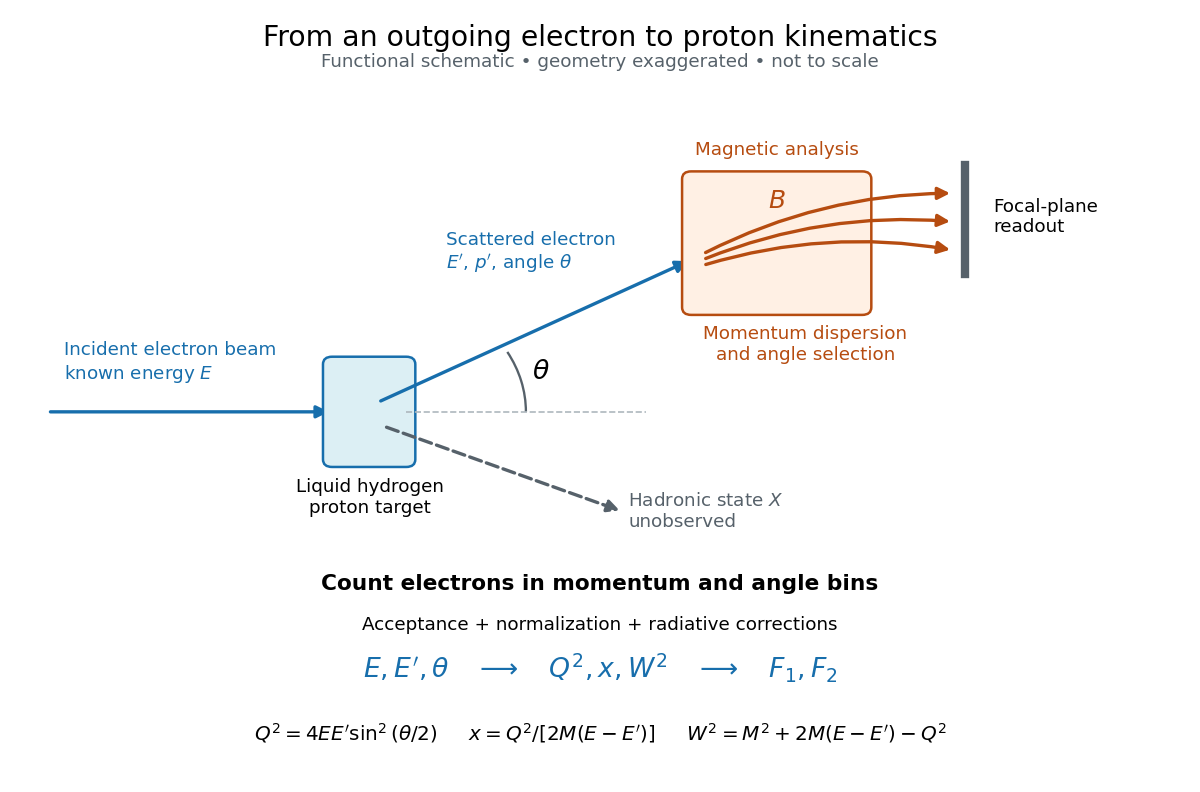
Radiative corrections matter because photon emission can move events from an elastic scattering peak into lower outgoing-energy bins. The analyses subtracted the elastic radiative tail before unfolding inelastic radiation. Independent MIT and SLAC procedures provided a check. An uncorrected low- tail alone therefore cannot establish deep inelastic scattering.[ref]
Deep Inelastic Scattering: Experiments on the Proton and the Observation of Scaling by Henry Way Kendall. Section IV.C, radiative-tail subtraction, unfolding and independent analyses; Figs. 6–8
Work in natural units with , neglect the electron mass, and put the initial proton at rest with mass . Let and be the initial and final electron four-momenta, , and . Define the laboratory energy transfer . This has units of energy; the invariant has units of energy squared. The Bjorken scaling variable and the final hadron invariant mass obeyThese follow by squaring and , using and . Solving the Bjorken x definition gives the outgoing energy and then the scattering angle:Alternatively, substituting before solving gives . A chosen must satisfy and . In addition, must exceed the lightest allowed inelastic hadron threshold; positive alone is insufficient.
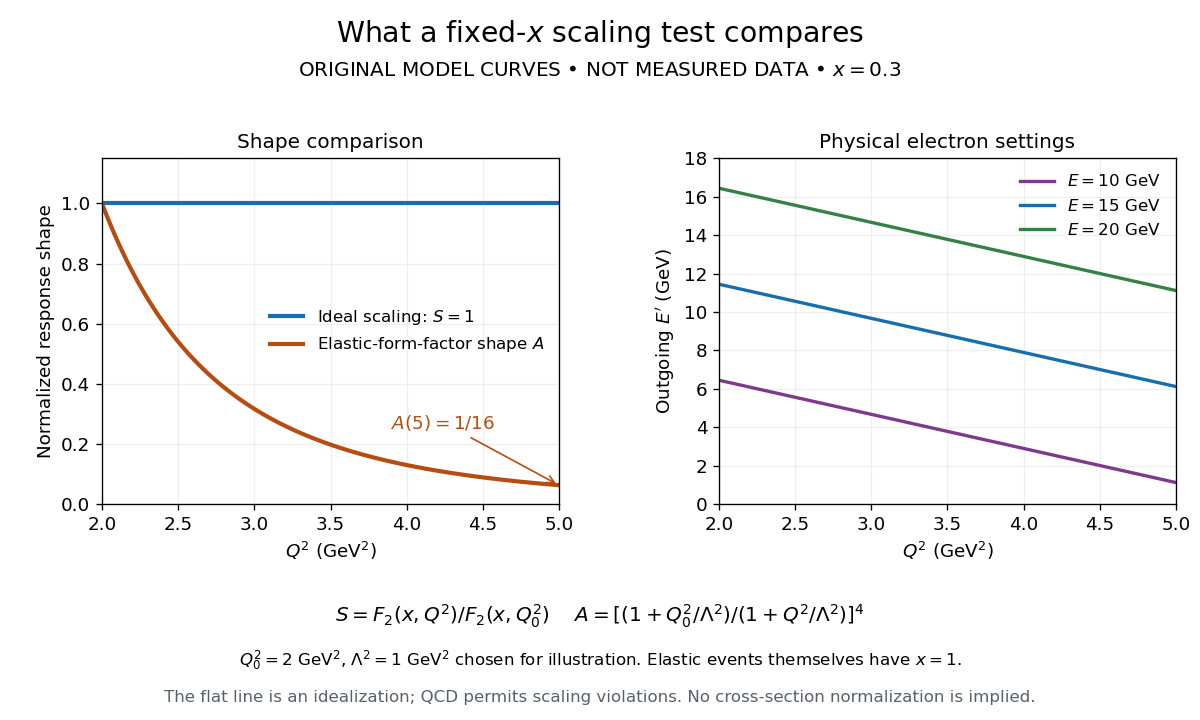
For an original numerical example, take , , and . Then , , , and . Varying and at this same Bjorken x keeps every setting physical and gives , above the proton-pion threshold and the stricter chosen continuum selection . These are calculated settings, not historical measurements.
An ideal Bjorken scaling model has : varying at fixed Bjorken x leaves this dimensionless deep-inelastic structure function unchanged. The comparison requires extracting a deep-inelastic structure function, rather than plotting raw event counts. Quantum chromodynamics predicts departures from exact Bjorken scaling; finite hadron masses also limit the idealization.
For an original shape comparison, choose and define with . The ideal model has . To display a contrasting size-dependent suppression, define an illustrative elastic-form-factor shape with the freely chosen . Its normalized squared magnitude isThus , whereas . The elastic-form-factor shape is a comparison of suppression mechanisms, not an elastic differential scattering cross-section assigned to : actual elastic scattering from a proton has and . Neither curve is measured data or a fit to the SLAC-MIT experiment.
The experimental interpretation required more than a flat curve. The angular dependence and small longitudinal response supported spin one-half partons, expressed at leading order by the Callan-Gross relation . Identification with fractionally charged quarks also drew on later electron, muon and neutrino comparisons. A scaling plot alone does not determine the individual electric charges of constituents.[ref]
Deep Inelastic Scattering: Comparisons with the Quark Model by Jerome Isaac Friedman. 1990 Nobel lecture, identification of the constituents and early neutrino results; 1991 reprint p. 623
The leading parton model formula already shows the ambiguity: combines squared electric charges with unknown parton distribution functions. One measured function cannot independently fix all these quantities. Confinement also explains why an inclusive final hadron state need not contain an isolated outgoing quark.
In deep inelastic scattering, the reference frame where the exchanged virtual photon has zero energy and spatial momentum magnitude .
The inelasticity in deep inelastic scattering is , where is the incoming lepton momentum, the target momentum and the transfer. In the target rest frame it is the fraction of the incoming lepton energy transferred to the target. It is unchanged by replacing by a collinear parton momentum , and in massless kinematics.
In deep inelastic scattering, the scaling variable is with . In the massless collinear parton model, the outgoing on-shell condition identifies with the struck parton's incoming longitudinal momentum fraction.
Here . In the leading massless collinear parton approximation, this kinematic variable equals the momentum fraction of the struck parton.
The inclusive product of hadronic-current matrix elements, summed over final states with a Lorentz-invariant phase-space measure. Electromagnetic current conservation makes both indices transverse to the exchanged four-momentum.
For an absorbed spacelike photon, use , , and the physical momentum delta function . The displayed invariant final mass is compatible with deep inelastic scattering for . Using with the same positive- definition instead gives , which becomes negative in the Bjorken scaling limit and has no physical hadronic spectral support. Reversing the photon convention requires reversing the associated scalar-product and scaling-variable conventions too.
For electromagnetic deep inelastic scattering with an unpolarized target, Lorentz invariance, parity and current conservation leave two independent deep-inelastic structure functions. With and , both tensor structures are transverse to . Terms with a free index disappear on contraction with a conserved leptonic tensor, although such terms can still be necessary to make the full hadronic tensor transverse.
For an on-shell massless quark with incoming momentum and outgoing momentum , average the initial spin and sum the final spin. The gamma matrix trace identities give . On shell , and defining and yields the displayed transverse decomposition. With the hadronic-tensor prefactor , one-particle Lorentz-invariant phase space gives . The antiquark has the same unpolarized tensor and squared electric charge.
The two scalar coefficients in the unpolarized electromagnetic hadronic tensor. Extra polarization or parity-violating currents can require further coefficients.
In the massless-target convention, the Callan-Gross relation sets this coefficient to zero at leading order in the parton model.
The product of lepton-current matrix elements with a specified spin sum or spin average. Its normalization must be stated when quoting a differential scattering cross-section.
For the current with rather than , the spin-summed symmetric leptonic tensor is . Integrating the standard two-body Lorentz-invariant phase space of two massless particles givesIts antisymmetric Levi-Civita symbol term integrates to zero. The normalization changes by a factor of four if the current uses instead. The result separates the leptonic integration from hadronic pseudoscalar-to-pseudoscalar form factors in a three-body decay rate.
Articles by others on the same topic



Deep inelastic scattering (DIS) is a high-energy particle physics process that provides insights into the internal structure of protons, neutrons, and other hadrons. It involves the scattering of high-energy electrons (or other leptons) off of protons or neutrons, where the energy of the lepton is high enough that it can probe the internal quark and gluon constituents of the target hadron.