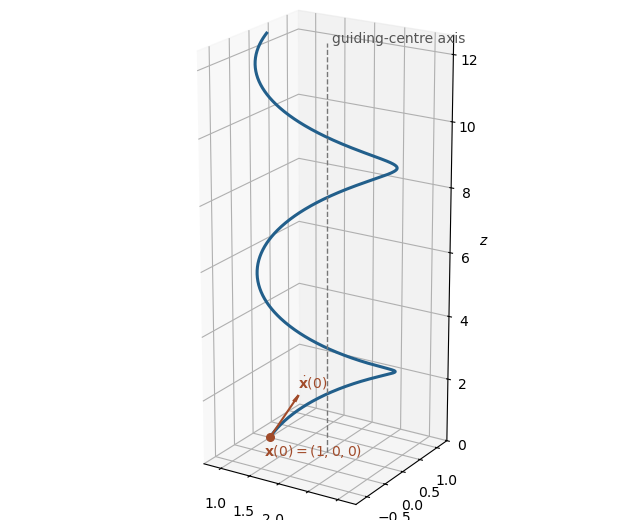
The Lorentz force and Newton's second law giveWriting , the component equations areThe initial velocity therefore givesand integration with the initial position givesThis is helical motion in a uniform magnetic field: a helix of radius around the line , , with its axis parallel to the magnetic field.
The three fixed charges are related by rotations through about the origin. Their three Coulomb's law forces on a charge placed at the origin have equal magnitudes and directions separated by , so their vector sum vanishes. Thusis an equilibrium point.
Let be the distance from the origin to each fixed charge, and denote their position vectors by . For a small planar displacement , the Taylor expansioncan be summed using the threefold symmetry relationsThe electric potential due to the fixed charges is consequentlyThe moving charge has electrostatic potential energy of point charges . Because the quadratic coefficient is positive, the origin is a strict local minimum of , and the equilibrium is stable.
Taking the gradient of the quadratic potential energy found in part (ii) resolves the linearized force into identical and components:Each component therefore performs simple harmonic motion withThus the angular frequency is
Articles by others on the same topic
There are currently no matching articles.