For and , the linear ordinary differential equation is , whose general solution isBy the stated parity reduction, an even eigenfunction has the form . The conditions have a nonzero solution exactly whenthat is,An odd eigenfunction has the form , and the corresponding determinant givesThus is an eigenvalue precisely under one of the two stated conditions.
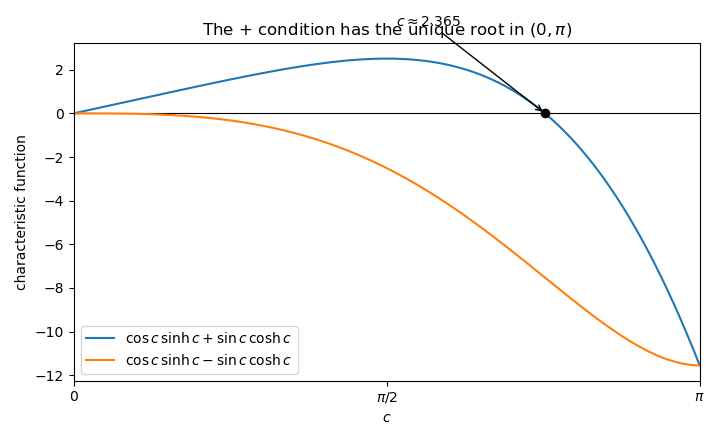
The fourth-order eigenvalue condition and its roots
. For the minus sign, division by away from gives . On , for , while on their signs differ, so there is no root. For the plus sign the equation isThere is no root in . On , the function increases strictly from to , so it has exactly one root by the intermediate value theorem. Numerically,Hence the combined condition has exactly one solution in .
Articles by others on the same topic
There are currently no matching articles.