Assume local thermodynamic equilibrium, negligible scattering of thermal radiation, and a plane-parallel atmosphere. With inward optical depth and outward ray cosine , the radiative transfer equation isFor a deep atmosphere, its formal solution of the radiative transfer equation isThe weighting samples of order unity. The Eddington-Barbier relation makes this precise when the source function is nearly linear: .
A molecular band with greater opacity reaches unit optical depth higher than the nearby continuum. If temperature decreases upward, that band samples cooler gas and appears in absorption. If an atmospheric thermal inversion makes the upper gas hotter, the band appears in emission. If both depths have the same temperature, an opaque isothermal atmosphere hasand no opacity-dependent features. This last conclusion assumes all wavelengths are opaque or the lower boundary emits the same Planck function; an optically thin isothermal layer over a different background need not be featureless.
For , both stars illuminate the circumbinary planet at approximately distance . Treat them as blackbodies, neglect internal heating, and assume Bond albedo and uniform global reradiation. The absorbed and emitted powers areThus the equilibrium temperature of a circumbinary planet isFor an example, take , , , , , , circular coplanar orbits, and . ThenThe cooler star contributes only of the hotter star's luminosity in this example.
An opaque isothermal atmosphere emits , with no absorption or emission bands. The Wien displacement law puts the maximum of this wavelength spectrum near . At observer distance , the planetary spectral flux is .
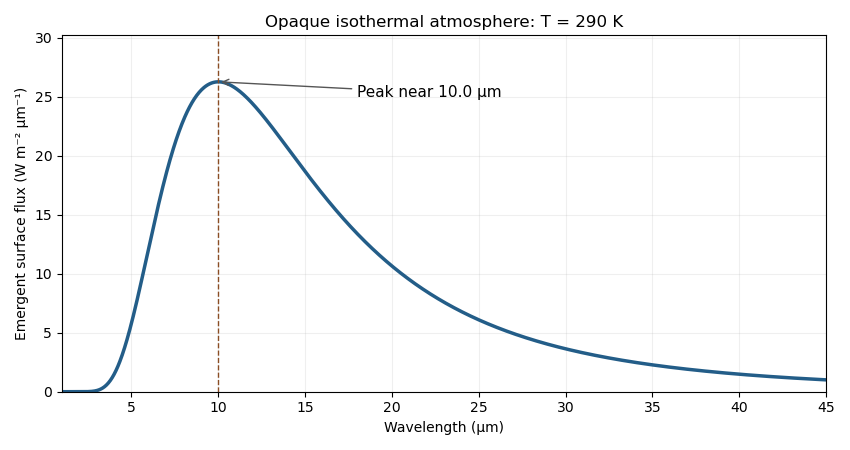
Isothermal circumbinary-planet emission spectrum
. The emergent surface flux for the example above. The wavelength spectrum peaks near ten micrometres; the exactly isothermal opaque model has no molecular bands. Details.
Assume all three planets retain approximately their original hydrogen-helium bulk composition. Stellar encounters change orbital energy and irradiation, not automatically the planet's elemental abundances. Their atmospheric structures can become approximately stationary long before their interiors finish cooling.
For the unperturbed Jupiter-like planet at , the zero-albedo globally averaged planetary equilibrium temperature is about . Stellar light heats the outer atmosphere, while internal cooling supports a deeper temperature gradient and convection. At cooler pressures, chemical equilibrium favors methane and ammonia; condensate clouds can include ammonia at high levels and water deeper down. Disequilibrium chemistry in an exoplanet atmosphere can preserve carbon monoxide or other species from deeper layers.
For the inward-migrated planet at , the irradiation-only planetary equilibrium temperature is ten times higher, about , because . Its irradiated planetary atmosphere has a heated radiative exterior, potentially strong day-night differences, and a deep radiative-convective boundary. At suitable pressures, chemical equilibrium increasingly favors carbon monoxide over methane; water remains important, while alkali absorption and high-temperature condensates can matter. An atmospheric thermal inversion depends on absorbers, clouds, and irradiation and is not guaranteed simply by migration.
The ejected object is a rogue planet. Its irradiation-based planetary equilibrium temperature becomes very small, but its actual emitting temperature is set primarily by internal cooling and Kelvin-Helmholtz contraction. After only several million years it can remain warm and self-luminous, with deep convection and an outward-cooling radiative atmosphere. Its photospheric chemistry and clouds depend on that cooling temperature; they cannot be inferred from the absence of a host star alone. None of these cases fixes an exact pressure-temperature profile without a cooling model, opacities, and atmospheric composition.
Articles by others on the same topic
There are currently no matching articles.