Assume a uniform stellar disc of radius , an opaque planetary radius , and a thin atmospheric annulus of thickness . Neglect planetary light during transit and scattering back into the beam. The attenuation part of the radiative transfer equation gives , where is the slant optical depth along a stellar ray through the atmosphere. The fraction of light removed from that annulus is therefore .
If the annulus is represented by one effective optical depth, its area divided by the stellar area isThe annulus model for transmission spectroscopy consequently gives the extra transit depthHere is normalized to the unobscured stellar flux and excludes the opaque-disc depth . For a spectral feature measured relative to a continuum with slant optical depth , the corresponding contrast is ; the displayed formula takes the annular continuum to be transparent.
A real exoplanet transmission spectrum has an impact-parameter-dependent optical depth. Its more accurate expression isStellar limb darkening and horizontally varying clouds further modify the weighting. The single-annulus approximation is useful for estimating an atmospheric spectral-feature amplitude, rather than predicting every spectral line.
At 10 parsecs, arcseconds corresponds to astronomical units. Take a solar-radius star with , zero Bond albedo, full day-night heat redistribution, negligible internal heating, and a hydrogen-helium atmosphere with mean particle mass . The planetary equilibrium temperature isFor Jupiter mass and radius, . Its atmospheric scale height isAssume a strong band spans atmospheric scale heights and saturates in the annulus model for transmission spectroscopy. The atmospheric spectral-feature amplitude isFor a five-standard-deviation detection, the uncertainty of the measured differential contrast must satisfyThis estimate scales linearly with the assumed feature height; one atmospheric scale height would require about . The question gives no opacity or abundance from which to fix , so an atmospheric detection threshold is necessarily assumption-dependent.
For thermal emission at , assume the planet and star emit as blackbodies. The thermal eclipse depth from the Planck law isThus the uncertainty required for a five-standard-deviation exoplanet secondary eclipse detection isThese are uncertainties of the final transit or eclipse contrasts, including the uncertainty of their reference levels. The distance affects photon counts and observing time but cancels from the flux ratios. An opaque exactly isothermal atmosphere emits a featureless blackbody spectrum: an eclipse detects its thermal light, while identifying atmospheric composition requires spectral features and a nonisothermal structure or other diagnostics.
In the annulus model for transmission spectroscopy, an added aerosol optical depth changes the signal to . Large particles can supply nearly wavelength-independent extinction. An opaque high exoplanet cloud deck then masks deeper gas, flattens the optical exoplanet transmission spectrum, and weakens atomic or molecular features.
Small particles can instead produce a rising transit radius toward short wavelengths. In an isothermal atmosphere, the slant optical depth of an isothermal atmosphere isTaking the effective radius near gives . For Rayleigh scattering, , so the scattering slope of a transmission spectrum isA steeper-than-expected optical slope or suppressed gas features can therefore indicate atmospheric haze or exoplanet clouds. These signatures are not unique: high mean molecular mass reduces , gas itself can produce Rayleigh scattering, and stellar surface heterogeneity can mimic slopes. Consistent optical and infrared features help distinguish these explanations.
Assume local thermodynamic equilibrium, negligible scattering of thermal radiation, and a plane-parallel atmosphere. With inward optical depth and outward ray cosine , the radiative transfer equation isFor a deep atmosphere, its formal solution of the radiative transfer equation isThe weighting samples of order unity. The Eddington-Barbier relation makes this precise when the source function is nearly linear: .
A molecular band with greater opacity reaches unit optical depth higher than the nearby continuum. If temperature decreases upward, that band samples cooler gas and appears in absorption. If an atmospheric thermal inversion makes the upper gas hotter, the band appears in emission. If both depths have the same temperature, an opaque isothermal atmosphere hasand no opacity-dependent features. This last conclusion assumes all wavelengths are opaque or the lower boundary emits the same Planck function; an optically thin isothermal layer over a different background need not be featureless.
For , both stars illuminate the circumbinary planet at approximately distance . Treat them as blackbodies, neglect internal heating, and assume Bond albedo and uniform global reradiation. The absorbed and emitted powers areThus the equilibrium temperature of a circumbinary planet isFor an example, take , , , , , , circular coplanar orbits, and . ThenThe cooler star contributes only of the hotter star's luminosity in this example.
An opaque isothermal atmosphere emits , with no absorption or emission bands. The Wien displacement law puts the maximum of this wavelength spectrum near . At observer distance , the planetary spectral flux is .
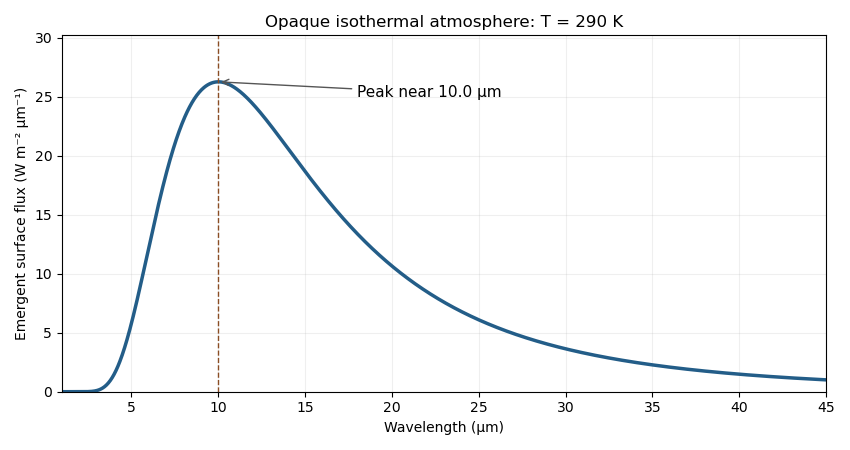
Isothermal circumbinary-planet emission spectrum
. The emergent surface flux for the example above. The wavelength spectrum peaks near ten micrometres; the exactly isothermal opaque model has no molecular bands. Details.
Assume all three planets retain approximately their original hydrogen-helium bulk composition. Stellar encounters change orbital energy and irradiation, not automatically the planet's elemental abundances. Their atmospheric structures can become approximately stationary long before their interiors finish cooling.
For the unperturbed Jupiter-like planet at , the zero-albedo globally averaged planetary equilibrium temperature is about . Stellar light heats the outer atmosphere, while internal cooling supports a deeper temperature gradient and convection. At cooler pressures, chemical equilibrium favors methane and ammonia; condensate clouds can include ammonia at high levels and water deeper down. Disequilibrium chemistry in an exoplanet atmosphere can preserve carbon monoxide or other species from deeper layers.
For the inward-migrated planet at , the irradiation-only planetary equilibrium temperature is ten times higher, about , because . Its irradiated planetary atmosphere has a heated radiative exterior, potentially strong day-night differences, and a deep radiative-convective boundary. At suitable pressures, chemical equilibrium increasingly favors carbon monoxide over methane; water remains important, while alkali absorption and high-temperature condensates can matter. An atmospheric thermal inversion depends on absorbers, clouds, and irradiation and is not guaranteed simply by migration.
The ejected object is a rogue planet. Its irradiation-based planetary equilibrium temperature becomes very small, but its actual emitting temperature is set primarily by internal cooling and Kelvin-Helmholtz contraction. After only several million years it can remain warm and self-luminous, with deep convection and an outward-cooling radiative atmosphere. Its photospheric chemistry and clouds depend on that cooling temperature; they cannot be inferred from the absence of a host star alone. None of these cases fixes an exact pressure-temperature profile without a cooling model, opacities, and atmospheric composition.
For a spherical planet, combine the hydrostatic pressure support equation with :Neglect surface pressure. Since , the hydrostatic lower bound on planetary central pressure isFor a physically usual mass density decreasing outward, the mean interior density exceeds the global mean. Hence , giving the sharper minimum within this class,Uniform mass density attains the sharper bound; direct integration with gives . Real planets are centrally concentrated through compression and dense cores, so their central pressure is higher.
Using , , , and , the universal bounds are approximately for Earth and for Jupiter. The uniform-density estimates are respectively and , or and megabars. Either comparison gives a Jupiter minimum about 6.4 times the Earth minimum.
At from a four-solar-luminosity star, the incident flux is proportional to , approximately the same as for Jupiter at around the Sun. Thus Jupiter supplies a possible old comparison at roughly the same mass and irradiation.
Assume the radius law holds from the young epoch to an old age of , that the irradiation history can be represented by the same fixed value, and that the present old radius is . If is approximated by stellar age, thenIf instead starts at completion of formation, the model's formation delay of up to leaves the young planet with thermal age between and . Taking the old thermal age as approximately then gives –.
Thus an exponent of order 0.1 is a reasonable conditional estimate. A single radius at one age cannot determine both the exponent and normalization of a power law; the old Jupiter comparison and the assumptions about formation time and irradiation are essential.
Exoplanet transit photometry discovers a giant planet through a periodic flux decrement and measures . Stellar-radius estimates turn this into a planetary radius. The radial-velocity method discovers the stellar orbital reflex motion and constrains . Follow-up exoplanet transit photometry is required to measure a geometric radius when such a planet also transits; a radial-velocity detection alone gives no direct size. Alternatively, exoplanet direct imaging finds young luminous giants, whose sizes are inferred less directly from luminosity, temperature, distance, and a planetary mass-radius relation or atmosphere model.
The two broad explanations for hot-Jupiter radius inflation are retention of primordial heat and addition of new interior power.
Delayed cooling of an inflated giant planet can arise from enhanced atmospheric opacity, which slows radiative escape; an irradiation-maintained radiative blanket, which insulates the convective interior; or compositional stratification and inefficient layered convection, which inhibit the outward transport of heat. These alter the rate of Kelvin-Helmholtz contraction.
Heating of an inflated giant planet can arise from tidal heating maintained by eccentricity or obliquity; Joule heating of currents driven by atmospheric winds through a magnetic field; or downward transport and dissipation of atmospheric mechanical energy generated by irradiation. To affect radius, the energy must be deposited at a depth and rate that changes the interior cooling balance. Simply absorbing starlight high in the atmosphere does not automatically supply deep heating. These are proposed mechanisms with different efficiencies, not six universally established contributions in every inflated planet.
A close-in giant is often in synchronous rotation after tidal locking, giving persistent dayside heating and nightside cooling. Its contrast is controlled by the competition between radiative relaxation time in a planetary atmosphere, wind transport characterized by the atmospheric advection time, wave adjustment, and drag. When heat transport is fast compared with radiation, day-night heat redistribution lowers the contrast; when radiation is fast, each hemisphere stays closer to its local radiative balance.
For a rough atmospheric column estimate,At comparable pressure, higher planetary equilibrium temperature sharply shortens radiative relaxation, tending to increase the day-night contrast. Wind speeds, rotation, and magnetic drag can modify this trend; dissociation and recombination can carry additional heat in very hot atmospheres.
At higher altitude, lower pressure generally means shorter radiative relaxation and a larger contrast. Infrared bands with larger opacity probe these higher layers, while lower-opacity windows sample deeper layers with longer cooling times and more effective redistribution. A wavelength-dependent exoplanet thermal phase curve can therefore reveal how the contrast and hot-region displacement change with pressure.
Let be Jupiter's current total emitted luminosity. Under the stipulated split, its intrinsic luminosity after removal of sunlight is approximately . If the accessible energy reservoir down to is , the constant-luminosity estimate gives .
Assume the more massive giant has approximately the same radius as Jupiter, a comparable structure factor, and an accessible cooling reservoir scaling as , as in the Kelvin-Helmholtz cooling time. Assume also that the final cold state contributes negligibly to that reservoir and that the giant radiates at the constant stipulated luminosity . ThenThereforeThis is a characteristic scaling under the stated assumptions, not a detailed evolutionary age. A different mass-radius relation, a different accessible internal-energy fraction, or time-dependent luminosity changes the result; the mass and luminosity alone do not uniquely determine a cooling time.
Let be the globally averaged absorbed stellar flux. The single-layer greenhouse model has an atmosphere transparent to incoming visible light and with infrared absorptivity and emissivity . Treat the surface as a blackbody and neglect internal heating. The layer emits both upward and downward.
Atmospheric radiative balance givesSurface radiative balance givesEliminating yieldsThe transparent limit has , and a fully infrared-opaque layer has . The model omits convection, wavelength-dependent opacity, and atmospheric absorption of starlight, so it captures the simplest greenhouse energy balance rather than a full surface-temperature prediction.
Assume a hydrogen-helium perfect gas with mean particle mass , Jupiter gravity , and mixing over one atmospheric scale height. At ,The eddy mixing time is . A chemical quench level at one bar requires , hence the vertical eddy diffusion coefficient must be of orderThe number depends quadratically on the assumed mixing length; using a fraction of reduces it accordingly.
Above the chemical quench level, neglect photochemistry, condensation, and molecular diffusion. The quenched atmospheric mixing ratio is approximately constant, while the number density isThus the abundance fraction is frozen, but the absolute number density falls with pressure and altitude. Examples are carbon monoxide–methane quenching, through , and nitrogen–ammonia quenching, through .
First refine the ephemeris, planetary mass, stellar radius, and stellar variability using exoplanet transit photometry and the radial-velocity method. Then combine observations that probe different regions rather than relying on one spectrum. A present-day programme could use the following complementary measurements; in the 2019 setting of the paper, James Webb Space Telescope observations would have been a future capability.
- Exoplanet transmission spectrum at roughly – with the Hubble Space Telescope or optical ground-based spectroscopy: constrain exoplanet clouds, atmospheric haze, the scattering slope of a transmission spectrum, and sodium or potassium absorption.
- Near-infrared exoplanet transmission spectrum with NIRISS at – and NIRSpec modes covering roughly –: measure water, carbon monoxide, carbon dioxide, and methane bands, then constrain atmospheric metallicity of a giant planet and atmospheric carbon-to-oxygen ratio through a joint atmosphere model.
- Exoplanet secondary eclipses at near- and mid-infrared wavelengths with NIRSpec and MIRI, especially about – for the latter's time-series low-resolution mode: infer brightness temperatures, the vertical pressure-temperature structure, and whether an atmospheric thermal inversion turns bands into emission.
- A full-orbit exoplanet thermal phase curve in one or more infrared bands with the James Webb Space Telescope: constrain day-night heat redistribution, nightside emission, and the offset of the hottest region, with different bands probing different pressures.
- High-resolution near-infrared spectroscopy around molecular bands such as carbon monoxide near using CRIRES on the Very Large Telescope: resolve the planetary Doppler shift and seek wind velocities or rotation broadening after accounting for the orbital velocity.
- Ultraviolet transit spectroscopy with the Hubble Space Telescope, or ground-based near-infrared helium spectroscopy at : search for atmospheric escape and an extended upper atmosphere.
Together these address aerosols, molecular composition, elemental enrichment, vertical thermal structure, horizontal heat transport, winds, and escape. Repeat key events and monitor stellar activity, since stellar contamination and instrumental trends can imitate atmospheric signals. Use actual brightness, saturation limits, and predicted feature amplitudes to choose observing modes and exposure times.
The wavelength ranges and time-series capabilities are documented in the NIRISS SOSS guide, NIRSpec overview, MIRI spectroscopy guide, and ESO's CRIRES description.
Articles by others on the same topic
There are currently no matching articles.