Write , , and . The velocity is linear through all three layers, so and has no jump. Each interface has density drop . The jump conditions for stratified inviscid shear flow becomeBetween interfaces, the Taylor–Goldstein equation is . A decaying solution can therefore be writtenIts derivative jumps are , while its values at the interfaces are . Hence the coefficients satisfyThe determinant must vanish. With , and , one has . Expanding gives the dispersion relation for two density interfaces in uniform shear:
Put and . The dispersion relation for two density interfaces in uniform shear isIts discriminant is , so both roots are real. Their sum is positive; therefore one is negative precisely when their product is negative. That condition isSolving for givesIn this interval , so is the growing normal mode. At either endpoint the corresponding root is zero and the mode is neutral.
For large , the coupling is exponentially weak. If each interface were isolated, its interfacial gravity waves would have dimensional phase velocities , orThe upper-interface wave travelling against its positive local current has speed . The lower-interface wave travelling against its negative current has speed . Their laboratory speeds match at zero when . Weak interaction then produces counterpropagating wave instability rather than two independent travelling waves.
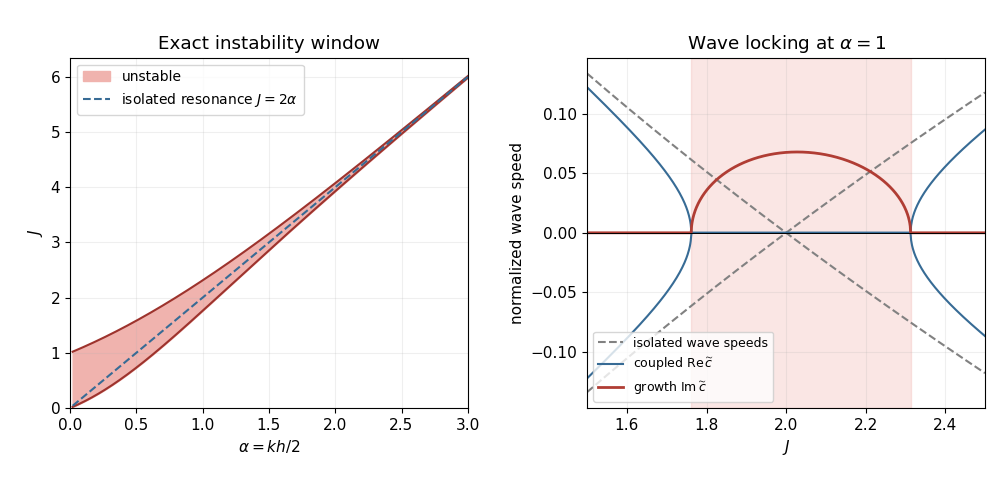

The band has the large-wavenumber form . Exactly at resonance, , soThus the instability window and growth rate both become exponentially small as the interfaces become weakly coupled.
Articles by others on the same topic
There are currently no matching articles.