Let be the displacement amplitude of an interface. Its kinematic boundary condition is , on either side, so the first of the jump conditions for stratified inviscid shear flow isFor zero surface tension, pressure is continuous at the displaced interface. Since the background hydrostatic pressure has derivative , linearization gives . Using and the kinematic condition givesThis derivation also works when jumps: the displacement is shared, while the vertical velocity need not be. It avoids ambiguous products of distributions at a discontinuous velocity profile.
Write , , and . The velocity is linear through all three layers, so and has no jump. Each interface has density drop . The jump conditions for stratified inviscid shear flow becomeBetween interfaces, the Taylor–Goldstein equation is . A decaying solution can therefore be writtenIts derivative jumps are , while its values at the interfaces are . Hence the coefficients satisfyThe determinant must vanish. With , and , one has . Expanding gives the dispersion relation for two density interfaces in uniform shear:
Put and . The dispersion relation for two density interfaces in uniform shear isIts discriminant is , so both roots are real. Their sum is positive; therefore one is negative precisely when their product is negative. That condition isSolving for givesIn this interval , so is the growing normal mode. At either endpoint the corresponding root is zero and the mode is neutral.
For large , the coupling is exponentially weak. If each interface were isolated, its interfacial gravity waves would have dimensional phase velocities , orThe upper-interface wave travelling against its positive local current has speed . The lower-interface wave travelling against its negative current has speed . Their laboratory speeds match at zero when . Weak interaction then produces counterpropagating wave instability rather than two independent travelling waves.
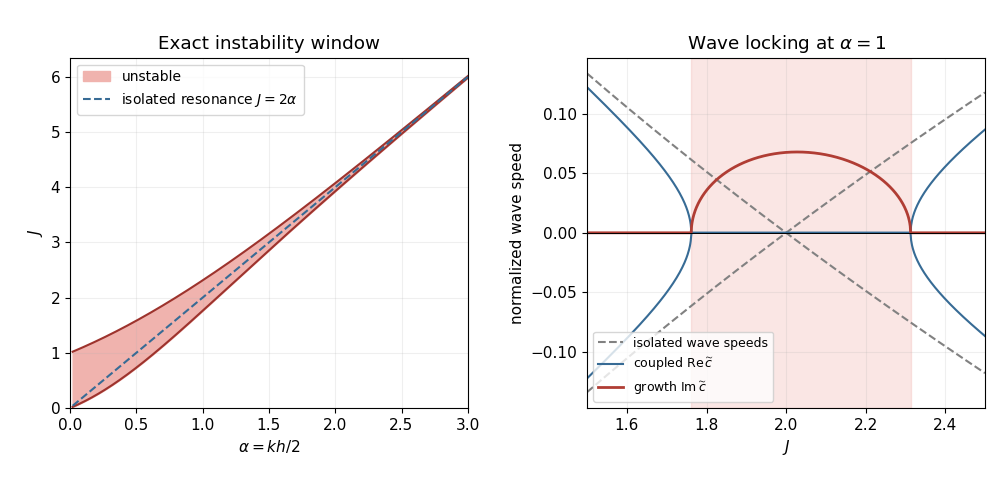

The band has the large-wavenumber form . Exactly at resonance, , soThus the instability window and growth rate both become exponentially small as the interfaces become weakly coupled.
Articles by others on the same topic
There are currently no matching articles.