The cosmological continuity equation expresses conservation of dark-matter mass: is the density contrast, is the peculiar velocity, and a prime denotes a conformal time derivative. The cosmological Euler equation expresses momentum conservation: is the conformal Hubble rate, is the peculiar gravitational potential, is the density, and is the velocity-dispersion tensor of collisionless matter. The terms are respectively Hubble drag, convective acceleration, gravity, and velocity-dispersion stress.
For curl-free flow, introduce the peculiar-velocity divergence and set . A Fourier transform of the nonlinear continuity term giveswith the alpha mode-coupling kernelTaking the divergence of the Euler equation gives the quadratic velocity kernelThis is the beta mode-coupling kernel; its symmetry follows from the two velocity factors.
Expand , where the standard perturbation theory density kernel convolves linear fields. Through fourth order in the Gaussian linear field, the only power-spectrum diagrams are the tree contraction , the loop joining two vertices , and the two orderings that join an vertex to a linear leg, . Their expressions are
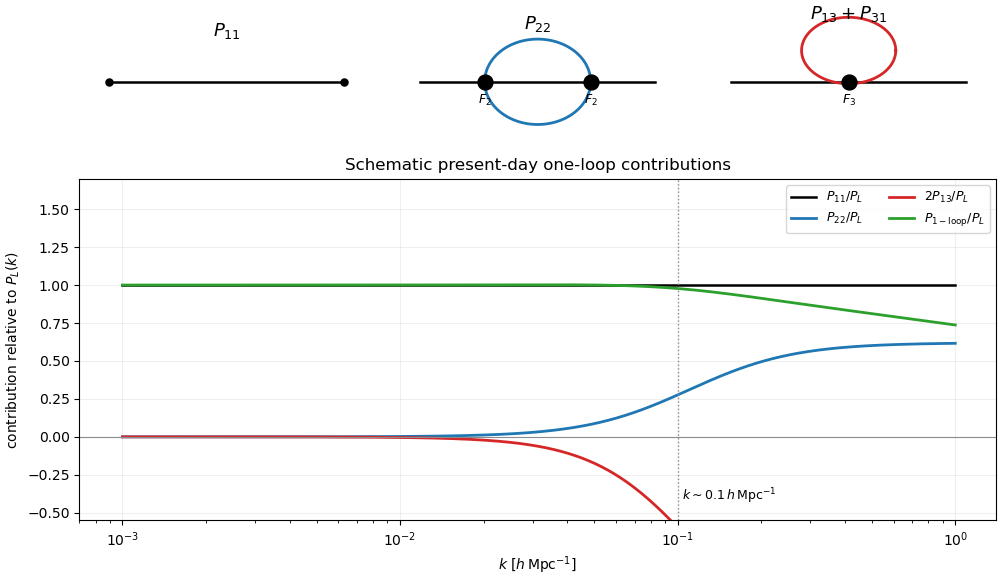

The effective field theory of large-scale structure supplements the one-loop prediction by the leading deterministic counterterm and a stochastic term,where the normalization scale may be absorbed into and mass and momentum conservation make at small . The ultraviolet part of the P13 contribution to the one-loop matter power spectrum hasIts cutoff dependence has exactly the form of the effective sound-speed counterterm in large-scale structure, so the running of cancels it. The stochastic and higher-derivative counterterms similarly absorb the allowed analytic ultraviolet dependence of and higher orders.
Conservation of tracer number under the map from the Lagrangian coordinate to the Eulerian position givesMatter conservation gives , and henceAt linear order, and thereforeThe Lagrangian-to-Eulerian linear bias relation is
Articles by others on the same topic
There are currently no matching articles.