The operator is not invariant under a scalar-field shift symmetry because one field is undifferentiated. An arbitrary large coefficient would therefore radiatively generate equally unsuppressed nonderivative operators, including a mass and a steep scalar potential, and would spoil the approximate shift symmetry and flat potential needed for single-field slow-roll inflation. In a technically natural slow-roll model its coefficient must consequently be small, so it does not produce parametrically large primordial non-Gaussianity. Treated merely as an effective spectator-field interaction, it does generate the tree-level primordial bispectrum computed below, whose size is controlled by the dimensionless interaction strength at the Hubble scale; taking that strength large abandons the controlled slow-roll premise.
Since and , the interaction isto first order in . The tree-level in-in formalism givesThere are two Wick contractions for each choice of the undifferentiated field at the vertex. With , the stated Bunch-Davies vacuum mode obeysThe two powers of from the differentiated modes cancel , and the remaining integral isRemoving the momentum-conserving delta function, the bispectrum from a time-derivative cubic scalar interaction is therefore
With the Fourier transform convention , scale invariance of the position-space three-point function givesBecause , the reduced primordial bispectrum must satisfyIn the result of part b, the bracket has momentum degree five, while has degree eleven. Its total degree is therefore , exactly as required.
The constant scalar-field shift symmetry has momentum-space actionFor the canonical commutation relation , its Noether charge can be writtenIndeed, .
Regulate the zero mode by a soft momentum and write the free modes asThe Wronskian normalization follows from the canonical commutator, while the power spectrum is . Inserting the creation part of on the ket and the annihilation part on the bra, their difference is precisely the Wronskian. For this gives, after taking and setting the irrelevant normalization ,Equivalently, before removing the regulator, the right-hand side is the soft three-point function divided by .
The variation of the product isIts expectation value vanishes because the background has . The Ward identity and part b therefore give the shift-symmetry soft theorem for a scalar bispectrumThus an exact internal shift creates no leading soft response of the two hard modes.
The single-field inflation squeezed-limit consistency relation for the comoving curvature perturbation isEquivalently, . The scalar shift in parts a--c is an internal symmetry and leaves the hard fields unchanged, so its right-hand side vanishes. A long adiabatic curvature mode instead acts as a spatial dilation of the hard coordinates, and its response is the scale dependence measured by the scalar spectral index.
The cosmological continuity equation expresses conservation of dark-matter mass: is the density contrast, is the peculiar velocity, and a prime denotes a conformal time derivative. The cosmological Euler equation expresses momentum conservation: is the conformal Hubble rate, is the peculiar gravitational potential, is the density, and is the velocity-dispersion tensor of collisionless matter. The terms are respectively Hubble drag, convective acceleration, gravity, and velocity-dispersion stress.
For curl-free flow, introduce the peculiar-velocity divergence and set . A Fourier transform of the nonlinear continuity term giveswith the alpha mode-coupling kernelTaking the divergence of the Euler equation gives the quadratic velocity kernelThis is the beta mode-coupling kernel; its symmetry follows from the two velocity factors.
Expand , where the standard perturbation theory density kernel convolves linear fields. Through fourth order in the Gaussian linear field, the only power-spectrum diagrams are the tree contraction , the loop joining two vertices , and the two orderings that join an vertex to a linear leg, . Their expressions are
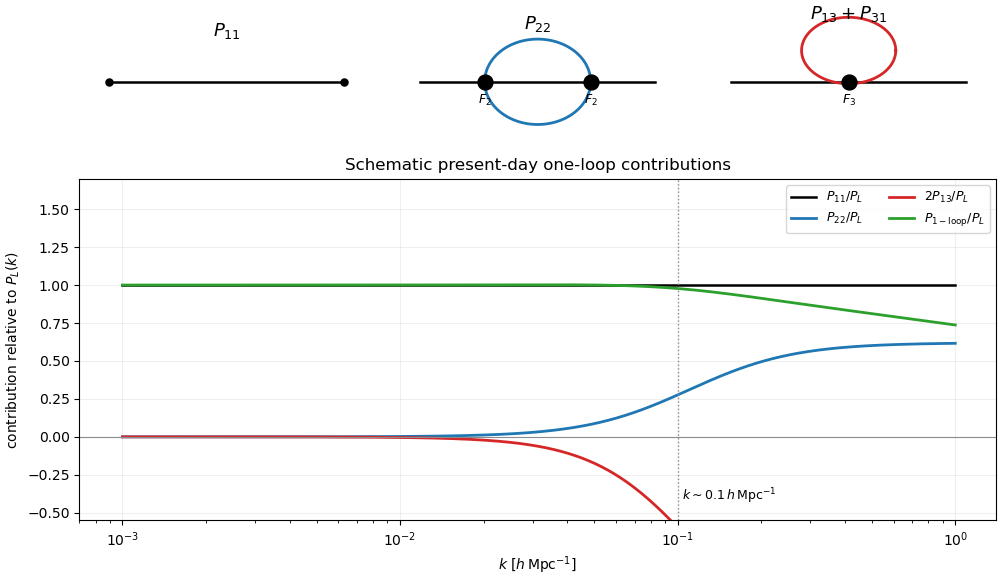

The effective field theory of large-scale structure supplements the one-loop prediction by the leading deterministic counterterm and a stochastic term,where the normalization scale may be absorbed into and mass and momentum conservation make at small . The ultraviolet part of the P13 contribution to the one-loop matter power spectrum hasIts cutoff dependence has exactly the form of the effective sound-speed counterterm in large-scale structure, so the running of cancels it. The stochastic and higher-derivative counterterms similarly absorb the allowed analytic ultraviolet dependence of and higher orders.
Conservation of tracer number under the map from the Lagrangian coordinate to the Eulerian position givesMatter conservation gives , and henceAt linear order, and thereforeThe Lagrangian-to-Eulerian linear bias relation is
In the absence of scalar anisotropic stress, the traceless spatial Einstein field equations giveThe photon mass-shell condition , together with and , gives to first orderUse the time component of the geodesic equation, divide it by , and substitute the stated Christoffel symbols. Keeping the perturbed ratios where they multiply the background terms makes those terms cancel. Comparing the result with the total derivative of yieldsThe first term is the time-dependent gravitational redshift and the second is the gravitational frequency shift along the photon direction.
Write the total derivative of the phase-space distribution function asSince is constant for the background photon gas, expand the Bose-Einstein distribution asAt first order the four terms are respectivelyThe angular-deflection velocity is already first order and multiplies the first-order angular dependence of , so its contribution is second order. Thus the collisionless left-hand side of the Free-streaming photon Boltzmann equation is
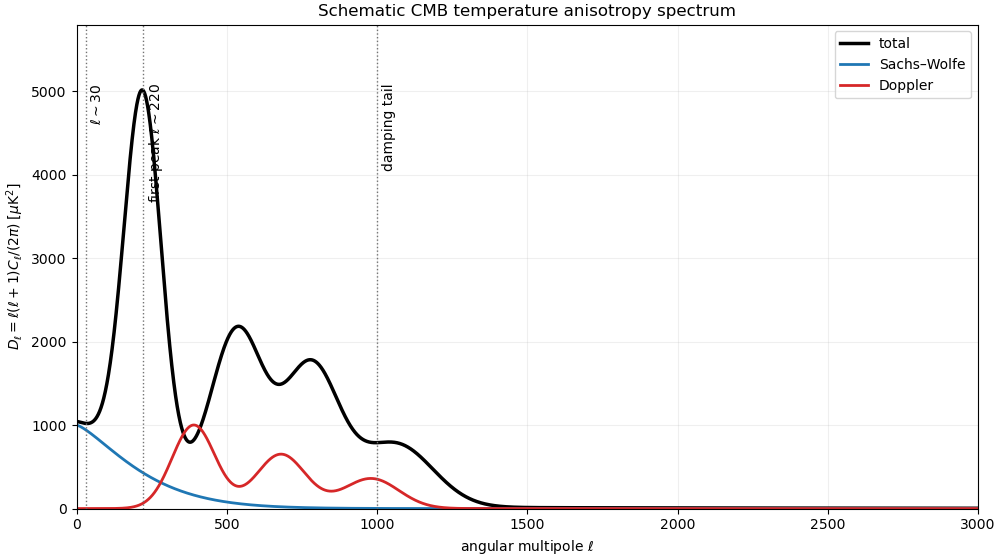

The conventional vertical variable is in , plotted against the dimensionless angular multipole . The Sachs-Wolfe effect supplies a nearly flat large-angle plateau for . The total spectrum has its first acoustic peak near with of order , followed by further Cosmic microwave background acoustic peaks; the Doppler CMB anisotropy is phase shifted relative to the photon-density oscillation. At , Cosmic microwave background diffusion damping lets photons random-walk across perturbations during recombination and produces the rapidly falling damping tail.
Articles by others on the same topic
There are currently no matching articles.