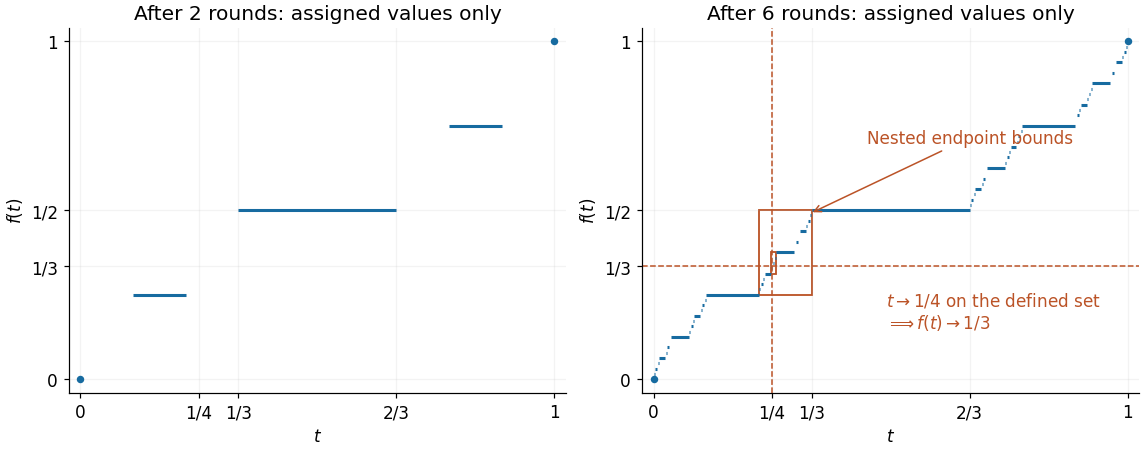
We give the explicit point . Repeatedly choose the left remaining third and then the right remaining third. After choices, the resulting closed interval is , whereThese formulas follow from a finite geometric series. They show , and that both endpoints tend to . The point is also strictly inside each intermediate left third: its distance from is one quarter of the current length. It therefore never enters any assigned closed middle third or its endpoints, so .
Endpoint values in the Cantor function construction obey the same left/right choices, with halving in place of thirding. ThusAll these endpoints are in the domain of the partial function: is the right endpoint of a middle third assigned at round , and is the left endpoint of a middle third assigned at round .
Given , choose so that , and put . If and , then . The assumed monotonicity givesConsequently . This proves directly, on the stated partial domain,There are defined points arbitrarily close to , for example and , so the limit of a function is not vacuous. No continuous extension has been assumed. The residual here omits the endpoints that the question assigns values to; it is the usual Cantor set with those assigned endpoints removed.

Articles by others on the same topic
There are currently no matching articles.