Solutions to all seven questions, including every optional question and all lettered and Roman subparts, of the examination sat on 22 June 2021.
True. Put , and . These suprema exist by completeness of the real numbers, since the sets are nonempty and bounded. Every set element of the union is at most , so is an upper bound. Conversely, every upper bound of bounds both and , and is therefore at least both suprema. Thus
True. Write and . Every , satisfies , giving an upper bound for the set of pairwise differences. For every , the definitions of supremum and infimum give and withThen . Hence no smaller upper bound works, andHere means pairwise subtraction, rather than set difference.
False. Take the finite sets . Their suprema are both , whereas the set of pairwise products is . ConsequentlyNegative factors can reverse an inequality, which prevents the proposed argument with separate suprema.
For the first sequence, . The squeeze theorem gives , and every subsequence of a convergent sequence has the same limit of a sequence. Thus its set of subsequential limits is .
For the second sequence, the four possible sine values giveThe even-indexed subsequence is constantly one, and , so both zero and one occur as subsequential limits. A convergent subsequence is bounded, so it contains only finitely many terms with . Of the remaining three residue classes, at least one occurs infinitely often. The corresponding further subsequence has limit of a sequence zero or one; the subsequence rule forces the original convergent subsequence to have that same limit of a sequence. Therefore the exact answer is . Divergence to along is not a finite subsequential limit.
The Bolzano-Weierstrass theorem states that every bounded sequence of real numbers has a convergent subsequence. It is enough to select infinitely many terms of the tangent sequence that stay uniformly bounded.
For each positive integer , choose , using the floor function. Then . Moreover , so these are strictly increasing indices. By the period and monotonicity of the tangent on ,Thus is a bounded subsequence. Applying the Bolzano-Weierstrass theorem to it gives a convergent subsequence, which is also a subsequence of the original sequence. Such a convergent subsequence therefore exists.
If , set . The definition of limit of a sequence gives for all sufficiently large , contradicting . Hence .
Factor the difference of cubes. Since both cube roots are at least one,Given , the definition of limit of a sequence supplies with for . The displayed inequality then gives , proving directly that .
Let . By the definition of Cauchy sequence, choose an integer such that whenever . Apply the given inequality with . It supplies for whichBoth and are in the Cauchy sequence estimate, soFor every the triangle inequality givesThis is the definition of convergence to zero: . The proof uses only the Cauchy sequence estimate, positivity, and the stipulated inequality; it does not assume the general completeness of the real numbers theorem for Cauchy sequences. Taking also avoids the empty initial set in a literal reading of the condition for very small .
Put for . The factorial givesThe logarithm identityfollows from continuity of the logarithm at one and . The product rule for limits of sequences therefore makes the displayed ratio tend to zero. In particular, some satisfies for all . By mathematical induction, . A geometric sequence with ratio in tends to zero, so the squeeze theorem proves
The sequence does not converge. For , the largest prime factor is , while the sum of prime factors with multiplicity is . This subsequence therefore has ratio .
There are infinitely many prime numbers: if there were only , a prime factor of would be absent from the list. Listing the prime numbers in increasing order gives a subsequence of indices for which , so the ratio is constantly one. Every subsequence of a convergent sequence has the same limit of a sequence. The two distinct subsequential limits rule out convergence.
A series converges if its partial sums have a finite limit of a sequence as ; its sum is then . It has absolute convergence if the series converges, where is the absolute value of the term.
Assume first that the original nonnegative series converges to . Its partial sums increase to . Write for the partial sums of the rearrangement of a series. Since is an injection, the indices are distinct, soThus is an increasing bounded sequence, and the bounded monotone sequence theorem gives .
For any fixed , surjectivity of givesFor , nonnegativity implies . Taking limits of sequences first in and then in gives . Hence .
Conversely, is a bijection, and the original series is the rearrangement of a series of defined by . The same argument proves its convergence whenever converges. Both series converge together, and their sums are equal.
In level , each group isand there are such groups. The partial sums at completed groups are therefore zero. Inside a group of level , the only other partial sums are and . Every level contains finitely many terms, so the level containing the th term tends to infinity with . Thus all partial sums lie between zero and a bound tending to zero. By the squeeze theorem, the series has sum .
For the next two parts, label the positive occurrences of size by and the negative occurrences of size by . There are exactly occurrences in and in . Occurrences with equal value retain separate labels, so checking their counts verifies a bijection of terms.
Place the single term in first. For in order, append copies of the pairThis uses all of and all of exactly once, so it is an explicit rearrangement of a series. Its beginning isEvery completed pair leaves the partial sum at . Within a level- pair the partial sum differs from by at most . As this tends to zero, proving that the rearranged series has sum .
Start with all of and , namely , whose sum is . For in order, append copies of the tripleThis uses all occurrences of and all occurrences of , exactly once. Together with the initial terms, every original occurrence is used, establishing a rearrangement of a series. Its beginning isEach triple has sum zero. At its intermediate terms the partial sum is at most above . This bound tends to zero, so the whole series, rather than just the subsequence of sums at completed triples, has sum .
A function is differentiable on if, for every , the finite limit of a functionexists. Here and is sufficiently small that . This limit of a function is the derivative of at .
The mean value theorem states: if a real-valued function is continuous on a closed interval , where , and differentiable on , then there is with
Take any . By differentiability implies continuity, is continuous on , and it is differentiable on . The mean value theorem gives for whichTherefore : is a nondecreasing function, which is the non-strict meaning of increasing here.
For any in the interval, the mean value theorem, applicable by differentiability implies continuity, givesAll pairs of values are equal. Thus , the constancy theorem.
Write the symmetric difference quotient as the average of two ordinary difference quotients:If is differentiable at , both terms tend to the derivative . Hence the symmetric derivative satisfies .
The absolute value function is continuous, and because . Its right one-sided derivative at zero is and its left one-sided derivative is , so it is not differentiable at zero. Away from zero it is differentiable, hence has a symmetric derivative there as well. This supplies an example meeting the hypotheses on, for example, .
We prove the symmetric derivative criterion for monotonicity using an antiderivative. Fix and defineThe fundamental theorem of calculus gives because is continuous. For each interior ,Since , the definition of symmetric derivative gives such that for . Therefore, for ,
We next show that is a convex function. On any closed interval let be the affine function joining to . If were positive anywhere, the extreme value theorem would give a positive maximum at an interior point . For every sufficiently small , that maximum would implyThe affine function contributes zero to this symmetric difference, contradicting the strict positive inequality above. Thus on every such interval, exactly convexity.
For a differentiable convex function, secant slopes bound endpoint derivatives. Explicitly, the chord inequality at and at , followed by , givesSo is nondecreasing. If for some , monotonicity would make constant on , forcing for , a contradiction. Consequently : is strictly increasing. This proof requires no continuity of and never applies the ordinary mean value theorem to a merely symmetrically differentiable function.
If there were no interior with , the symmetric derivative would be positive everywhere in . Part ii would make strictly increasing there. Choose . Continuity at the endpoints and monotonicity on the interior implycontradicting . Hence such an exists.
If there were no interior with , then everywhere. Apply the same argument to the continuous function , whose endpoint values are equal. This is again impossible. ThusThe two points need not be distinct.
The intermediate value theorem states that if is continuous and lies between and , inclusive, then some satisfies . If lies strictly between the endpoint values, then lies in .
For , choose , . For , define the continuous functionIts values at the grid points have the telescoping sumIf one summand is zero, we already have a zero of . Otherwise the summands cannot all have the same sign, so two of these values have opposite signs. The intermediate value theorem between their arguments gives with . Set , . ThenThis is the horizontal chord of reciprocal-integer length property; the telescoping sum explains why reciprocal integers appear.
An explicit piecewise linear function isThe adjacent formulas agree at and , so the function is continuous, and . Any pair of points at distance can be written with . For every such ,Thus their values are never equal. The horizontal chord of reciprocal-integer length conclusion does not extend to this distance.
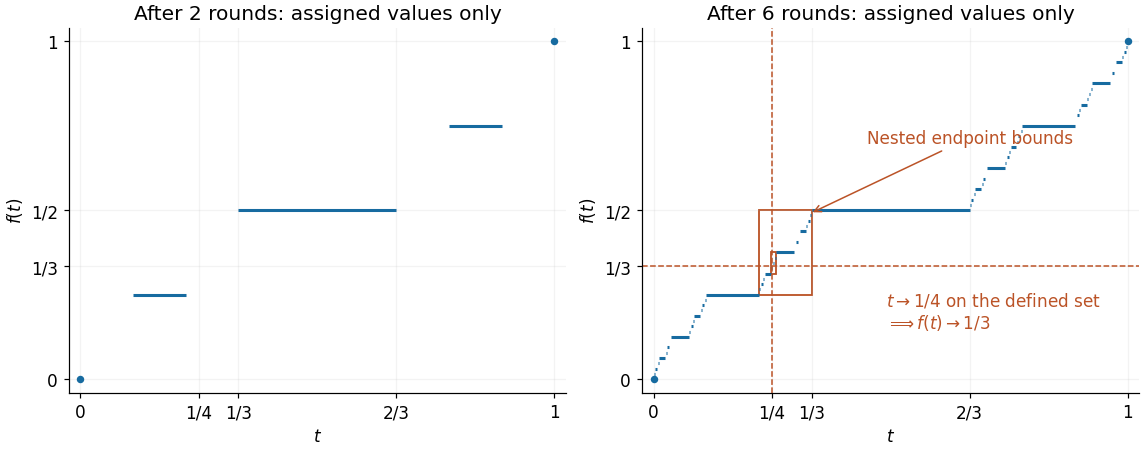
The construction is the partial middle-third construction of the Cantor function. After rounds of assigning middle thirds, every remaining open interval has endpoint valuesfor some , and every such consecutive pair occurs. This follows by mathematical induction. Initially the endpoint values are . An interval with those consecutive endpoint values receives the valueon its closed middle third. Its two remaining open intervals therefore have consecutive endpoint values at denominator . All previously assigned endpoint values persist. Hence all even numerators at the next denominator were already present, and all odd numerators have just been assigned. Including the initial values zero and one provesThese are precisely the dyadic rational values between zero and one.
We give the explicit point . Repeatedly choose the left remaining third and then the right remaining third. After choices, the resulting closed interval is , whereThese formulas follow from a finite geometric series. They show , and that both endpoints tend to . The point is also strictly inside each intermediate left third: its distance from is one quarter of the current length. It therefore never enters any assigned closed middle third or its endpoints, so .
Endpoint values in the Cantor function construction obey the same left/right choices, with halving in place of thirding. ThusAll these endpoints are in the domain of the partial function: is the right endpoint of a middle third assigned at round , and is the left endpoint of a middle third assigned at round .
Given , choose so that , and put . If and , then . The assumed monotonicity givesConsequently . This proves directly, on the stated partial domain,There are defined points arbitrarily close to , for example and , so the limit of a function is not vacuous. No continuous extension has been assumed. The residual here omits the endpoints that the question assigns values to; it is the usual Cantor set with those assigned endpoints removed.

Rolle's theorem states that a continuous function with , differentiable on , and satisfying has for some .
Fix and set . The functionis continuous and differentiable as required, and . By Rolle's theorem, some satisfiesSince , this gives . Multiplying by and adding one proves the strict square root bound
Apply Rolle's theorem on each . This gives ordered zeros of the derivative strictly between the original zeros of . Apply Rolle's theorem to between each consecutive pair of its zeros to obtain ordered zeros of . Continue in this way.
To justify the iteration, for , the derivative is differentiable throughout and hence continuous there by differentiability implies continuity. Every new closed interval lies strictly inside , so Rolle's theorem applies at each step. After steps there are zeros of . At this givesThis is the distinct-zero case of the Rolle root count with multiplicities.
Use the endpoint continuity of from part b, and interpret the displayed endpoint derivatives as one-sided endpoint values. Starting with , Rolle's theorem gives with . Since also , apply Rolle's theorem to on to obtain with . Repeating givesFor , the lower derivative is continuous in the interior by differentiability implies continuity, and at by the existence of its next one-sided derivative. At the final step, the stipulated continuity of on and its differentiability on give exactly the hypotheses of Rolle's theorem on . ThereforeThe endpoint regularity matters: merely assigning arbitrary values to at while prescribing only the interior derivatives would not justify the first application of Rolle's theorem.
The extreme value theorem gives finite real numbersSince these values are attained, the set of strict upper bounds in the definition of is precisely , and the set of strict lower bounds in the definition of is precisely . They are nonempty and bounded on the required sides. By the definitions of infimum and supremum,
A maximum or minimum can occur at an endpoint. The rule that a derivative vanishes at an extremum requires an interior extremum and differentiability there. The hypotheses give no two-sided derivative at the endpoints, and even an existing one-sided derivative need not vanish there.
For example, on has at and at , but at every interior point; its endpoint one-sided derivatives are also one. Its graph meets both horizontal bounding lines without being tangent to either. Thus the claimed conclusion about two zeros of the derivative fails.
There is a second logical issue: the argument never establishes two distinct extremizing points. For a constant function, the maximum and minimum coincide and may be represented by the same point. The constant function does have many stationary points, but that needs its own argument; it does not follow from counting the same selected point twice. In Rolle's theorem, equal endpoint values ensure an interior extremum when the function is nonconstant, which is the missing mechanism here.
Let be a bounded function, with . A partition of an interval is ; its mesh of a partition is . Choose arbitrary tags . The corresponding Riemann sum isThe Riemann sum convergence theorem says that is Riemann integrable with Riemann integral if and only if, for every , some satisfiesfor every partition of an interval with and every permitted choice of tags. Equivalently, along every sequence of such tagged partitions of an interval with mesh of a partition tending to zero, the Riemann sums tend to . Both the shrinking mesh of a partition and freedom of tags are essential.
SetThe points strictly increase from zero to . With , the given expression is exactly the midpoint Riemann sumfor the partition of an interval of . The sine argument is precisely the midpoint tag, since it is half the sum of the consecutive endpoints.
For a fixed integration interval , append and choose the final tag . The resulting Riemann sum satisfiesThis makes explicit the small final interval that the original sum omits.
We verify that the augmented partition of an interval in part i has vanishing mesh of a partition. Define for . Its derivative isSince for , we have . The mean value theorem therefore givesThe appended interval has length , so for the augmented partition of an interval.
The sine is continuous, hence Riemann integrable on . By the Riemann sum convergence theorem, , using the fundamental theorem of calculus and the cosine antiderivative. As , the answer is
The stated weighted inequality is the Jensen inequality for a concave function. Assume ; if , both sides of the required inequality are zero. Write with . Applying the weighted inequality at the two endpoints givesThus the affine function joining the endpoint values lies below . By monotonicity of the Riemann integral,This is the lower bound in the Hermite-Hadamard inequality for a concave function.
For , choose the uniform partition of an interval into pieces and its midpoint tagsTheir arithmetic mean is exactly . Apply the given Jensen inequality with equal weights :Multiplying by gives a midpoint Riemann sum on the left. Its mesh of a partition is , so the Riemann sum convergence theorem givesFor the equality is immediate. Together with part i, this is the Hermite-Hadamard inequality with the directions appropriate to a concave function.
Articles by others on the same topic
There are currently no matching articles.