The intermediate value theorem states that if is continuous and lies between and , inclusive, then some satisfies . If lies strictly between the endpoint values, then lies in .
For , choose , . For , define the continuous functionIts values at the grid points have the telescoping sumIf one summand is zero, we already have a zero of . Otherwise the summands cannot all have the same sign, so two of these values have opposite signs. The intermediate value theorem between their arguments gives with . Set , . ThenThis is the horizontal chord of reciprocal-integer length property; the telescoping sum explains why reciprocal integers appear.
An explicit piecewise linear function isThe adjacent formulas agree at and , so the function is continuous, and . Any pair of points at distance can be written with . For every such ,Thus their values are never equal. The horizontal chord of reciprocal-integer length conclusion does not extend to this distance.
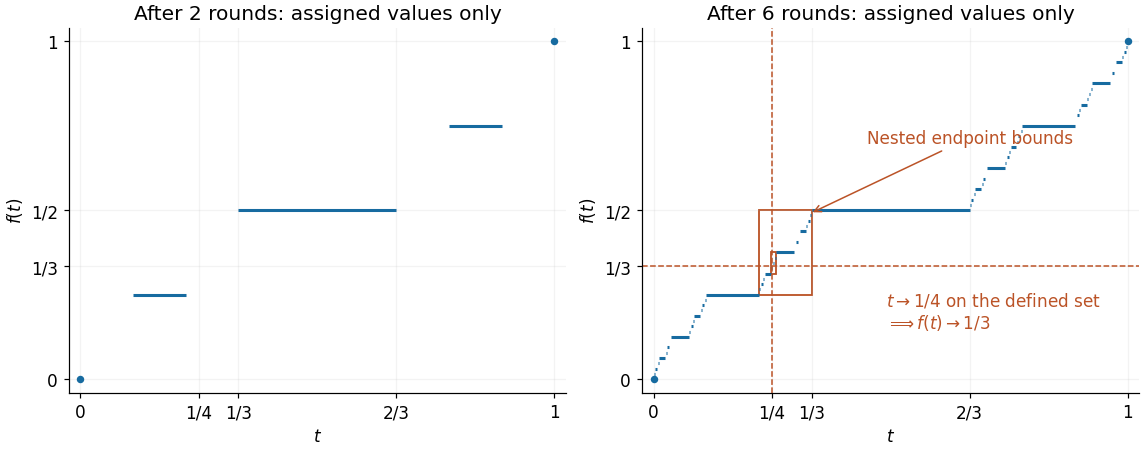
The construction is the partial middle-third construction of the Cantor function. After rounds of assigning middle thirds, every remaining open interval has endpoint valuesfor some , and every such consecutive pair occurs. This follows by mathematical induction. Initially the endpoint values are . An interval with those consecutive endpoint values receives the valueon its closed middle third. Its two remaining open intervals therefore have consecutive endpoint values at denominator . All previously assigned endpoint values persist. Hence all even numerators at the next denominator were already present, and all odd numerators have just been assigned. Including the initial values zero and one provesThese are precisely the dyadic rational values between zero and one.
We give the explicit point . Repeatedly choose the left remaining third and then the right remaining third. After choices, the resulting closed interval is , whereThese formulas follow from a finite geometric series. They show , and that both endpoints tend to . The point is also strictly inside each intermediate left third: its distance from is one quarter of the current length. It therefore never enters any assigned closed middle third or its endpoints, so .
Endpoint values in the Cantor function construction obey the same left/right choices, with halving in place of thirding. ThusAll these endpoints are in the domain of the partial function: is the right endpoint of a middle third assigned at round , and is the left endpoint of a middle third assigned at round .
Given , choose so that , and put . If and , then . The assumed monotonicity givesConsequently . This proves directly, on the stated partial domain,There are defined points arbitrarily close to , for example and , so the limit of a function is not vacuous. No continuous extension has been assumed. The residual here omits the endpoints that the question assigns values to; it is the usual Cantor set with those assigned endpoints removed.

Articles by others on the same topic
There are currently no matching articles.