For the Fourier cosine series, integration by parts givesand, for ,Only odd Fourier harmonics remain, so
For the Fourier sine series, another integration by parts givesConsequentlyAt and , the Fourier sine series instead has value zero.
To describe the requested graphs precisely, take congruent to modulo . The Fourier cosine series converges to the continuous triangular periodic extensionIts minima occur at the even multiples of , with value , and its maxima at the odd multiples, with value . The Fourier sine series converges toThe jump discontinuities at even multiples of go from to ; those at odd multiples go from to . Each jump is assigned its midpoint, zero, by the Fourier series.
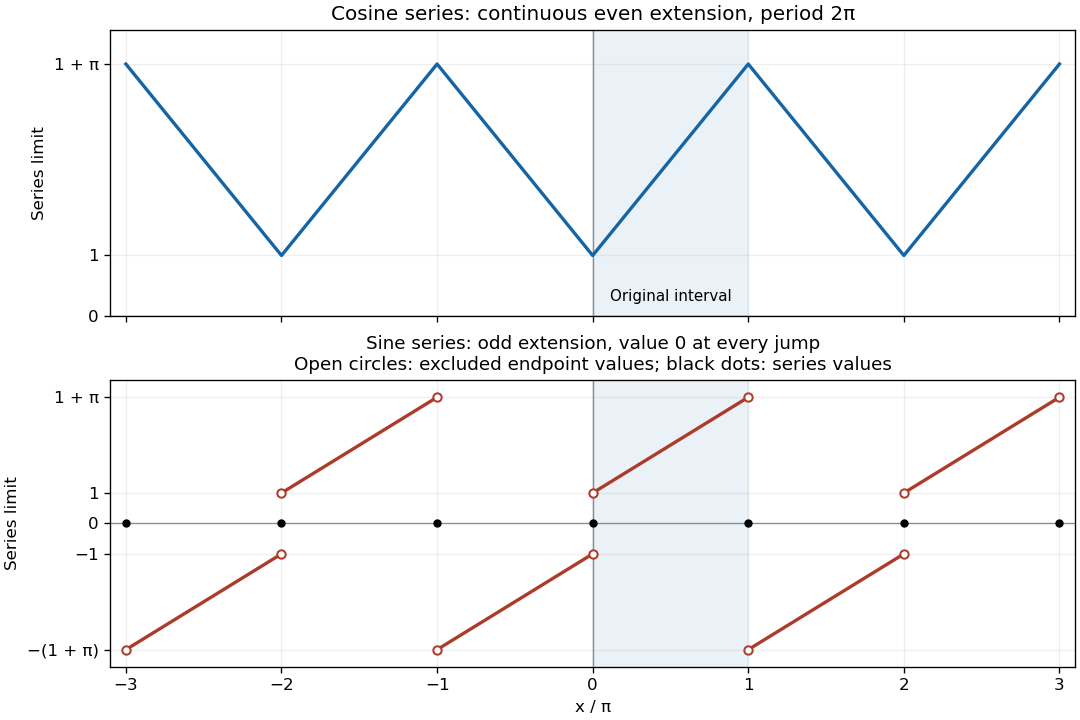

The truncated Fourier cosine series gives the better approximation on the closed interval, in the senses of uniform convergence and the asymptotic L2 norm error. To make the comparison precise, let and retain the frequencies , with the constant term also included in .
The cosine Fourier coefficients are . In fact, absolute convergence gives the uniform tail boundFor the Fourier sine series, every Fourier partial sum satisfies . Thusso there is no uniform convergence to on the closed interval. Its odd extension has jump discontinuities, producing the Gibbs phenomenon near the endpoints; its Fourier coefficients decrease only like .
The advantage persists in the L2 norm, which ignores individual endpoint values. By Parseval's identity and Fourier orthogonality,The nonzero odd cosine coefficients and both parity classes of sine coefficients also give matching lower bounds of these orders by comparison with the corresponding p-series. Hence their L2 norm errors decrease respectively like and . This is a comparison of approximation quality in specified norms, not a claim that one finite sum has smaller error at every individual interior point.
Articles by others on the same topic
There are currently no matching articles.