For and , the zero-endpoint Dirichlet boundary conditions select the Fourier sine basis functions . Separation of variables gives temporal factors with angular frequencies . Zero initial displacement removes the temporal cosine terms, givingDifferentiating at and using Fourier orthogonality givesThe evaluation property of the given initial velocity means in the sense of a Dirac delta, an idealized impulsively struck fixed-end string. Thus : every even mode vanishes, while the lowest two excited modes have . Their ordinary frequencies and amplitude ratio areThe signed coefficient ratio is . The impulse solution is interpreted as a distributional weak solution, rather than one with a smooth initial velocity.
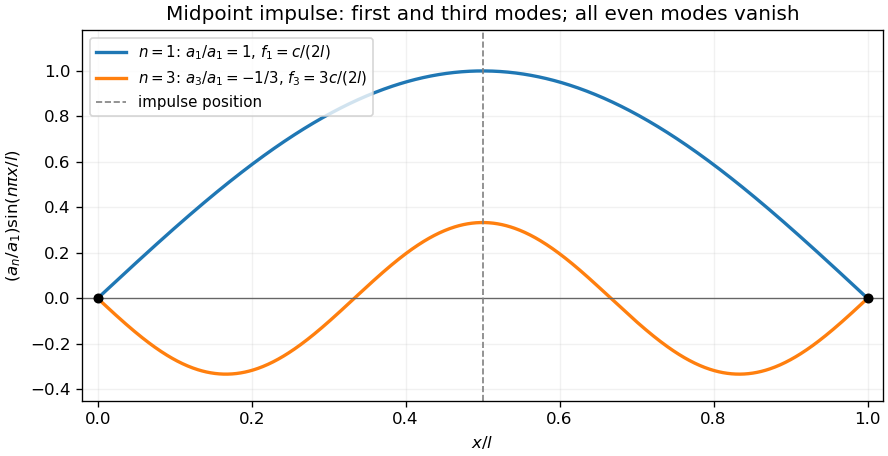
The two lowest string modes excited by a midpoint velocity impulse, with their signed relative amplitudes
. Details. 
For a separated harmonic function , Laplace's equation gives . Bounded periodic dependence in has ; decay on each half-plane selects for , when the potential is matched continuously at the sheet. These are the separated decaying modes. General decaying solutions can be superpositions of them; decay alone does not force a single value of .
The prescribed cosine density selects and . Its normal derivative jump is . Matching the stated jump givesThis is the gravitational potential of a sinusoidal sheet in the normalization of the question. It is continuous at the sheet and decays on both sides. Since changes sign, it can physically describe a Fourier component of a density perturbation rather than an everywhere positive isolated mass sheet.
Articles by others on the same topic
There are currently no matching articles.