The dot product is , and both vectors have length . The angle between vectors therefore satisfies , giving
The integrand is an odd function, because is odd and is even. Its integral over the symmetric interval is therefore
The denominator is positive away from the origin. The partial derivatives areThey both vanish exactly onThese are lines of stationary points, with values and , respectively.
Multiply numerator and denominator by the complex conjugate of :Thus the real part and imaginary part are respectively
The proposed function has partial derivatives and . Substitution in the heat equation requires , henceThe coefficient remains arbitrary.
Within this polynomial family, already holds and gives . Thus one solution isTwo specified point values alone do not give uniqueness among all solutions of the heat equation.
For a uniform distribution on the unit square, probability is the ratio of areas. The incircle has radius , so
Conditioned on being inside the circle, the point is a uniform random point in a disk of radius . The annulus from to has area . Dividing by the disk's area givesThe radial probability density function is on and integrates to one. Without conditioning, the corresponding annulus probability for a point in the original square is .
Write . At an intersection, , so its scalar triple product with vanishes. The expression in the question is exactlyUnder a shift of origin by , the direction vectors stay fixed, while both change by . Thus and the condition are invariant. For nonparallel lines this is also sufficient for intersection; for parallel lines it only asserts coplanarity and need not imply intersection.
Put and . Then and . Bilinearity of the cross product givesThe tetrahedron volume is one sixth of the absolute value of this triple product. Sliding either vertex pair along its line preserves or , because its separation is fixed and the direction vectors are fixed. Thus the volume is unchanged, including the zero-volume coplanar case. This is tetrahedron volume under sliding opposite edges.
Every set of students is equally likely to be the specified college. There are choices in total and choices consisting entirely of the specified group. Therefore the hypergeometric distribution gives
Choose students from the lazy students and from the other . Dividing by the total number of possible college memberships givesThe assumptions ensure all these values are possible. This sampling is without replacement, as required by the hypergeometric distribution.
By symmetry, each student in the university has probability of being in the college and then selected. Hence the prior probability is
The lecture attendances are independent Bernoulli trials with success probability . Their count has the binomial distribution:
Here “absent” denotes absence at both observed lectures. The assumed independence makes its conditional probability
The prior probability is . Using Bayes' theorem, the posterior probability after two absences isThus the probability rises from 10% to about 73.5% within the assumed attendance model. Two absences are 25 times as likely under the lazy model, overcoming the prior odds of ; they still do not make the classification certain.
The integrand is even and decays at both infinity and zero, since . On set , a strictly increasing bijection onto the whole real line. ThenUsing evenness for the negative half-axis givesThe second summand is an integrable odd function, so its integral vanishes. The remaining Gaussian integral givesFor the second integral use separately on each half-axis. The factor becomes , and reversing the transformed limits yields . ThusThese identities are instances of the Gaussian integral with an inverse-square term. Splitting at zero before either change of variables avoids treating a discontinuous transformation as a single bijection.
The characteristic equation gives complementary terms . A linear particular solution is , since its substitution gives . The initial conditions give and , hence
The complementary characteristic roots are . Substituting into the differential operator gives , so a particular solution is . The initial conditions then require and , giving
The repeated characteristic root is , matching the exponential forcing. Put ; then , so . The zero initial conditions give , henceThe extra quadratic factor is the resonance associated with the double root.
Put and . For , differentiation gives and therefore . The Korteweg-De Vries equation reduces toSince is nonconstant, both coefficients must vanish. Thus the nonzero solitary wave isThere is also the trivial solution , for which has no effect. The negative amplitude follows from the minus sign of the nonlinear term; it agrees with the sech-squared solitary wave of the KdV equation.
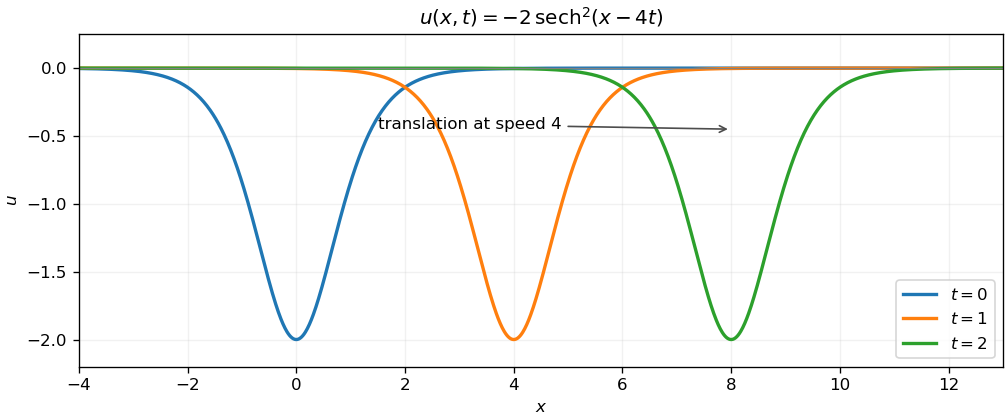
A negative solitary wave translates to the right without changing its profile
. Details. 
Differentiate the equation for with respect to , commuting mixed partial derivatives for a sufficiently smooth solution. With this givesThis is the viscous Burgers equation when .
For , the chain rule gives and . ConsequentlyThusThis is the potential form of the Cole-Hopf transformation, with . For it is a forward diffusion equation; at the exponential transformation is undefined, while negative gives a backward heat equation.
Integrating the first component in gives . Matching the second requires , so . Matching the third gives . Thus the field is conservative, with scalar potentialDirect differentiation verifies on all of .
The curl is , which is not identically zero. A gradient of a smooth scalar potential has zero curl, so is not conservative on .
On the first segment, , so both line integrals vanish. On the second, , giving contributions and . On the last, , the contributions are and . ThereforeThe first also equals , as the fundamental theorem for line integrals predicts.
The parametric curve runs from to , with . Substitution into the two line integrals givesHenceThe first is unchanged because the field is conservative. The two different answers for the second exhibit its path dependence, consistent with its nonzero curl.
The permutation matrix acts by . Applying this cyclic permutation three times returns every vector to itself, proving . Explicitly and multiplication once more gives the identity matrix.
With , the characteristic polynomial factors into , up to the overall sign convention. The eigenvalues are and . Integer values require an odd integer satisfying . The positive integer factorization forces andThe resulting eigenvalues and corresponding nonzero eigenvectors areAny nonzero scalar multiple is equally valid. The factorization also shows that no other positive integer works.
For , is real symmetric. Sylvester's criterion says that all eigenvalues are positive exactly when its leading principal matrix minors are positive. These are , , and . ThereforeAt either endpoint one eigenvalue is zero, so the strict positivity requirement excludes it.
Every harmonic in this Fourier series has period . Since the first-harmonic coefficient is nonzero, the fundamental period cannot be smaller: translating by a period must multiply that nonzero complex coefficient by . Thus, taking ,
Write . For the partial sum , ordinary multiplication givesOn , the integrals of every nonconstant sine or cosine vanish. Fourier orthogonality further gives and the same identity for two sines, while every sine-cosine integral is zero. ThusFor square-integrable , its Fourier partial sums converge to in L2 space, so their squared norms converge to the squared norm of . Passing to the limit proves Parseval's identity:Working with finite partial sums before taking the norm limit avoids an unjustified interchange of an infinite double series and integration.
Articles were limited to the first 100 out of 113 total.
Articles by others on the same topic
There are currently no matching articles.