Put and . The gradient components are and . If either or vanishes, both must vanish. Otherwise both squared coordinates must be one. Therefore the five stationary points in the original coordinates are
At the Hessian matrix is , with eigenvalues and , so is a saddle point. At the other four points the mixed second derivative vanishes and the two diagonal entries both equal . HenceThe four extrema are global: because each factor has maximum at absolute argument one.
The zero level set consists of the lines and . The height is positive where and negative where that product is negative. In each of the four resulting regions, closed nonzero contours surround its extremum; levels closer to zero extend further from the extremum towards the zero-level axes and towards large distance. The height tends to zero at infinity. The figure marks the four extrema and central saddle point, and includes the downhill path used below.
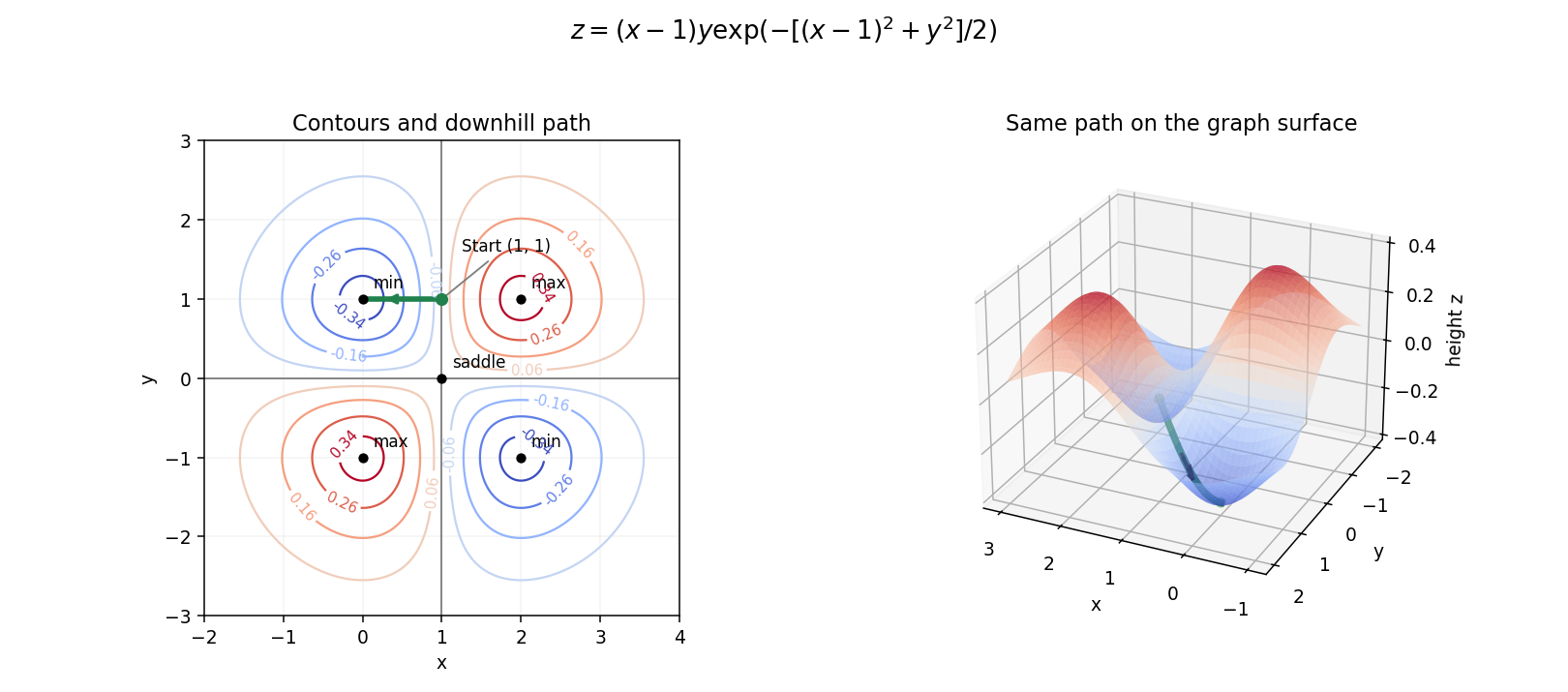
Contours, stationary points and the steepest downhill path on the Gaussian-weighted surface
. Details. 
For the graph surface , an upward normal is . At , let ; then and . Normalizing gives the unit normal vectorIts negative is the equally valid downward normal.
A tangent displacement has the form . At the specified point, and , so the fastest decrease of height per unit surface distance has and . The unit downhill tangent is . Therefore, for speed measured along the surface,Its Euclidean norm is , and it is orthogonal to the surface normal. The general construction is steepest descent on a graph surface; using a horizontal speed equal to would overestimate the full three-dimensional speed.
The horizontal direction of steepest descent on a graph surface is parallel to . On the line , the component vanishes identically, so that line is invariant under the downhill path. Starting at , for , so decreases towards zero. The path reaches the minimumAt the minimum no strictly downhill direction remains. A constant-speed parametrization reaches it after the finite arc length divided by ; the unnormalized gradient flow approaches the same endpoint only asymptotically in its own time parameter.
Articles by others on the same topic
There are currently no matching articles.