If , the equation would imply , contradicting the assumed nonparallel directions. Hence . Then and force . This proves that the two vectors are linearly independent.
The function is an odd function, since is even and the sine is odd. Its integral on the symmetric interval therefore cancels:
Zero is an eigenvalue exactly when the determinant vanishes. Here , soFor either value the other eigenvalue is two, as follows from the trace.
Factorization gives , so the zeros are and , with a double root at two. The derivatives are and . ThusThe second derivative changes sign at one, confirming the inflection point. The curve rises from , crosses at , reaches its local maximum, falls to touch the axis at two, then rises to . Neither local extremum is a global extremum on the whole real line.
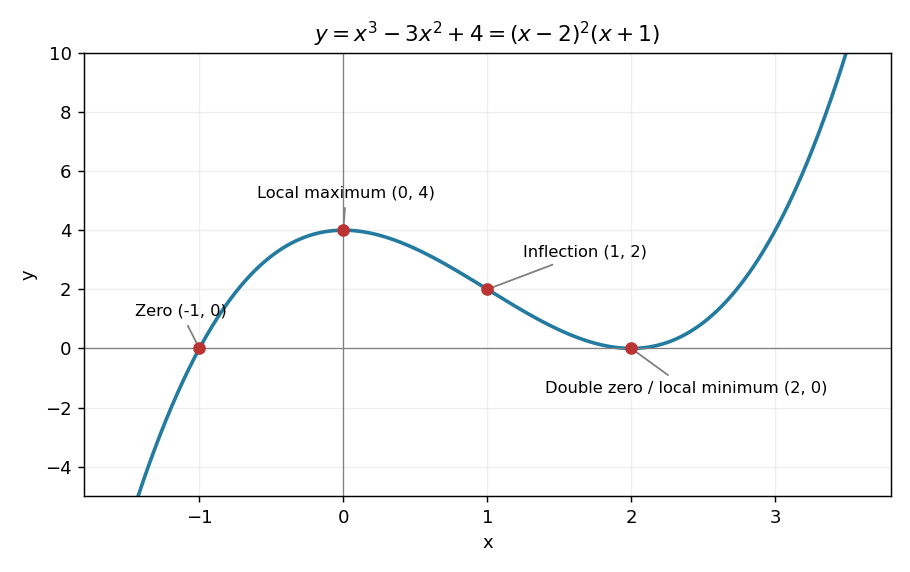
Zeros, two stationary points and an inflection point of the cubic
. Details. 
Expanding gives , so and . Hence , proving that it solves the one-dimensional wave equation. Equivalently its two summands are oppositely travelling profiles, as in D'Alembert's formula.
The logarithm must be expanded about two, not about one. FactorApplying the supplied logarithm expansion to the bracket gives . Thus, through second order,In fact the cubic coefficient vanishes, since and the second term is even; the Maclaurin series remainder can be sharpened to .
The inequality is equivalent to . The cosine exceeds close to zero and , and is less than close to . Within the specified interval this givesThe four equality angles are excluded because the inequality is strict; zero and satisfy it and are included.
For , the exponential power series gives the normalization of the Poisson distribution:For , the limiting law assigns probability one to and zero to every positive integer . Negative would not define the stated probability distribution.
The direction vector is . The vector equation and symmetric Cartesian equation of the line areThe -plane has , which gives . Thus its intersection with the line has position
The plane normals are and . Their cross product is , perpendicular to both normals and hence parallel to the intersection line. Setting in both equations gives the common point . ThereforeThe normals are not parallel, so their intersection is a unique line.
From the line point to , take and line direction . Orthogonal projection gives the nearest parameter . The perpendicular displacement has squared Euclidean normHence the distance from a point to a line in three dimensions isThe nearest point is ; subtracting it from gives a vector orthogonal to , verifying the minimum.
The characteristic equation is , whose roots are . For distinct real roots, ; at the repeated-root threshold , . In the complex-root case put to obtainThis is precisely the oscillatory regime of the damped harmonic oscillator. The zero solution is of course nonoscillatory; the regime describes its nontrivial motions.
The damped angular frequency is . The oscillation envelope is proportional to . A decrease by a quarter leaves three quarters of the original amplitude, so . ThereforeThis concerns the envelope; it does not ask when the instantaneous displacement first equals three quarters of a chosen value.
Let , with . A particular solution of the forced harmonic oscillator is . Substitution gives and , hence and . Adding and imposing the two initial conditions gives and . ThusThe first term tends to zero. The amplitude of the surviving sinusoid isAs an independent interpretation, the residual amplitude of an oscillator after an integrable force is . Here that integral is , giving the same result.
Put and . The gradient components are and . If either or vanishes, both must vanish. Otherwise both squared coordinates must be one. Therefore the five stationary points in the original coordinates are
At the Hessian matrix is , with eigenvalues and , so is a saddle point. At the other four points the mixed second derivative vanishes and the two diagonal entries both equal . HenceThe four extrema are global: because each factor has maximum at absolute argument one.
The zero level set consists of the lines and . The height is positive where and negative where that product is negative. In each of the four resulting regions, closed nonzero contours surround its extremum; levels closer to zero extend further from the extremum towards the zero-level axes and towards large distance. The height tends to zero at infinity. The figure marks the four extrema and central saddle point, and includes the downhill path used below.
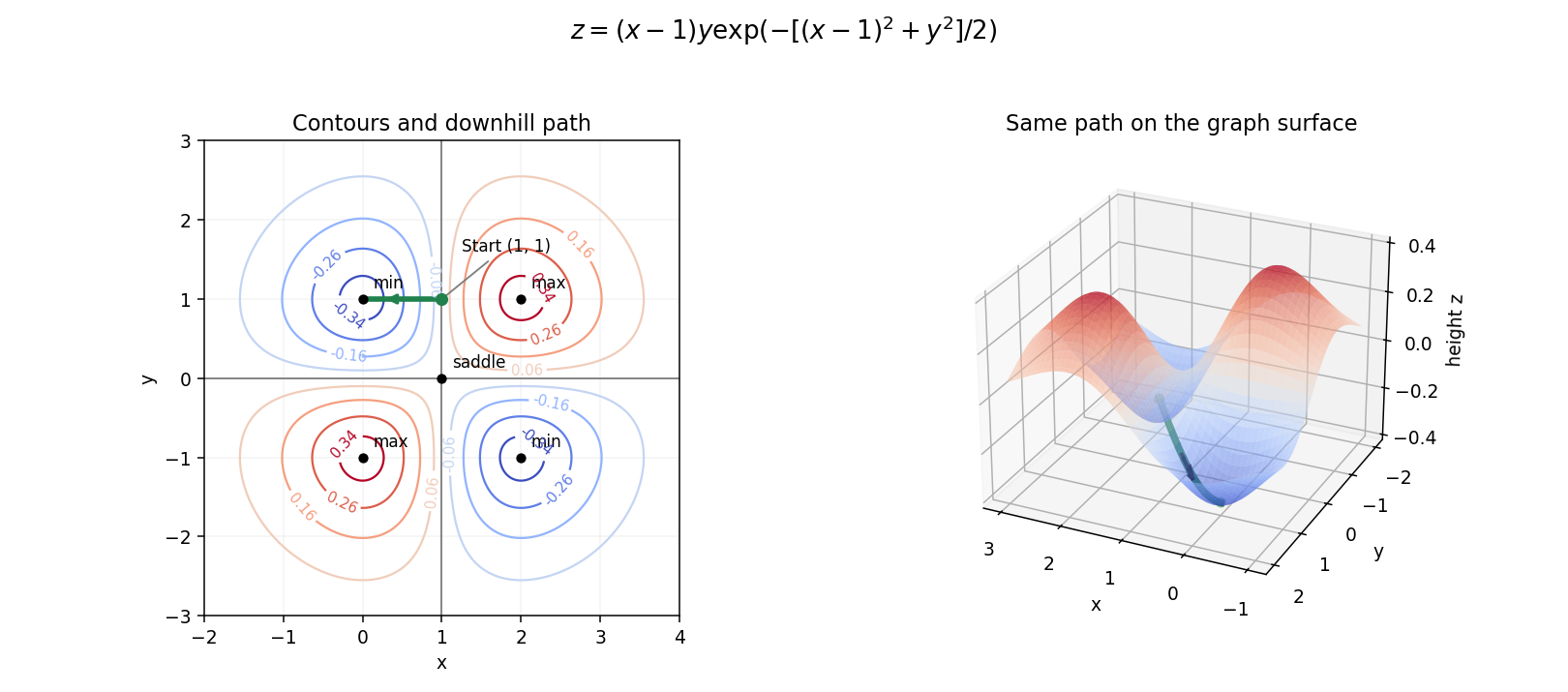
Contours, stationary points and the steepest downhill path on the Gaussian-weighted surface
. Details. 
For the graph surface , an upward normal is . At , let ; then and . Normalizing gives the unit normal vectorIts negative is the equally valid downward normal.
A tangent displacement has the form . At the specified point, and , so the fastest decrease of height per unit surface distance has and . The unit downhill tangent is . Therefore, for speed measured along the surface,Its Euclidean norm is , and it is orthogonal to the surface normal. The general construction is steepest descent on a graph surface; using a horizontal speed equal to would overestimate the full three-dimensional speed.
The horizontal direction of steepest descent on a graph surface is parallel to . On the line , the component vanishes identically, so that line is invariant under the downhill path. Starting at , for , so decreases towards zero. The path reaches the minimumAt the minimum no strictly downhill direction remains. A constant-speed parametrization reaches it after the finite arc length divided by ; the unnormalized gradient flow approaches the same endpoint only asymptotically in its own time parameter.
The cofactor matrix is . Transpose it to form the adjugate matrix, and divide by the determinant :Direct matrix multiplication gives , checking all entries.
A homogeneous square linear system has a nonzero solution exactly when its coefficient matrix is singular. HereThusFor this value, the second equation gives and the first gives ; the third then holds automatically. All solutions are , with for the nonzero ones.
The coefficient matrix is a Vandermonde matrix, with determinantTherefore a nonzero solution exists exactly whenFor example if , the first two columns are equal and is a solution. If exactly two parameters agree, the distinct remaining column is independent of the repeated one, so the kernel has dimension one. If all three agree, only remains, giving a two-dimensional kernel.
Use the real Fourier series convention for period two. Since is an even function, , and . Twice applying integration by parts, with , givesHenceThe periodic extension is continuous at its endpoints, so the series takes the specified endpoint values as well as the interior values.
Again the function is even, so all sine coefficients vanish. Its constant term is . With , an antiderivative isThus . In the requested factored notation,This is the period-two specialization of the Fourier series of periodic hyperbolic sine and cosine. The function values match at the endpoints, although its derivative has a jump in the periodic extension.
For , the chain rule gives , with analogous formulas for the other components. HenceOn the right the numerator denotes the position vector, while its denominator is the cube of its magnitude.
The vector is constant, so . Also , by the same chain rule. The product rule therefore yieldsThe three components follow by differentiating .
For constant , the curl of a cross product identity reduces toCommuting mixed second partial derivatives gives . Hence the requested sum equals , which is zero because is harmonic. The argument assumes the indicated second derivatives are continuous on the domain.
From the preceding gradient, . Summing the three Cartesian second partial derivatives givesThus the reciprocal radius is harmonic away from the origin. Its negative gradient isThe curl vanishes because is a gradient field and mixed second derivatives commute. The exclusion of the origin is essential: the potential and field are singular there.
For a continuous random variable with probability density function , its expected value and variance areThe mean requires an integrable first absolute moment, and a finite variance requires a finite second moment. When these hold, .
Take and substitute . The density becomes the standard Gaussian distribution density . Its normalization follows from the supplied Gaussian integral after scaling by . Since is an integrable odd function, its integral is zero, and therefore .
For the second moment, . Integration by parts givesThe endpoint term vanishes by Gaussian decay. Consequently
The conditional probability product rule gives . Applying it once more givesThe conditionals in the original expression require their conditioning events to have positive probability.
The events and form a partition. The law of total probability therefore givesAs written, both conditionals require nonzero conditioning probabilities.
The numerator equals , while . Thus, wherever the original quotient is defined,In particular a zero numerator and denominator cannot be cancelled; the original expression requires . This is the rearrangement of Bayes' theorem.
Under a uniform shuffle, every unordered five-card hand is equally likely, giving possible hands. Choose the triple's rank in 13 ways and its suits in ways; then choose a different pair rank in 12 ways and its suits in ways. Each full house determines these choices uniquely, so there is no further ordering factor. ThereforeThe count uses binomial coefficients because the order of cards within a hand is irrelevant.
Articles were limited to the first 100 out of 118 total.
Articles by others on the same topic
There are currently no matching articles.