Write for the mean in minutes. An exponential distribution with that mean has rate , so its probability density function isThe density has units of inverse minutes, ensuring that its integral is a dimensionless probability.
Take on the horizontal axis and on the vertical axis, both nonnegative. There is no interruption when the noise occurs after the scheduled ending, namely . This is the part of the first quadrant above the diagonal . Equality has probability zero, so assigning the boundary either way does not affect the calculation.
The same original diagram below also marks the region used in part (e); its lower boundary offset is an illustrative positive choice of .
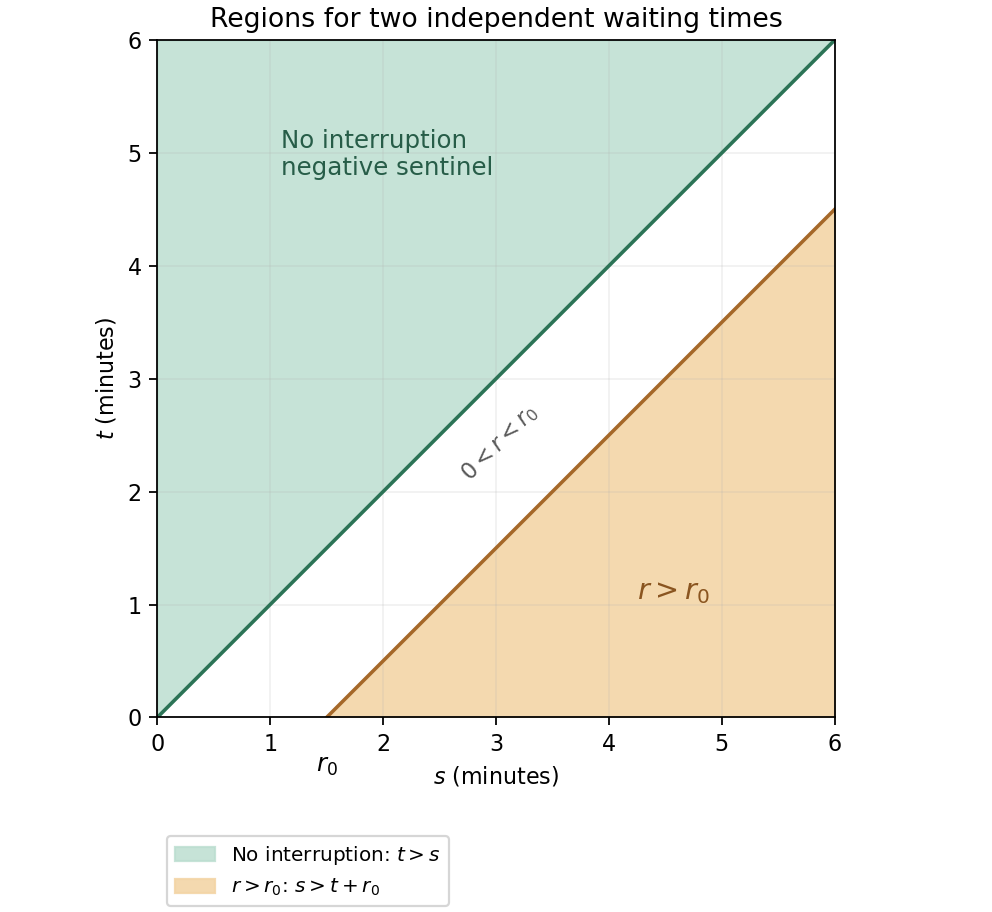
The no-interruption region above the diagonal and the region of positive remaining time exceeding a chosen threshold
. Details. 
For a small rectangle of side lengths , independence makes its probability approximately . Thus the joint probability density function is the productAdding the probabilities of disjoint small rectangles covering a region of integration, and taking their sizes to zero, gives the double integral of this product over that region. Without independence, the two marginal distributions alone would not determine the joint probability density function.
Integrate over the region :ThereforeThis is also the two-clock case of competing exponential clocks. A larger mean time to noise increases this probability, while a larger mean service length decreases it.
On interrupted outcomes, ; on the other outcomes the sentinel value is negative and cannot exceed . ConsequentlyOn the diagram in part (b), this is the first-quadrant region below , starting at the horizontal intercept . It lies strictly inside the interruption region .
Use the lower limit for the inner integral:HenceThe prefactor is the probability that interruption occurs; the remaining exponential is its conditional positive tail. This is the positive difference of independent exponential waiting times. The exponent is dimensionless because both and are measured in minutes.
As , the exponential factor tends to zero, so . Requiring an arbitrarily large amount of remaining time must have vanishing probability for this finite-mean distribution.
When , the prefactor is . Therefore as . The clocks then have identical independent continuous laws, so either is equally likely to finish first. A tie has probability zero. The limit is the interruption probability, rather than one, because non-interrupted outcomes retain the negative sentinel value.
The time already elapsed since the noise is minutes. Conditional on a particular noise time and on still being in progress, memorylessness of the exponential distribution givesThis law does not depend on . Averaging over the conditional distribution of therefore leaves the same remaining-time law. HenceThe elapsed minutes are not subtracted from the original mean; the exponential residual lifetime has the same mean after any elapsed duration.
Articles by others on the same topic
There are currently no matching articles.