Collect the coefficients of the three unknowns in rows. The linear system has matrix formThe next two parts solve this same system by the two requested methods.
Use Gaussian elimination on the augmented matrix. First take and , then :By back substitution, the last row gives , the second gives and hence , and the first gives . ThusThe right-hand side has been transformed in every row operation, preserving the solution set.
Choose Cramer's rule, the permitted alternative to finding an inverse. The determinant isReplacing each column by the right-hand side givesConsequentlyThe nonzero determinant also proves uniqueness.
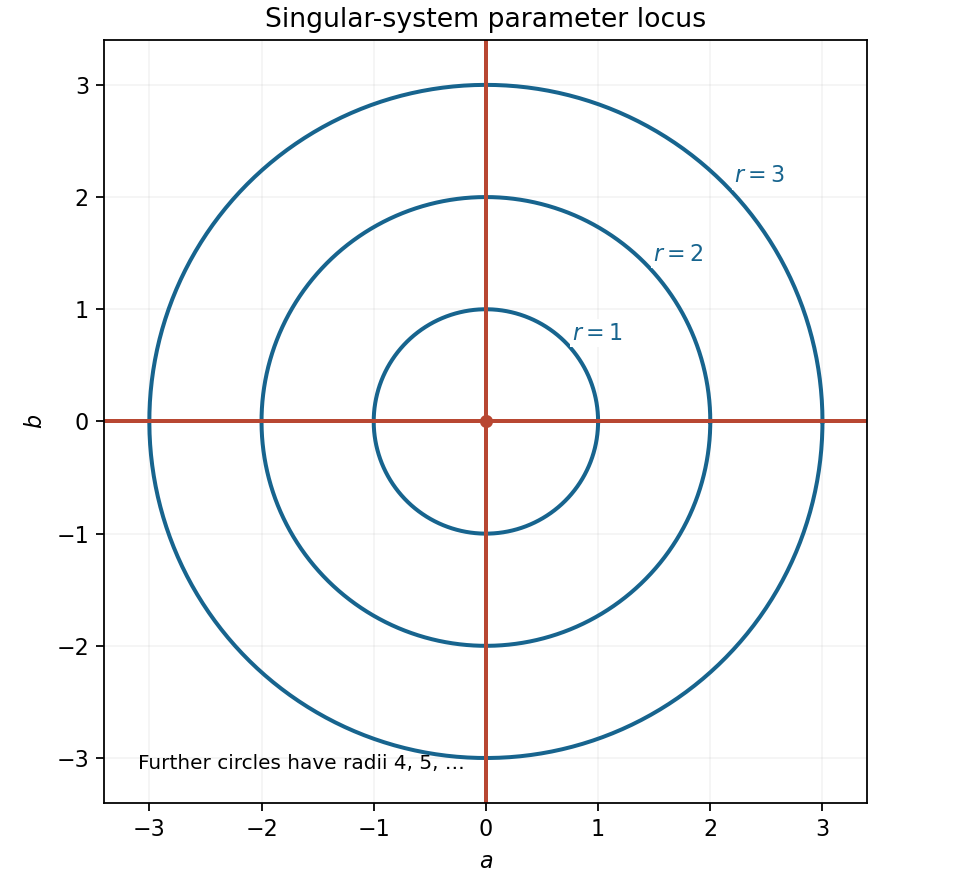
The square roots simplify to the absolute values and . Put . A nontrivial solution of the homogeneous linear system exists exactly when its coefficient matrix is singular:The second factor vanishes precisely when , or , giving both coordinate axes. The first factor vanishes when is a nonnegative integer. Hence the complete locus isThese are the two axes together with concentric circles of positive integer radii. The zero-radius case is the origin, already included on the axes; at that point both equations vanish and any nonzero pair works.

Articles by others on the same topic
There are currently no matching articles.