With the standard real normalization, the Fourier series of a period- function iswhereFor the partial sum , Fourier orthogonality eliminates all cross terms. The constant term contributes , while every squared sine or cosine integrates to , givingFor a square-integrable function, completeness of the trigonometric orthogonal basis in the Hilbert space makes in norm. Passing to the limit proves Parseval's identity:Square integrability is the needed hypothesis here; periodicity alone is not an integrability or convergence condition.
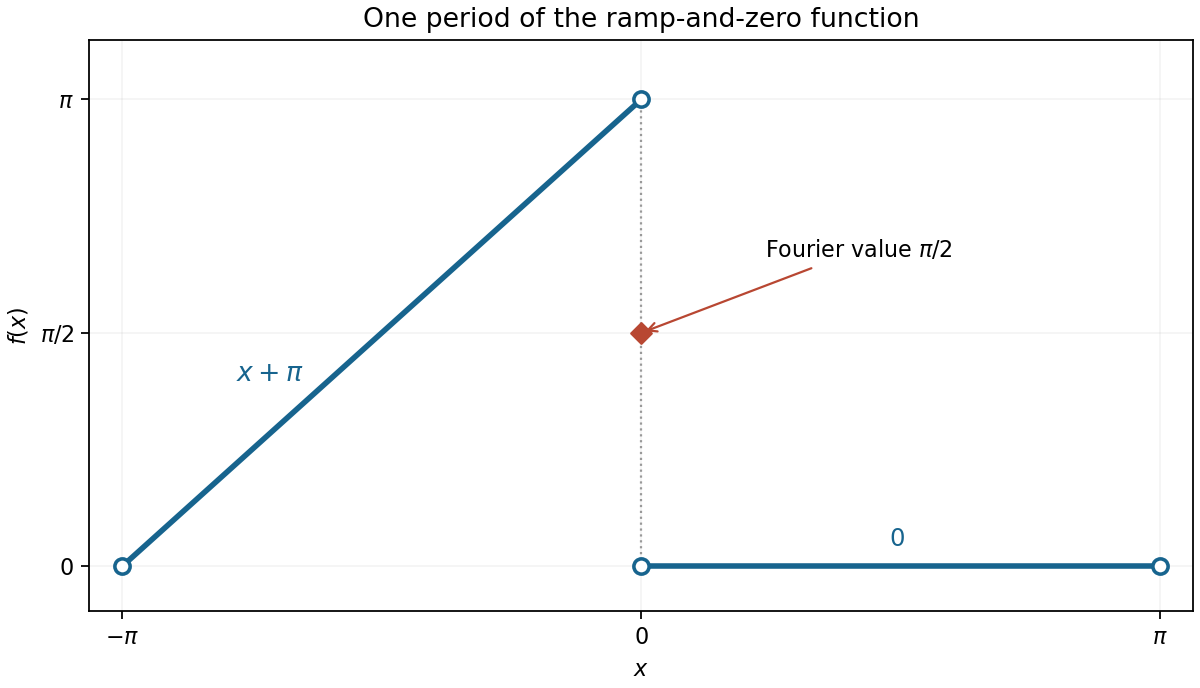
Over one period, the graph rises linearly from the limiting point to , then drops to zero and stays there up to . Repeat this pattern every . The given open endpoints do not fix values at the jumps, but changing individual point values does not change any Fourier coefficient.
Only the negative half-interval contributes. The constant coefficient isFor , integration by parts givesandConsequently the requested Fourier series isIt equals the given function on each open continuity interval. By the Dirichlet-Jordan convergence theorem, at it takes the jump midpoint , while at it takes zero because the periodic one-sided limits agree there.

Articles by others on the same topic
There are currently no matching articles.