The gradient equations factor asFor they give . Otherwise , which gives and the matching . Thus there are exactly four stationary points.
The Hessian matrix isAt it is , and at it is . At and its determinant is . The second-derivative test therefore yieldsThe extrema are local: along the cubic is unbounded both above and below.
The partial derivatives give and . If either coordinate is zero, both vanish. Otherwise substitution gives , so the real stationary points are , and .
The Hessian matrix isAt the origin its eigenvalues are and , so it is a saddle at level zero. At either of the other points its eigenvalues are and , so both are strict minima at level . In fact,with equality only at those two points. HenceFor levels , two separate closed contours surround the two minima. At the contours form two lobes, in the first and third quadrants, meeting at the origin. Their limiting tangent directions there are the coordinate axes because the leading term is . On the diagonal the outer zero-level points are . Positive levels form one closed outer contour enclosing both wells; there are no contours below . The graph is symmetric under exchanging and under reversing both signs, but not under a quarter-turn. These features are the case of the quartic double well with bilinear coupling.
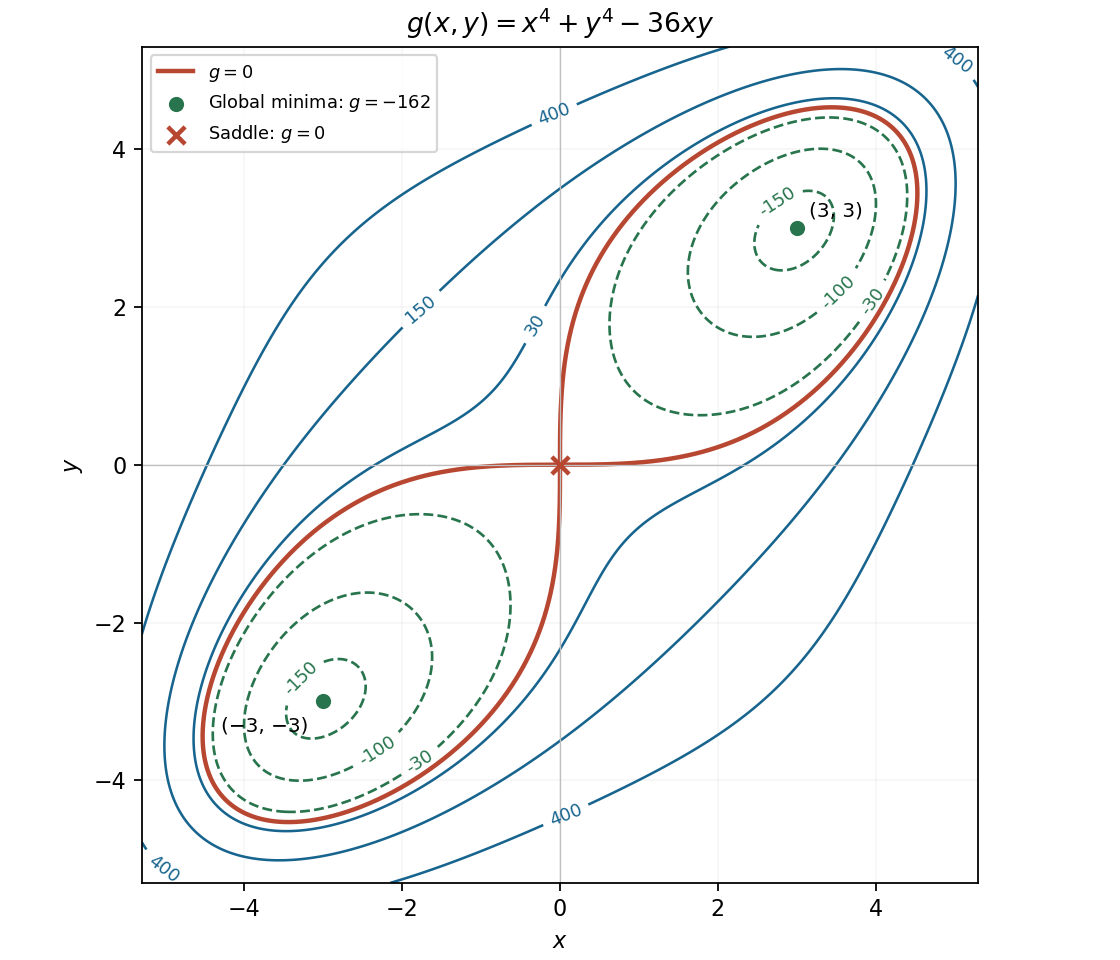
The quartic function's two minima, saddle, and transition from two contour loops to one
. Details. 
Articles by others on the same topic
There are currently no matching articles.