Let mean control-group membership and the adverse event. Equal allocation gives , so the law of total probability gives . Bayes' theorem then givesThis is defined when . If both are zero, the conditioning event has zero probability and the stated conditional probability is undefined.
Normalize the Rayleigh distribution by substituting :For its sketch, the density starts at zero, is positive for , and tends to zero at infinity. Differentiation givesIt therefore has a single maximum at , with height .
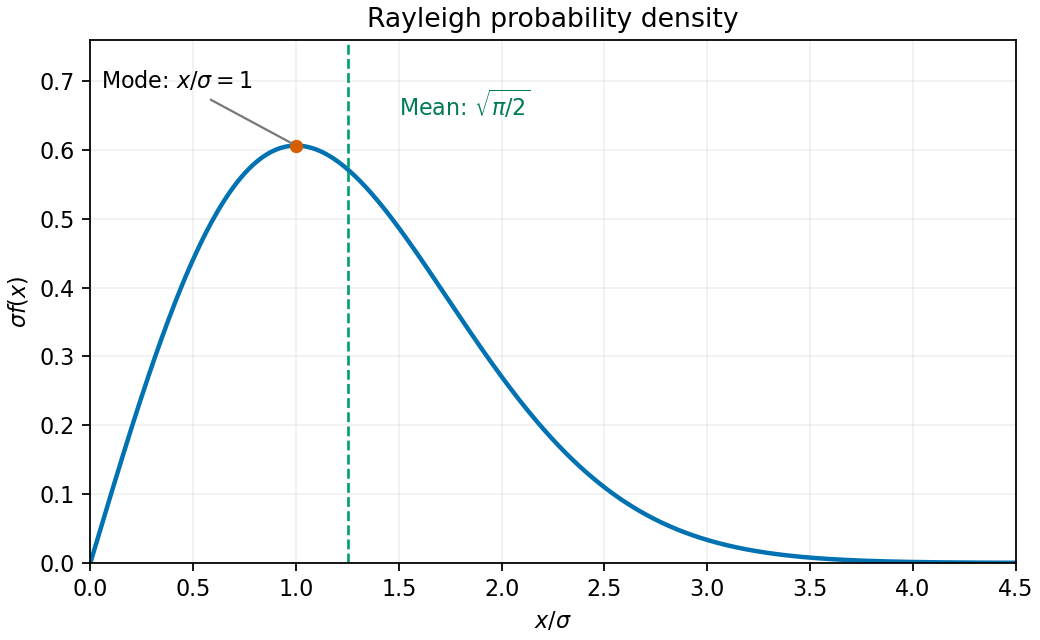

The expected value isIntegrating by parts with makes the boundary term vanish and leaves . The Gaussian integral gives
Use the usual model of independent games, each with Sheila-win probability . After games, an outcome with wins and losses has possible orders. Since both totals are below eleven, none of those sequences has already ended the match. ThusFor a completed Sheila win with losses, the last game must be her eleventh win. The preceding games contain ten wins and losses, so their probability is , followed by one further factor . The allowed loss counts are , and these terminal events are disjoint. HenceThis is the match win probability with a fixed winning score, obtained by the negative binomial stopping argument. Constant marginal game-win probabilities alone would not justify the product without the usual independence assumption.
Articles by others on the same topic
There are currently no matching articles.