A uniform distribution has constant density on its support, fixed by normalization. ThusThe density's assigned values at the endpoints do not affect probabilities.
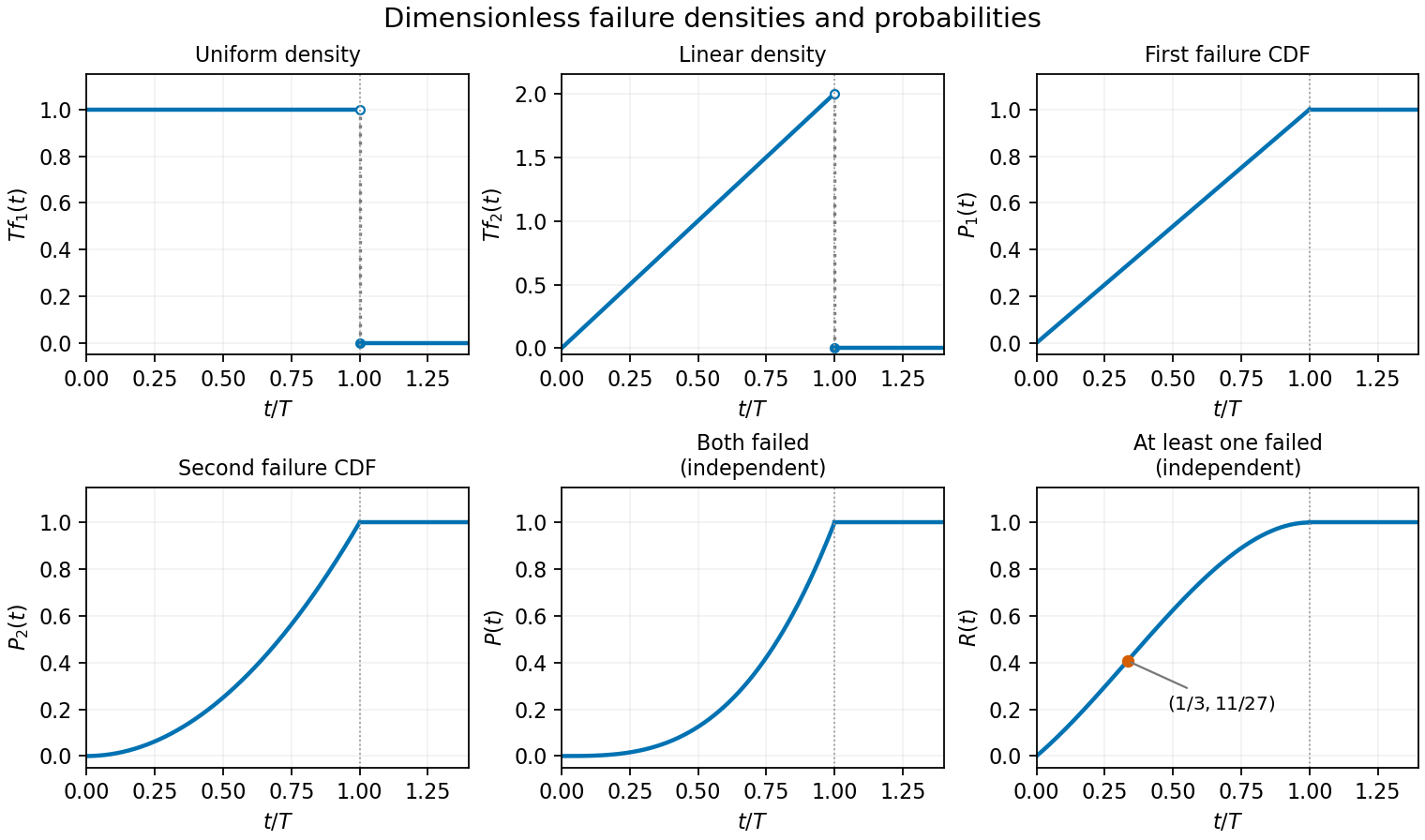
Normalization requires . ThereforeThe graph rises linearly from zero to the left-hand limit , then drops to zero beyond . Its enclosed triangular area is one. The combined sketch in (f) uses dimensionless time and shows this density together with the cumulative probabilities.
Integrating the first probability density function gives the cumulative distribution functionIts graph is a straight ramp from to , followed by a horizontal plateau.
The second cumulative distribution function is the integral of its density:Its graph is an upward-curving parabolic arc from to , followed by a horizontal plateau. Both cumulative functions are continuous at their upper support endpoints.
The product formula requires independent failure times. This assumption is not stated in the original PDF. Under that intended assumption, put and use the failure probabilities for two independent lifetimes:Its graph is a cubic increasing from to , convex before reaching its plateau.
Without independence, the marginal distributions do not determine . The Fréchet inequalities give the sharp pointwise boundsFor example, taking and with the same uniform random variable preserves both prescribed marginals but gives , rather than .
Under the same independence assumption, inclusion-exclusion givesOn ,There is one interior inflection point, where the curvature changes from positive to negative:At the graph reaches one with zero slope and then stays constant. There is no further change from one sign of curvature to the opposite sign there.

Without independence, still holds, but only is forced by the marginals. Its inflection behaviour is then not determined. The shared- construction in (e), for example, gives before the plateau.
Articles by others on the same topic
There are currently no matching articles.