The cross product of the two in-plane directions is , with Euclidean norm . Either sign gives a unit normal vector:The plane equation is , so the distance from a point to a plane gives
Write . Its three roots have modulus and arguments , with . Thus all three complex roots areFurther integer values of repeat these roots.
The Taylor series of the logarithm givesThe first nonzero term is therefore . It is positive on either side of the origin, so the stationary point is a strict local minimum. In fact , with equality only at zero, making it the global minimum as well.
The characteristic polynomial is . For the components are equal; for they are opposite. After normalization, the eigenvalues and associated eigenvectors areAn overall sign change of either normalized eigenvector is equivalent.
Taking each partial derivative of the scalar potential givesThe factor in the middle component comes from the chain rule. The potential is smooth, so the curl of a gradient identity gives .
Each Cartesian component of contributes to the divergence, while the constant vector contributes zero. Hence
On , an integrating factor is . Multiplication gives , so the general solution is . The initial value forces . Therefore
The divergence is . In spherical coordinates, the angular integral is and the volume element contributes . Thus
The original PDF contains the product ; the transcription drops the after the first sine. Using gives the finite Fourier sine seriesThus , , and all other sine coefficients vanish. No cosine or constant terms are present.
The number of tails has a binomial distribution. The complement of at least two tails consists of zero tails or exactly one tail. Therefore
Equating the three Cartesian components givesThe first and third equations yield and , hence , . They also satisfy the middle equation, so the intersection is
Set . Taking the dot product of the vector equation with givesHere and , so . Substitution then givesGeometrically the possible vector must lie on the line , and the scalar constraint picks one point. Equivalently the rank-one matrix update is invertible because . This is the nonsingular case of solvability of an affine rank-one vector equation.
The original PDF has here; the transcription loses its minus sign. Now and , so the scalar condition becomes and leaves arbitrary. ConsequentlyThe solution set is a straight line parallel to , equivalently the intersection of and .
For the geometric mechanism, let . Since , , , and . Thus is an oblique projection onto the plane along . The specified lies in this image plane, and adding any multiple of the kernel direction leaves its image unchanged.
Geometrically the image of is still the plane , while this is outside it. Thus the failure is inconsistency, rather than a unique solution with a singular denominator.
Orient the common axis of the wedge faces along and its azimuthal bisector along positive . Reflection symmetries give . In spherical coordinates, use , , and . The volume isSince , the first moment isDividing by the volume locates the centre of mass:This is the centroid formula for a spherical wedge.
For the sketch, is positive and decreases from to , with . Indeed, on putting , the sign of is the sign of . The negative of this expression has derivative for and starts at zero, proving strict decrease.
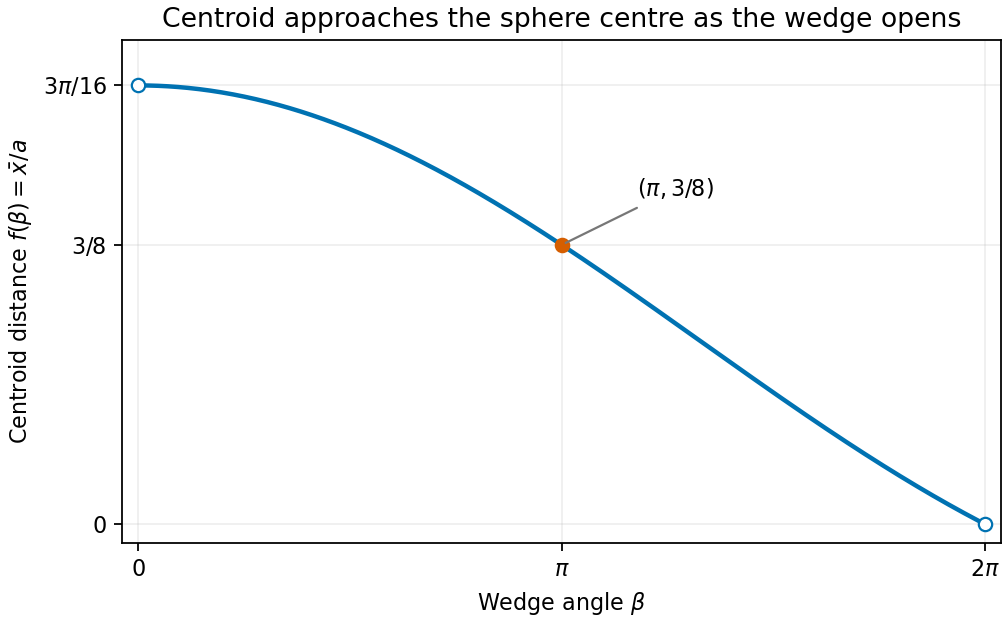
Use the same axes as in (a) and choose the outward orientation. On the curved spherical lune, and . Its vector area isThe and components cancel. The component is , henceHere points along the azimuthal bisector; another coordinate choice rotates this vector accordingly. Its magnitude is the signed projected area, not the scalar curved area . Reversing the orientation reverses its sign.
The curl of the first vector field iswhich is not identically zero. Thus is not conservative on and cannot equal a negative gradient there.
For the second field, direct differentiation showsTherefore is conservative, and the requested negative-gradient potential isIts curl vanishes, consistently with the curl of a gradient identity.
On the first straight segment, and only is nonzero, so both integrals vanish. On the second segment, and only is nonzero; each integrand is one, contributing . On the last segment, and only is nonzero; each integrand is , contributing . ThusThe second result also follows from the fundamental theorem for line integrals, using the potential found in (a). Agreement on this one path does not make conservative.
Parametrize the diagonal by for . ThenThe second expression is , immediately giving . The first differs from it by . Two applications of integration by parts giveHenceThe changed value for explicitly demonstrates path dependence, while gives the same endpoint-dependent result.
A uniform distribution has constant density on its support, fixed by normalization. ThusThe density's assigned values at the endpoints do not affect probabilities.
Normalization requires . ThereforeThe graph rises linearly from zero to the left-hand limit , then drops to zero beyond . Its enclosed triangular area is one. The combined sketch in (f) uses dimensionless time and shows this density together with the cumulative probabilities.
Integrating the first probability density function gives the cumulative distribution functionIts graph is a straight ramp from to , followed by a horizontal plateau.
The second cumulative distribution function is the integral of its density:Its graph is an upward-curving parabolic arc from to , followed by a horizontal plateau. Both cumulative functions are continuous at their upper support endpoints.
The product formula requires independent failure times. This assumption is not stated in the original PDF. Under that intended assumption, put and use the failure probabilities for two independent lifetimes:Its graph is a cubic increasing from to , convex before reaching its plateau.
Without independence, the marginal distributions do not determine . The Fréchet inequalities give the sharp pointwise boundsFor example, taking and with the same uniform random variable preserves both prescribed marginals but gives , rather than .
Under the same independence assumption, inclusion-exclusion givesOn ,There is one interior inflection point, where the curvature changes from positive to negative:At the graph reaches one with zero slope and then stays constant. There is no further change from one sign of curvature to the opposite sign there.
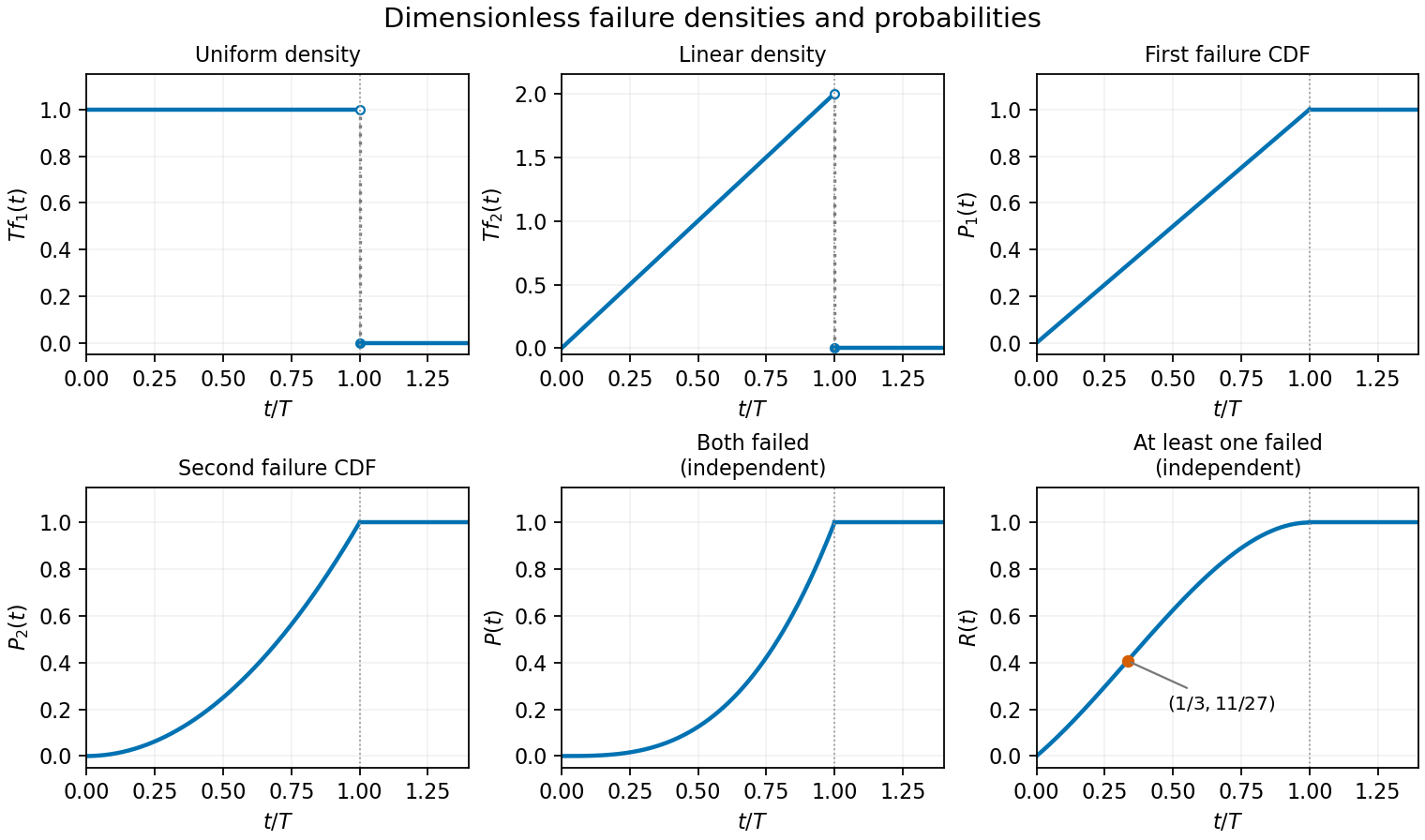
Without independence, still holds, but only is forced by the marginals. Its inflection behaviour is then not determined. The shared- construction in (e), for example, gives before the plateau.
The characteristic equation has roots , and a trial multiple of gives the particular solution . ThusThe first two conditions give and , hence . At , the exponentials equal . ThereforeNo solution satisfies all three conditions. The first two initial data already determine a unique solution of the second-order linear differential equation; the extra condition is inconsistent with it.
Use the same general solution. The first two conditions now give and , so , . HenceAt , its value is , so the third condition is also satisfied. This is the unique consistent solution.
The repeated factor in the differential operator suggests . Direct differentiation gives , so andThe first value gives . The second gives , hence and . Therefore
For a continuously differentiable differential one-form, exactness requires . It is locally sufficient, and globally sufficient on a simply connected domain; on a domain with holes, closedness alone need not imply exactness.
An integrating factor for a differential one-form depending only on must satisfyThus, where ,If the ratio depends only on , this defines a nonzero factor and makes it a closed differential form, hence locally exact. For a factor depending only on , the analogous calculation givesprovided the ratio is a function only of on the region where . A nonzero constant multiple of either factor works equally well.
Write the equation as , with and . Thenso a suitable integrating factor is on either half-line. For example, on the resulting exact form isHence the solution, written to cover either sign of , isThe original equation remains meaningful at , where it requires . Only gives a finite differentiable extension across zero, namely .
Here and . Their derivatives giveThus on intervals with , choose the integrating factor . The multiplied form isConsequentlyThis implicit family includes and the branch when . Where the coefficient of is nonzero, its differentiated form directly recovers the original equation. A useful equivalent relation is . At , the original equation requires ; continuation there must be checked in that original equation rather than justified by the singular integrating factor. In particular the zero solution extends everywhere, and extends smoothly across the cosine zeros where it is defined.
Put , so . On an interval with , substitution and cancellation giveSince , no constant- solution is lost when separating. Integrateto obtainAfter restoring , a local implicit general solution isThe inverse tangent is chosen continuously on a solution branch. Using the continuous polar angle of extends the expression to charts through when the original equation permits it. A differentiable graph cannot pass through , because there the original equation would require .
An eigenvalue equation has the form , where is an eigenvector and its eigenvalue. It means that the linear map preserves the vector's line and acts there by multiplication by . Nonzero solutions occur precisely when ; the zero vector is excluded because it would satisfy the equation for every .
Each proposed displacement has second derivative . Matching the coefficients of the common time factor in the three equations givesThese algebraic relations hold for the entire oscillation, including the isolated times when the common cosine vanishes.
With , the eigenvalue equation isThe dimensionless matrix is the stiffness matrix divided by ; its eigenvalues determine squared angular frequencies.
Expanding the determinant along the first row givesThe eigenvalues and normalized spatial eigenvectors, in increasing frequency order, areFor each mode both signs of give the same cosine displacement. An arbitrary overall mode amplitude remains free. These vectors are the instances of the sine eigenvectors of the fixed-end spring chain.
The pairwise dot products of the normalized vectors areTheir squared norms are respectively , , and , all one. Hence they form an orthonormal basis. This also follows from the spectral theorem for real symmetric matrices, because is symmetric and its three eigenvalues are distinct.
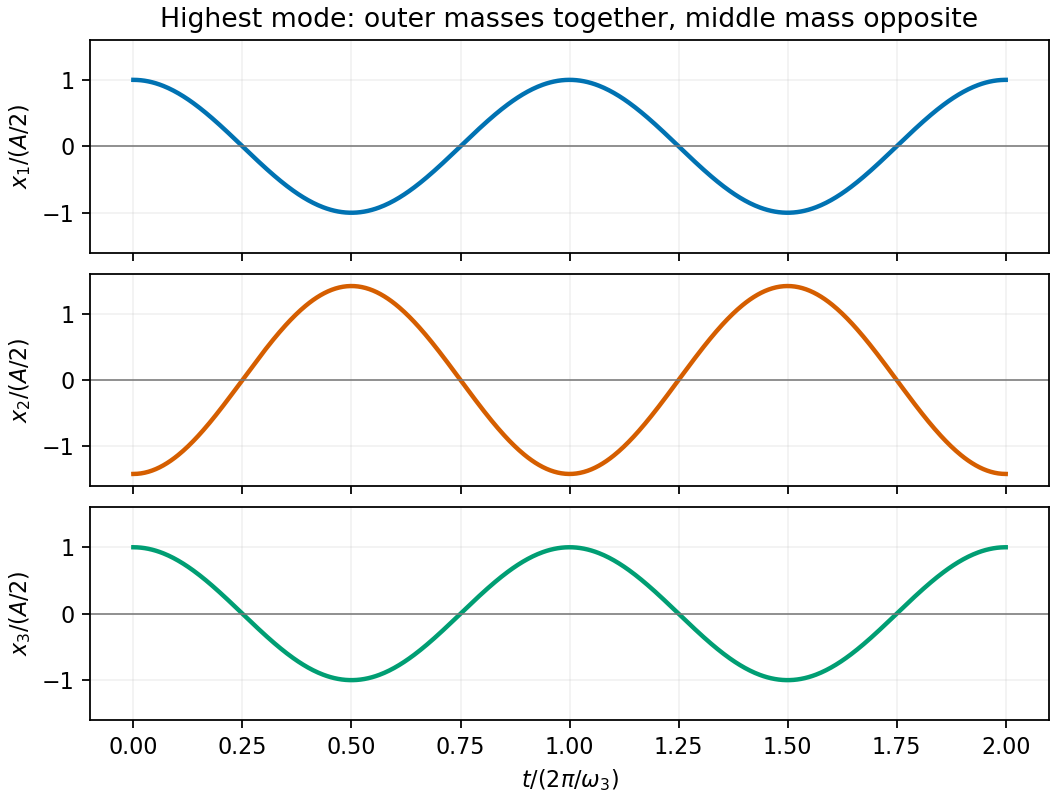
The largest angular-frequency magnitude is . With overall amplitude , the corresponding displacements areThus the two outer masses move together, while the middle mass moves oppositely with times their amplitude. All three have the same period .


The sine and cosine functions are orthogonal over a complete period. For positive integers ,while every mixed sine-cosine integral and every integral of a nonconstant single harmonic is zero. These identities follow from the product-to-sum formulas and the integer-period endpoint values.
Multiply the Fourier series by and integrate. All terms except vanish, giving . Repeating with sine isolates . ThusIntegrating without a harmonic also gives . The factor on the constant term in the chosen convention is essential.
Put , so the nonzero half-cycle is . The constant coefficient isThe sine coefficients satisfyby sine orthogonality. For the cosine coefficients, the product-to-sum identity gives, when ,The case is zero directly. HenceThe first five nonzero terms, counting the constant as the zero-frequency term, areThe general coefficient formula specifies every remaining term. This is the Fourier series of a half-wave rectified sinusoid; the waveform is continuous at the joins, so the series gives its actual value there.
The given identity immediately yields . Thus only the fundamental sine coefficient changes: becomes . No new integral is needed. The first five nonzero terms areThis also follows from translation of a Fourier series: a half-period delay multiplies the th harmonic by , leaving the constant and even harmonics unchanged and reversing the only odd harmonic present.
Articles were limited to the first 100 out of 116 total.
Articles by others on the same topic
There are currently no matching articles.