Choose Cartesian coordinates with unit vectors satisfying the right-hand rule, . Put , and one unit along the positive , and axes, respectively. The following original drawing also includes the vectors needed in the next part.
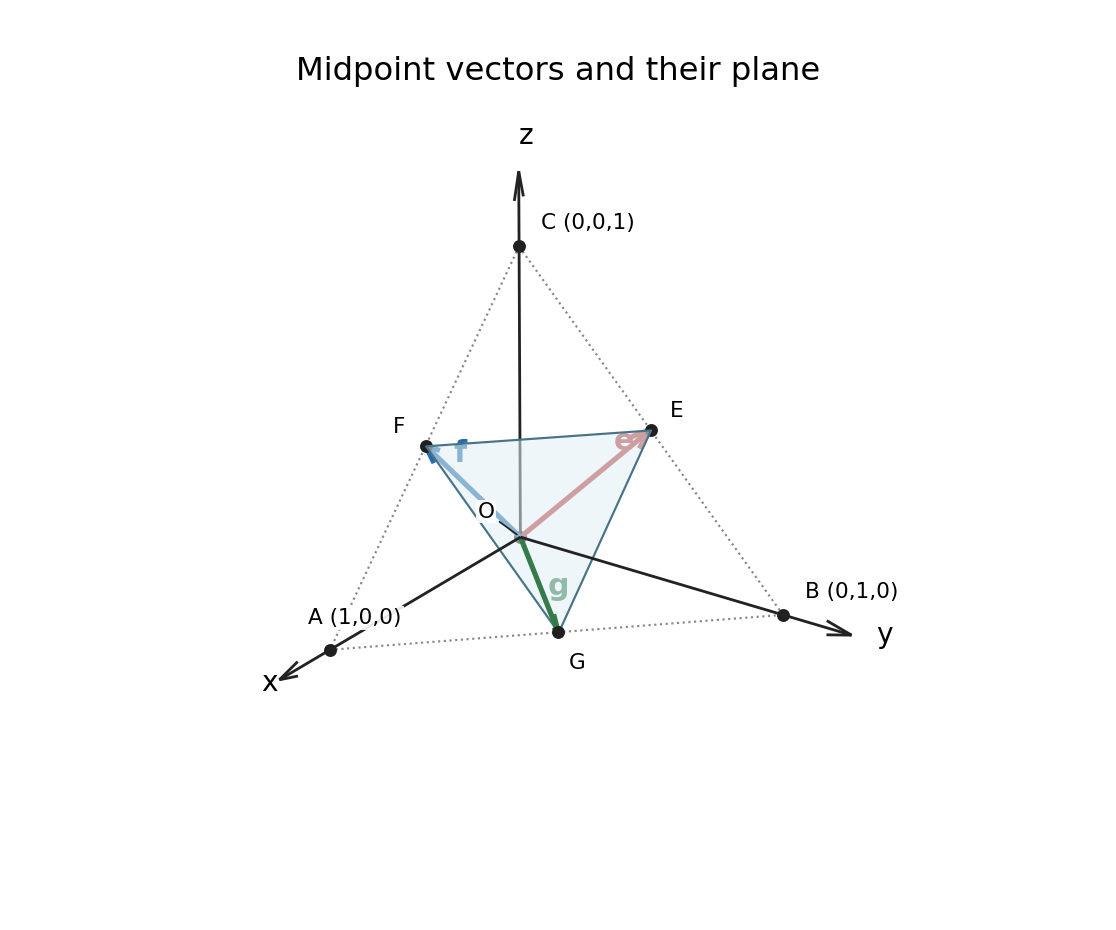
Cartesian axes and three independent midpoint position vectors
. Details. 
The position vectors end at the midpoints of , and , respectively. The drawing places , and on those edges and shows the arrows from the origin. The volume of their parallelepiped is the absolute scalar triple product:Equivalently, this is the absolute determinant of the matrix whose columns are the three vectors. Since it is nonzero, the vectors are linearly independent. Three linearly independent vectors in the three-dimensional vector space form a basis.
Writing and comparing Cartesian coordinates givesThe unique solution, guaranteed by the basis property, is . Thus
Two directions within the plane areTheir cross product is , so a unit vector normal to the plane isIts negative is equally valid. An equation of a plane through three points in vector form isor, parametrically, . Since the coordinate sum of is one, the Cartesian equation of a plane isThe distance from a point to a plane is the absolute normal displacement, giving
Let . A point on the line has position vector . By bilinearity and antisymmetry of the cross product,For a point with position vector , the area of the parallelogram spanned by and equals base length times perpendicular Euclidean distance. Hence the shortest Euclidean distance to the line isFor , these quantities areThus . The perpendicular meets at , whose displacement from has precisely this length.
Articles by others on the same topic
There are currently no matching articles.