The fundamental theorem of calculus, using continuity of near , givesThe lower endpoint is constant, so it contributes no additional term.
On the negative half-line, differentiation gives . The integration path from to stays away from the singularity at zero. ThereforeThis choice satisfies .
A suitable real antiderivative on the disconnected domain isFor , directly; for , and the chain rule again gives . The graph is even, crosses zero at , tends to on either side of zero, and tends to as . Independent additive constants may be chosen on the two disconnected half-lines; both are set to zero here.
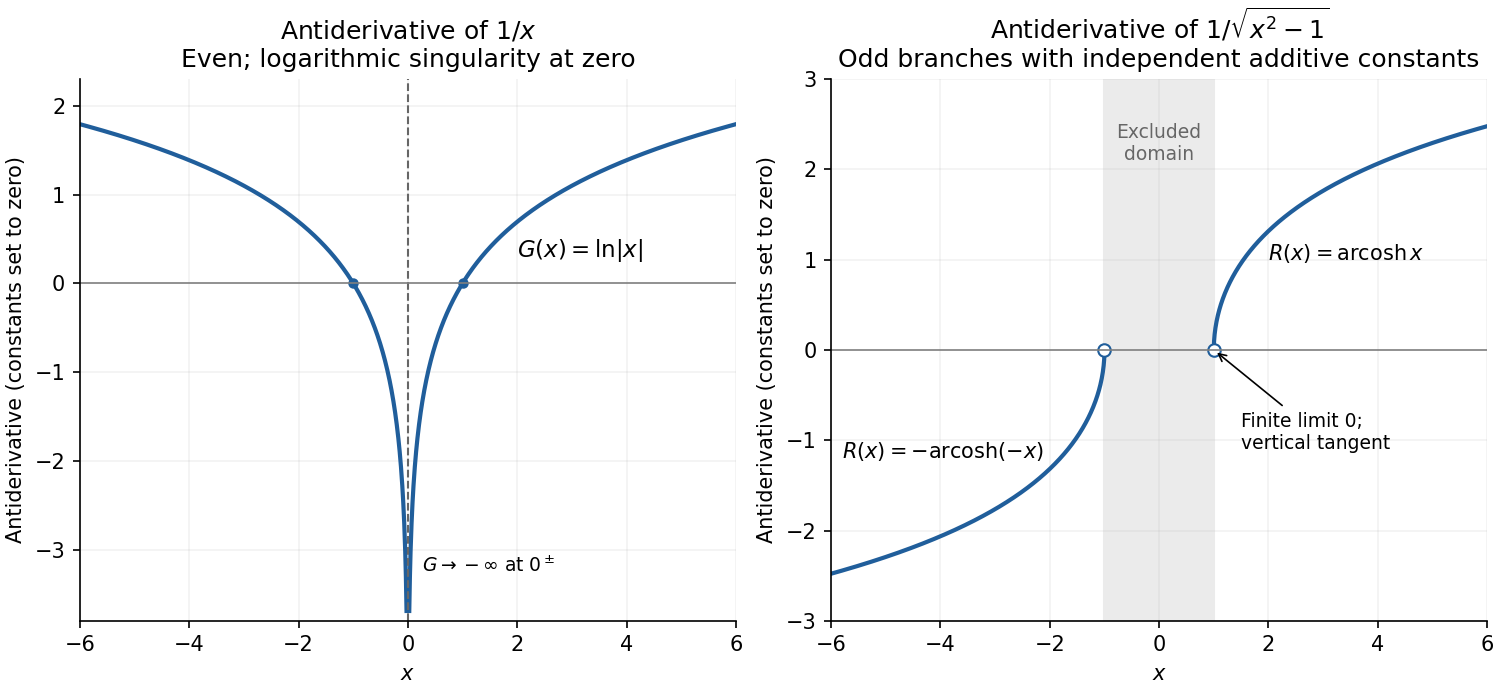

At , the integrand is unbounded but integrable: . Thus the lower-limit integral is understood as an improper integral. With ,The lower endpoint corresponds to , givingThe limiting value at is zero. Here is the inverse hyperbolic cosine.
A single formula valid on both real components isLet . Since ,Equivalently, for and for . The graph is odd for this choice of constants, increases on both components, and approaches zero with vertical tangent as or . Its far-field behaviors are on the right and on the left. The interval is excluded. Independent additive constants could again be assigned to the two components. The right panel sketches these real inverse-hyperbolic antiderivative branches.
Let . The chain rule gives , so the two given summands combine into its logarithmic derivative, . For , , so the real logarithm is defined throughout the integration path. Since ,This satisfies , and differentiation recovers both terms of the integrand.
Articles by others on the same topic
There are currently no matching articles.