A probability density function must have total integral one. The numerator is an even function, soThis is positive, ensuring nonnegativity of the probability density function.
Put . The function graph is symmetric about the vertical axis, zero outside , and has its unique maximum at with height . On , it decreases as ; the negative side is its reflection. The one-sided interior endpoint values are , so the probability density function jumps to zero at both ends of its support. It also has a corner at its central maximum because of the absolute value in the exponent.
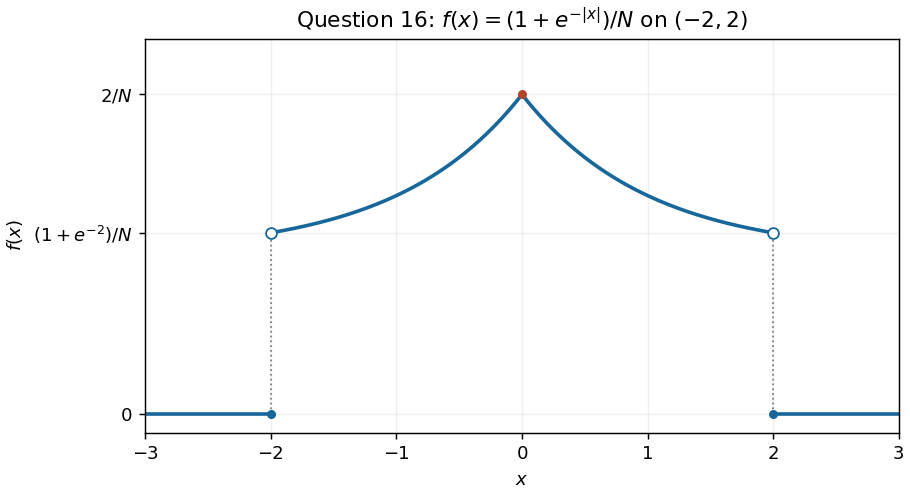

Values assigned exactly at do not affect any probability.
Since the probability density function is an even function, is an odd function. Its integral over the symmetric support vanishes, so
The expected value is zero, so the variance is . Symmetry givesThe polynomial term contributes . Two applications of integration by parts giveso its definite value on is . Therefore
Let be the cumulative distribution function of . Normalisation of the proposed probability density function requires . The integrated cumulative distribution function on a bounded interval identity givesFor a direct symmetry proof, the continuous symmetric probability distribution satisfies . HenceIn particular is nonnegative and has total integral one over its stated support.
Articles by others on the same topic
There are currently no matching articles.