Multiply numerator and denominator by the complex conjugate :Thus the real part is and the imaginary part is .
Since , equating its real part and imaginary part gives , orThe quadratic equation in factors as . Thus the set is the union of two straight lines through the origin:Their slopes multiply to , so they are perpendicular. Their angles to the real axis are and , modulo . The origin is included.
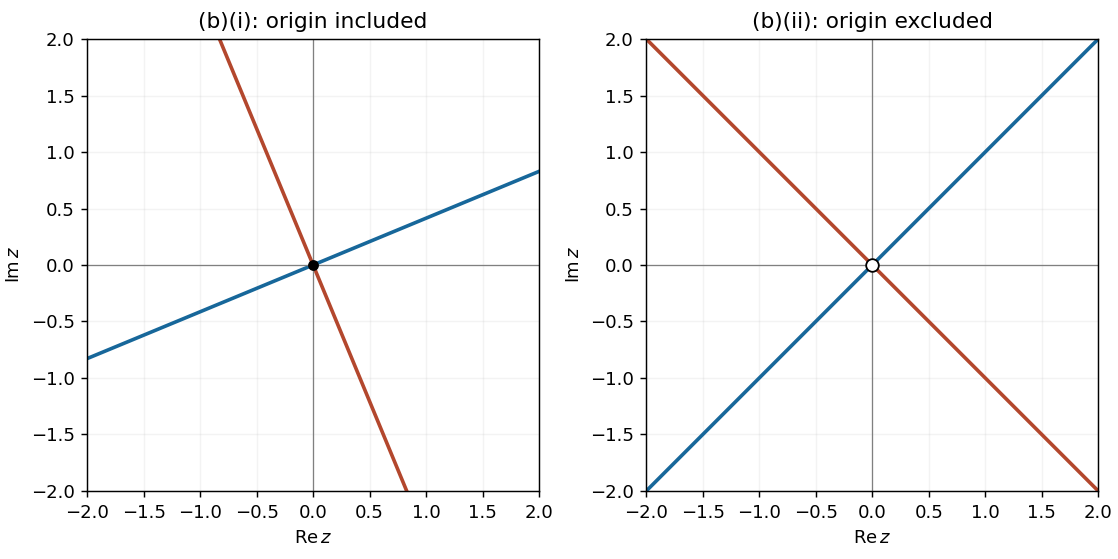

The denominator requires . Write , where and . Multiplication by the nonzero denominator givesso . Conversely, if and , then and . Thus the required Argand diagram consists exactly ofThese are two perpendicular straight lines, with the origin removed as shown in the figure in part (i).
For real , , so multiplication by the hyperbolic cosine is reversible. The identities and giveThus . The exponential function is injective, so the unique real solution is
Set . The hyperbolic cosine identity gives , hence the quadratic equationLet . The first root has modulus and complex argument ; the second has modulus and complex argument . Taking all complex logarithm values givesThe two families are distinct because their real parts are respectively and . This exhausts the solutions because both roots for and all possible complex arguments have been included.
Articles by others on the same topic
There are currently no matching articles.