Since , equating its real part and imaginary part gives , orThe quadratic equation in factors as . Thus the set is the union of two straight lines through the origin:Their slopes multiply to , so they are perpendicular. Their angles to the real axis are and , modulo . The origin is included.
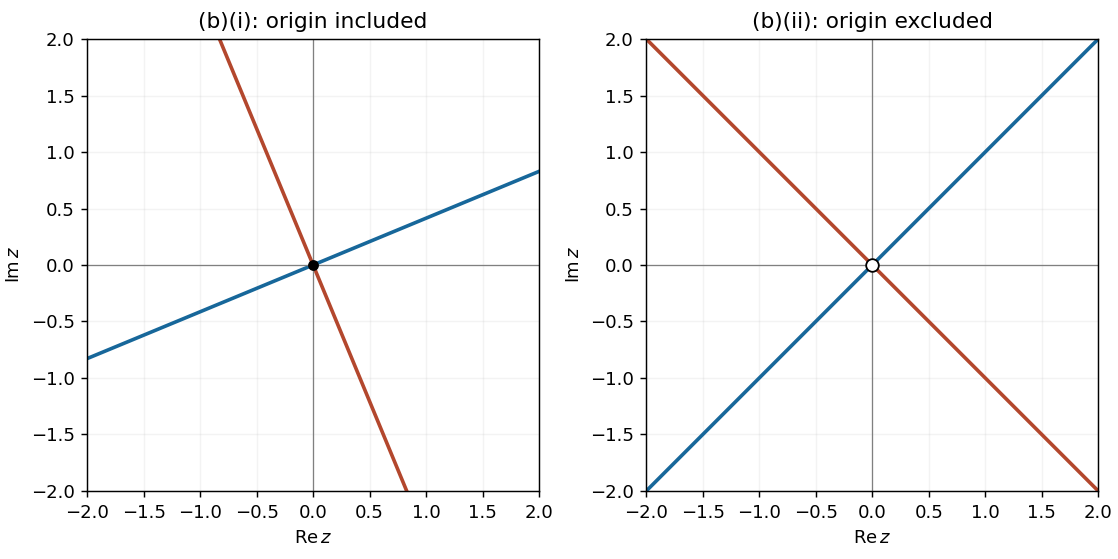

The denominator requires . Write , where and . Multiplication by the nonzero denominator givesso . Conversely, if and , then and . Thus the required Argand diagram consists exactly ofThese are two perpendicular straight lines, with the origin removed as shown in the figure in part (i).
Articles by others on the same topic
There are currently no matching articles.