The angles in the PDF are measured from the vertical normal to the interface. The horizontal displacements of the two path segments are and , while their lengths are and . Thus the geometric constraint and travel time areThe Lagrange multiplier equations giveCancelling the positive geometric factors gives , henceThis is Snell's law, . The relation depends only on the ratio of the two speeds, so changing leaves the relation unchanged; it changes which angles satisfy it together with the geometric constraint.
For a minimum check, let be the horizontal distance to the crossing point. ThenandThus the travel time is a strictly convex function of , and its stationary point is the unique global minimum. For positive , , placing the crossing between the two endpoint projections.
Put . By part (i), . The acute-angle geometry requires . Expressing the tangents in terms of their sines in the geometric constraint gives the required implicit equationThe hint suggests for an integer . Testing givesThus . Each term on the left is strictly increasing in over the allowed interval, so this solution is unique.
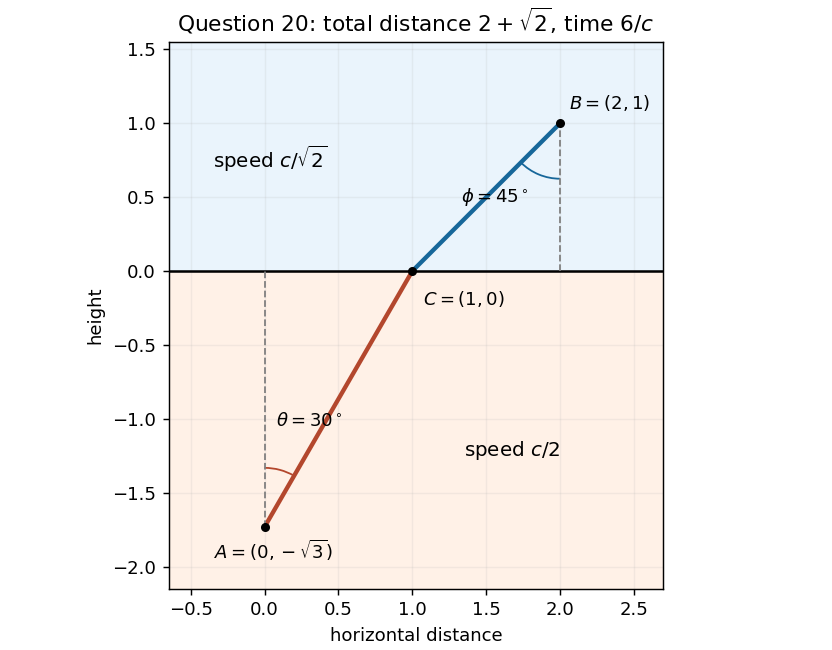
The acute angles follow from part (ii) and the Snell's law relation:The path lengths below and above the interface are respectivelyHence the total distance and minimum travel time areFor a sketch to scale, choose the interface as , with and . The crossing is because . The figure uses equal axis scales and shows the two normal-relative angles.

Articles by others on the same topic
There are currently no matching articles.