The stationary point equations are and . The sign assumptions make both ratios positive, so each equation has exactly one real solution. ThereforeSubstitution gives the stationary value
The Hessian matrix is diagonal:Its eigenvalues are and . Hence the second-derivative test gives a strict local minimum if , a strict local maximum if , and a saddle point of a scalar function if . No degenerate case occurs because both are nonzero.
The local minimum is the unique global minimum, since both separated summands are strictly convex functions and tend to at either end of the real line. Similarly, when both signs are negative there is a unique global maximum.
Here the stationary point is the origin, of value two. The Taylor expansion isThus nearby level curves are approximately concentric circles. Globally the level curves above two are closed around the unique minimum, symmetric under interchanging and , but not under changing either coordinate's sign. The faster exponential growth for positive coordinates compresses the curves on their positive sides.
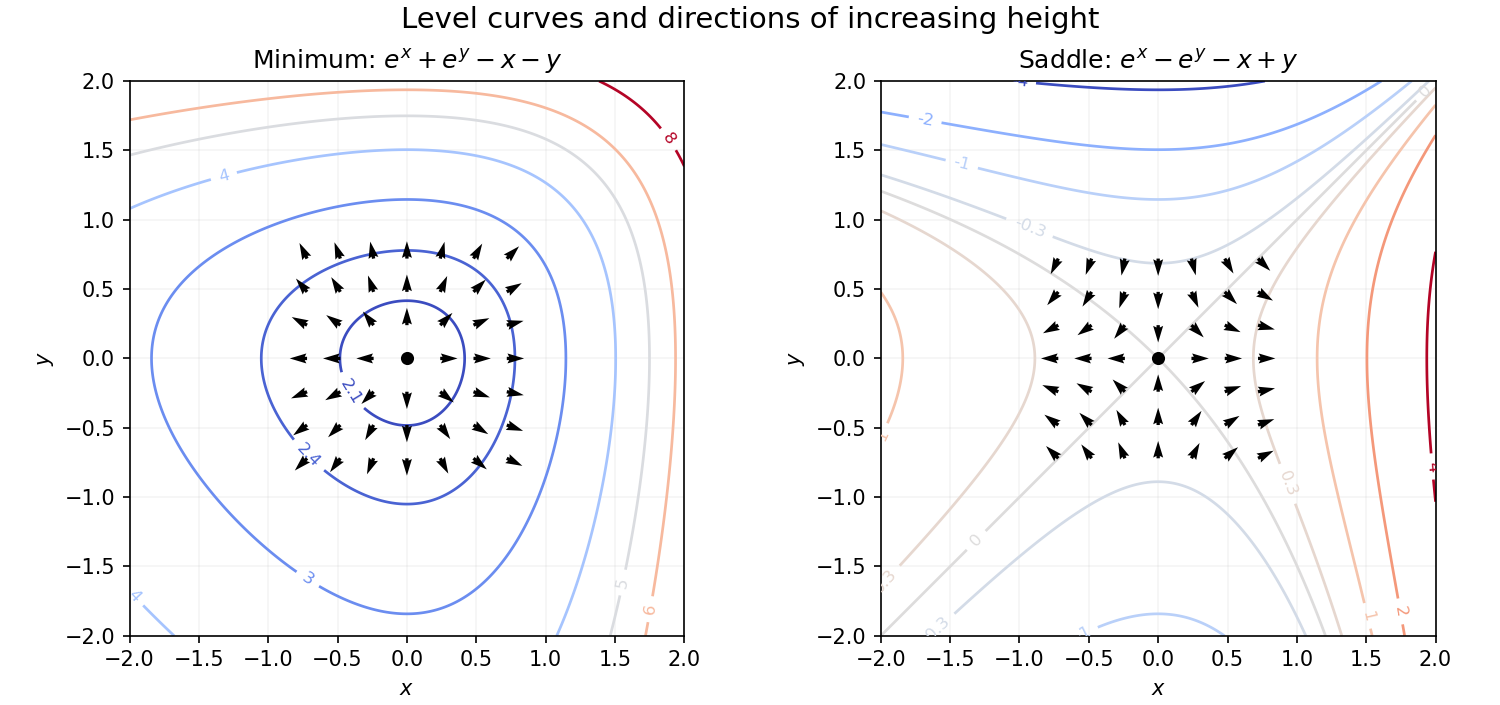

Now and the origin has stationary value zero. Near it,The level curves therefore resemble hyperbolas near the saddle point of a scalar function. Along the -axis for , while along the -axis for . The zero level set includes the exact diagonal and another branch crossing it at the origin; this second branch is tangent to but is curved away from the origin. The right panel of the contour figure displays these features.
For case (i),Each component has the sign of its coordinate, so the gradient points outward from the minimum. Near the origin it is .
For case (ii),Its component has the sign of , while its component has the opposite sign to . Thus arrows point outward on the -axis and inward on the -axis, with local form . These directions are included in the contour figure; in both cases the gradient is perpendicular to the level curves and points toward increasing .
Articles by others on the same topic
There are currently no matching articles.