The original PDF places complement bars on the second in each parenthesis and on the final . Thus the first parenthesis is the empty set, whereas the second is the whole sample space. Their union with any further subset is still the whole space:The bars are missing from the local OCR, so using its unbarred expression would give the wrong result.
In the cylindrical coordinate system, and . The point is in the third quadrant, so a representative azimuth in is . ThereforeThe angle is defined modulo .
For spherical coordinates, the distance from the origin is and the polar angle satisfies . The azimuth is the same as in part (a). ThusThe polar angle is in because the point lies below the -plane.
The vector triple product identity isConsequently a choice of the requested coefficients isThese are the standard identity's coefficients, even if the particular three vectors are linearly dependent and a representation need not be unique.
The area is zero if the vectors are parallel or either is zero. The corresponding triangle has half this area.
The traversal fixes the orientation of the vector area as half the cross product of the edges and :Its Euclidean norm is the area of the triangle, and its direction follows the right-hand rule.
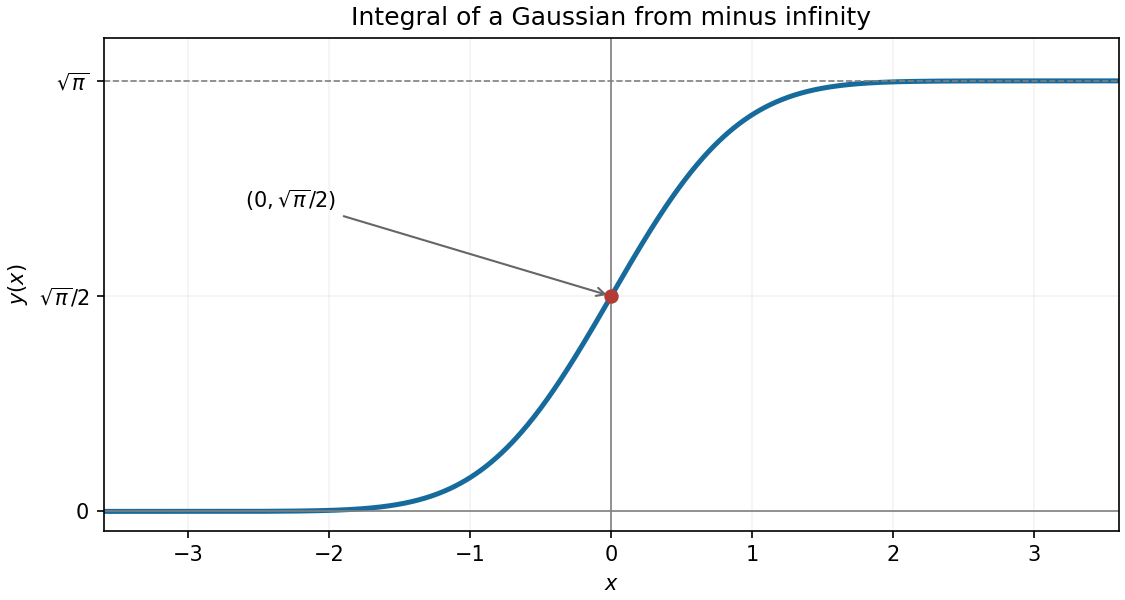
The fundamental theorem of calculus gives , so the graph is strictly increasing. Its second derivative is : it curves upward for and downward for , with an inflection point at zero.
By the Gaussian integral and the evenness of its integrand,Thus the only axis intersection is ; there is no finite -axis intersection because the integral is strictly positive for every finite . The error function gives .

Setting the tangent line approximation equal to zero gives the Newton root-finding iterationThe step requires a nonzero derivative at the starting point.
Normalize the direction to the unit vector . The directional derivative is the dot product of this unit vector with the gradient:
Reflection in the -axis preserves the disk but changes the sign of the integrand . The double integral is therefore its own negative and must beEquivalently, for each fixed the integrand is an odd function of on a symmetric interval.
The curl of a gradient is zero pointwise, so its surface integral over this sphere isFor this particular polynomial, , whose curl vanishes directly as well.
Contracting the Kronecker delta identifies . The remaining two independent sums are dot products, so the Einstein summation convention givesThe index expression here is verified against the PDF because the OCR corrupts it completely.
All three linear equations are multiples of the first, leaving the single constraint . Choose two real numbers freely:A basis for this two-dimensional linear subspace is .
The solution set is the plane through the origin with normal vector . The three original planes coincide, so their common intersection is this entire plane.
For the specified standard basis vectors, , soOn the other hand, and henceThese results are unequal, proving that the cross product does not satisfy the associative property.
If the three vectors lie in one plane through the origin and are independent, their cross product is a normal vector to that plane, so its dot product with is zero. If are dependent, their cross product is already zero. Thus coplanarity always forces the scalar triple product to vanish.
Taking the contrapositive proves that a nonzero scalar triple product rules out coplanarity. Geometrically its absolute value is the nonzero volume of the spanned parallelepiped.
Use displacements from , since coplanarity of points concerns an affine plane that need not contain the origin. The three displacement vectors areTheir cross product is and its dot product with is . Since the scalar triple product is nonzero,
The three displacements from areHere and its dot product with is zero. Because the cross product itself is nonzero, the first three points determine a plane and the fourth lies on it. Explicitly all four satisfyThus the four points are coplanar.
The stationary point equations are and . The sign assumptions make both ratios positive, so each equation has exactly one real solution. ThereforeSubstitution gives the stationary value
The Hessian matrix is diagonal:Its eigenvalues are and . Hence the second-derivative test gives a strict local minimum if , a strict local maximum if , and a saddle point of a scalar function if . No degenerate case occurs because both are nonzero.
The local minimum is the unique global minimum, since both separated summands are strictly convex functions and tend to at either end of the real line. Similarly, when both signs are negative there is a unique global maximum.
Here the stationary point is the origin, of value two. The Taylor expansion isThus nearby level curves are approximately concentric circles. Globally the level curves above two are closed around the unique minimum, symmetric under interchanging and , but not under changing either coordinate's sign. The faster exponential growth for positive coordinates compresses the curves on their positive sides.
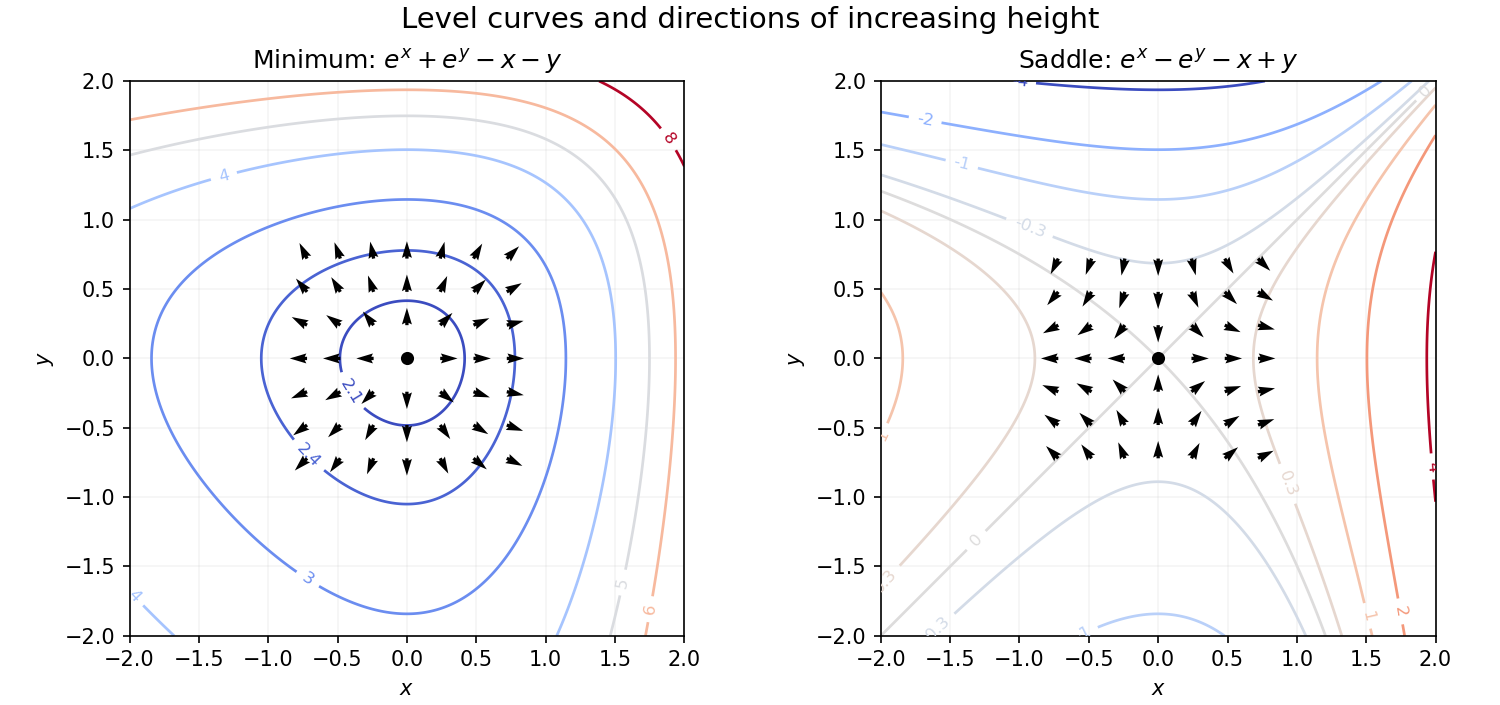

Now and the origin has stationary value zero. Near it,The level curves therefore resemble hyperbolas near the saddle point of a scalar function. Along the -axis for , while along the -axis for . The zero level set includes the exact diagonal and another branch crossing it at the origin; this second branch is tangent to but is curved away from the origin. The right panel of the contour figure displays these features.
For case (i),Each component has the sign of its coordinate, so the gradient points outward from the minimum. Near the origin it is .
For case (ii),Its component has the sign of , while its component has the opposite sign to . Thus arrows point outward on the -axis and inward on the -axis, with local form . These directions are included in the contour figure; in both cases the gradient is perpendicular to the level curves and points toward increasing .
On the first segment, parameterize , . The dot products with areTheir line integrals are one and , respectively.
On the second segment take , with tangent vector . The corresponding integrands are and , whose integrals are and . Adding the segments yields
On the curved path, and . Direct substitution givesThusBoth values agree with part (i), for every . Agreement on these two selected paths alone does not establish a conservative vector field.
For , all three curl components vanish for every . More constructively,Hence is conservative for every real . Its endpoint vector-field potential difference is , checking both line integrals.
For the other vector field, direct partial differentiation givesIt therefore has a vector-field potential exactly when , with no restriction on :The value of is irrelevant to . Its rotational part for general is . Both selected paths lie in , and this rotational part has zero dot product with every tangent vector to that plane. That explains why these paths cannot detect its nonzero curl when .
By the multiplication principle, the successive places have six, five, four, three, two and one available letters. Thus the number of permutations is
The last letter has two permitted choices, and each leaves permutations. The two classes are disjoint, so the count is
Let denote the set of arrangements with fifth, and those with sixth. Each contains arrangements, while their intersection contains . The inclusion-exclusion principle gives
Requiring exactly one condition means taking the symmetric difference of the two sets. Subtract their shared cases twice from the two individual counts:Equivalently, remove the twenty-four arrangements satisfying both conditions from the inclusive count .
The second bin is forced to contain , leaving the other four letters in the first bin. Since order within a bin is irrelevant, this gives exactlyset partition of the specified bin sizes.
The first four letters may be permuted in ways and the last two in ways without changing this partition. The multiplication principle therefore gives
Choose the unordered pair of letters in the second bin; the first bin is then determined. The binomial coefficient givesThe first and second bins are distinguished, so their roles are not interchangeable.
The product isEvery permutation determines exactly one bin partition, and each such partition has exactly forty-eight internal orderings. Thus the fifteen classes partition the original sample space of arrangements, without overlap or omission.
For first-bin size , choose its contents in ways. Each choice arises from permutations, obtained by ordering the two bins internally. The seven ordered size choices giveHere . Each row expresses the same binomial coefficient identity . Even for the bins retain their first/second labels, so the number is twenty rather than ten; the braces denote bin sizes in the question's convention, not interchangeable bins.
Articles were limited to the first 100 out of 156 total.
Articles by others on the same topic
There are currently no matching articles.