The unilateral Laplace transform is in its region of absolute convergence of a Laplace transform. Under the usual inversion hypotheses, the Bromwich inversion formula isThe vertical Bromwich contour is directed upward, with inside the transform's convergence half-plane and to the right of all its singularities. At discontinuities the standard symmetric inversion gives the mean of the one-sided values.
For a piecewise continuously differentiable with an integrable transformed derivative, integration by parts gives the Laplace transform of a derivative:Here the upper endpoint vanishes by the given decay condition, and right continuity at zero supplies the lower endpoint.
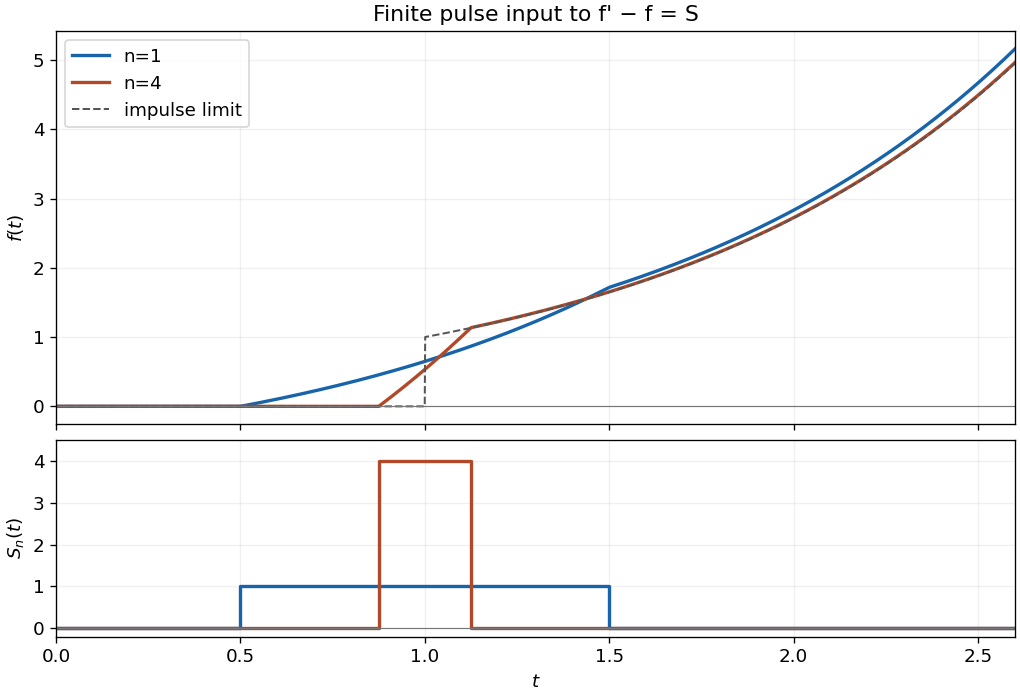
Set , . The finite pulse has Laplace transform . Since , transforming the equation givesThe partial fraction decomposition has inverse . By the Laplace transform time-shift rule,This finite-pulse response of a first-order linear equation gives the requested outer regions:For completeness, while the pulse is active the solution is . It is continuous at both switching times. After the forcing stops it grows as , because the homogeneous equation is . The apparent pole at in the full transform is removable; the Bromwich contour may be taken with .

Articles by others on the same topic
There are currently no matching articles.