For a holomorphic function, the Cauchy-Riemann equations are and . ConsequentlyA gradient is normal to its level set, so these identities give orthogonal level curves wherever the gradients are nonzero. At a critical point where , both gradients vanish and a regular tangent to a level set need not exist; the geometric orthogonality statement is restricted to regular intersections.
Differentiate the Cauchy-Riemann equations and use equality of mixed partial derivatives:Thus the real part is a harmonic function. The same calculation gives . Every holomorphic function has the required smoothness.
Inverting gives , hence the elliptic coordinatesEliminating at fixed gives the ellipseIts focal distance is . At fixed , eliminating instead gives the hyperbolaIts focal distance is also one, so both families have foci . A fixed traces an appropriate half of the hyperbola; complementary coordinate values complete it. Degenerate values give the focal segment and portions of the coordinate axes. Away from these degeneracies the curves are orthogonal by part (i), or by in the displayed parametrization. A branch of the inverse is used locally; its real part with is single-valued outside the focal segment.
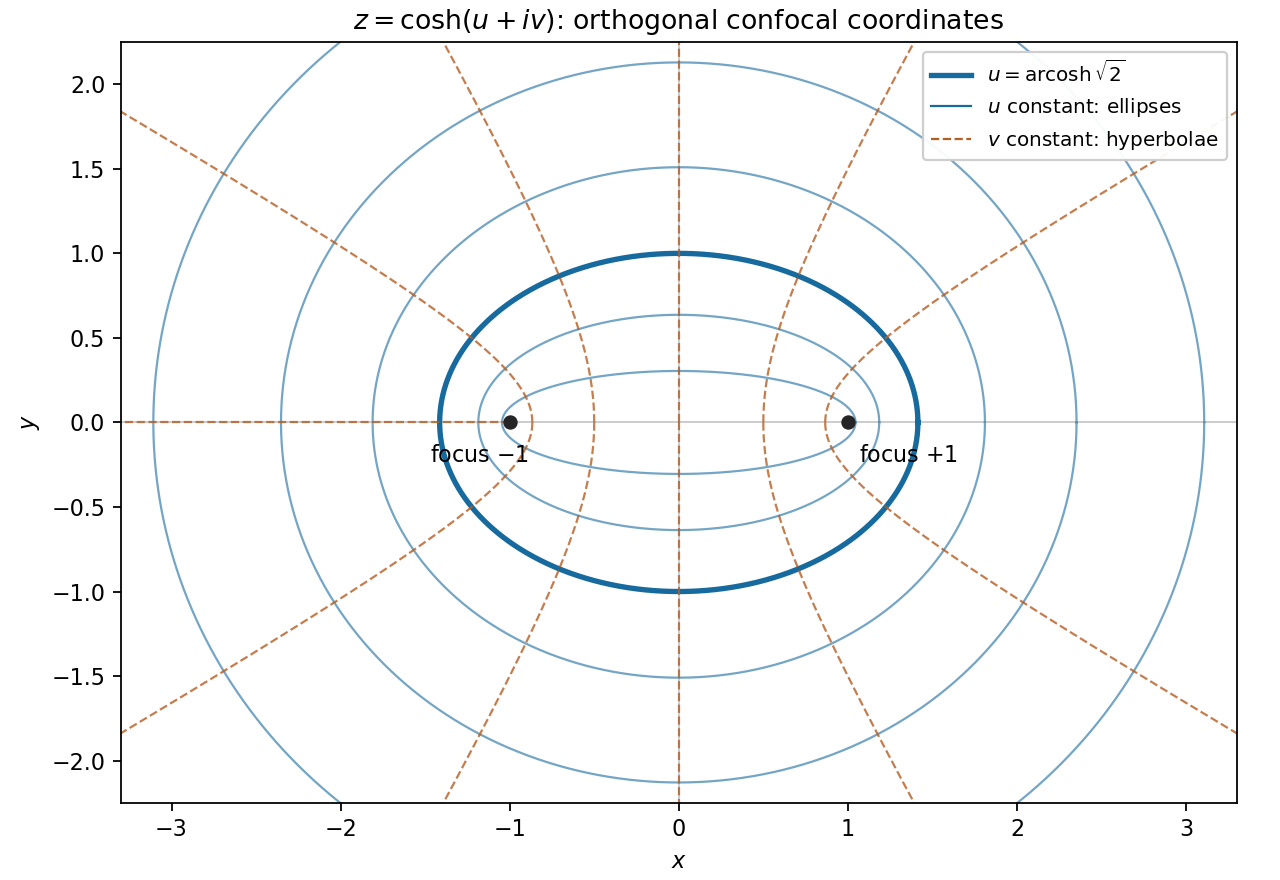

On the specified ellipse, the semiaxes are and , so its elliptic coordinate is . Thus in the exterior,is a harmonic function with a homogeneous Dirichlet boundary condition on that ellipse. Choose the square root with at infinity. Although a global complex logarithm requires a cut, its real part is well defined throughout the exterior and gives the same .
Expanding at large yields . ThereforeIn particular the potential grows logarithmically in the distance, in every direction at infinity. It is the exterior solution; no harmonic continuation through the focal segment in the ellipse's interior is claimed.
Use the Wirtinger derivatives and , for which . Since and are holomorphic,The Laplacian has real coefficients, so taking real and imaginary parts provesThis is the complex analytic representation of biharmonic functions; itself is generally not holomorphic because of its factor.
Articles by others on the same topic
There are currently no matching articles.