Take both displacement coordinates positive to the right. The kinetic energy and elastic potential energy areThus the equations of motion are and . With , the generalized eigenvalue problem for small oscillations isIts determinant gives . Put . The two-mass three-spring normal modes haveBoth squared frequencies are positive because . Also , so and : the lower mode moves the masses in phase, and the higher mode moves them oppositely. A general mode is an arbitrary sinusoidal amplitude multiplying its fixed shape.
For equal masses these reduce to , and , . For unequal masses the vectors need not be Euclidean-orthogonal; they are orthogonal in the mass inner product, .
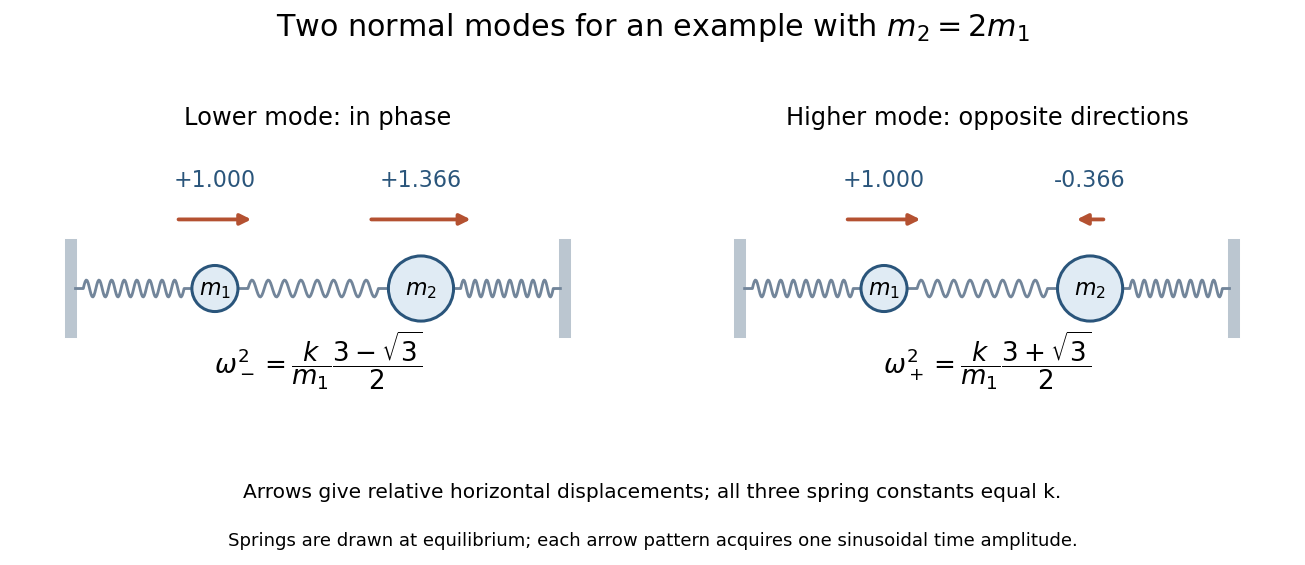
In-phase and out-of-phase mode directions for an illustrative unequal-mass system; arrow lengths show relative displacements
. Details. 
The displacement directions specified at release give . Let . By initial-data decomposition into two normal modes, write . Solving the two coordinate equations givesZero initial velocities remove the sine terms, soIn components,Substitution at zero gives , , and both derivatives vanish. For unequal masses both normal modes are generally present. When , , , so only the higher mode survives: and .
Since both initial displacements vanish, only sine terms are needed. Resolve the velocity into the two normal modes:Each modal initial velocity must be divided by its angular frequency to obtain its displacement amplitude. ThereforeExplicitly,At zero, both displacements vanish and differentiation gives . The motion combines the in-phase and out-of-phase modes, with opposite signed modal velocity coefficients. Their different frequencies produce changing constructive and destructive interference in the physical coordinates, so motion is transferred through the coupling spring. This does not require assuming equal masses or exact periodic transfer of all the energy.
Articles by others on the same topic
There are currently no matching articles.