The coordinate tangent vectors are the partial derivatives of the position vector:Their pairwise dot products vanish. Their lengths, the scale factors of orthogonal coordinates, are . Since , the last is positive throughout the body. Thus these circular torus coordinates are orthogonal wherever ; at the cross-section angle degenerates, as in ordinary polar coordinates.
The ordered Jacobian determinant isIts sign is positive for , so the volume element is . The coordinate degeneracy on the central circle has zero volume and does not obstruct volume integration.
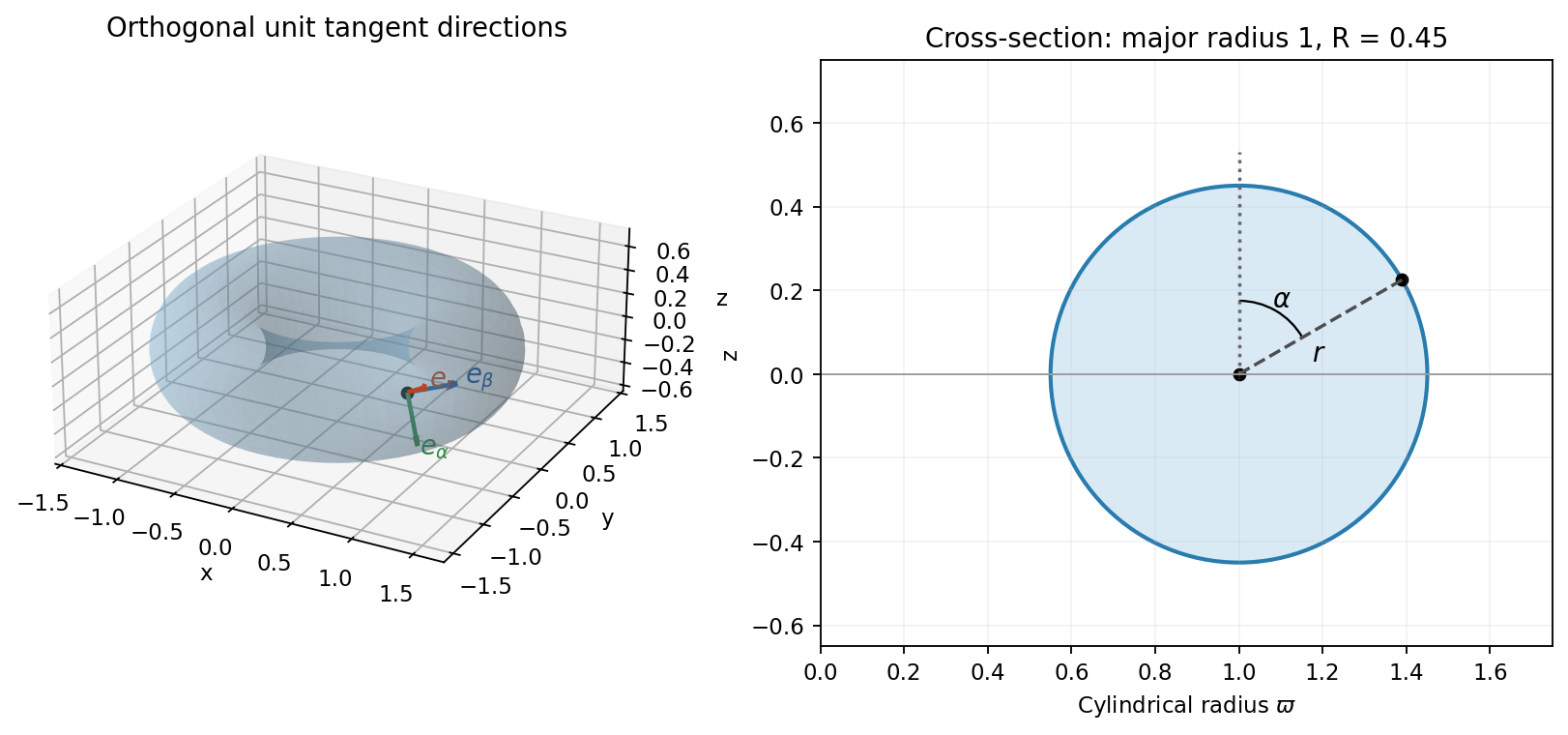
Circular torus coordinates and their orthogonal tangent directions
. Details. 
Take the closed surface with its outward orientation. For sufficiently smooth fields defined throughout the solid, the divergence theorem and the identity that the divergence of a curl is zero giveThus the curl term carries no net outward flux, and is independent of . The hole in the solid torus does not invalidate the divergence theorem; singularities of inside the integration region would invalidate the smoothness argument and must be excluded.
Only the quartic term contributes to the Laplacian. The mixed cubic has zero second derivative in each coordinate, while the exponential–trigonometric pairs are harmonic:Using and the Jacobian determinant from part (a), the divergence theorem givesThe term containing integrates to zero. Equivalently, the second vertical moment of a solid ring torus with major radius one is .
Articles by others on the same topic
There are currently no matching articles.