A complex function is holomorphic at a point if it is complex differentiable throughout some open neighbourhood of that point. Writing and , a convenient sufficient and necessary criterion under continuously differentiable real components is the Cauchy-Riemann equationsThey must hold throughout an open neighbourhood, rather than at an isolated point. Merely having partial derivatives that satisfy these equalities at one point is not enough without an appropriate differentiability hypothesis. For the composition , holomorphy of and on the relevant open sets suffices; the additional condition is needed when using a local inverse conformal map, not for holomorphy of the composition itself.
Choose the branch of holomorphic in the upper half-plane whose boundary value at zero is . Thenand integration gives on this branch. The normalization and intended upper-half-plane image fix the otherwise ambiguous square-root sign.
To see the image, put . For and ,The bottom edge maps monotonically onto . The right wall maps by onto , and the left by onto . These boundaries describe the conformal map of a vertical half-strip by sine.
For completeness, the map is one-to-one in the interior: equality of two sine values forces arguments differing by or summing to , and neither alternative yields two distinct points in this half-strip. It is onto the upper half-plane as well. Setting gives ; the root product is , and no root lies on because that would make real. Thus exactly one root has . The identity then gives , so belongs to the half-strip. The closure gives the stated boundary-inclusive region; holomorphy is understood in its open interior.
In this region the transformed function is . Its only finite intrinsic branch point in the closure occurs where :It lies on the left boundary. There are no singularities in the open half-strip. The points , where diverges, map to the bottom corners; is holomorphic through those corners since there.
For the principal logarithm, the boundary segment , , is the preimage of its cut . Points on that cut above admit local analytic continuation after changing branch; itself is the genuine logarithmic branch point.
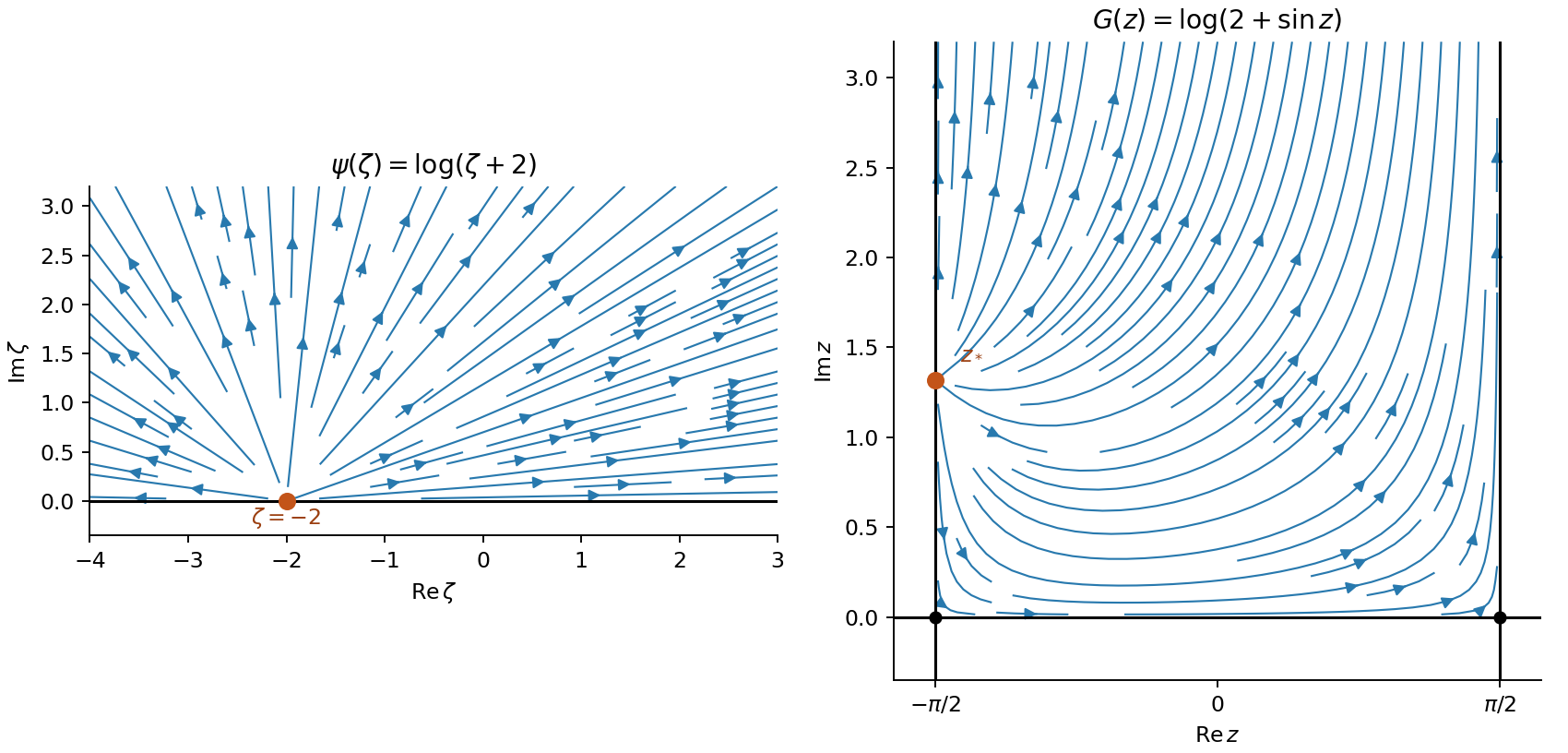
Writing ,ThereforeThe vector field points radially away from , with magnitude inversely proportional to distance from that point. It diverges on approach to that boundary point and tends to zero far away. This is the radial potential flow described by the logarithmic complex potential of a two-dimensional potential flow.
The chain rule givesTo make the directions explicit, set and . Multiplying by the complex conjugate of the denominator gives the logarithmic flow in a sine-mapped half-strip:In the open strip . The vertical component is negative near the lower left wall where , and positive above that curve. On the bottom the flow is rightward. On the right wall it is upward, whereas on the left wall it points downward below and upward above . The field is tangent to the boundaries except at the source and vanishes at the two bottom corners. At large , , so it tends to a uniform upward field .
Near , , showing a radial boundary source. The streamlines are the curves ; the figure shows their orientation without reusing the exam's graphics.

Articles by others on the same topic
There are currently no matching articles.