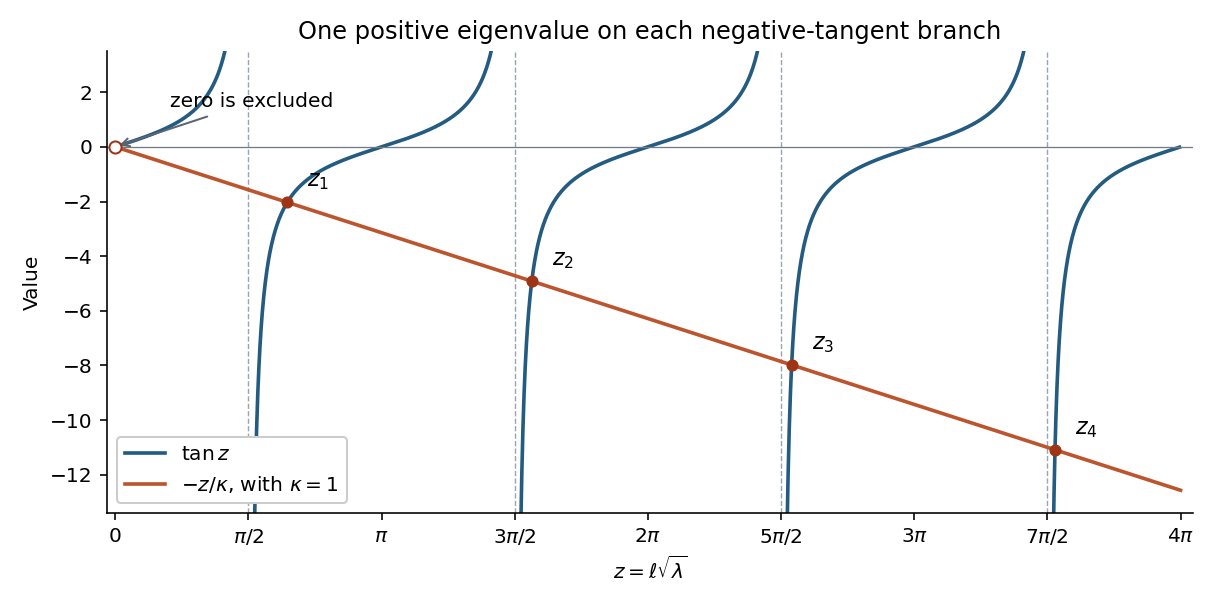
By part (c), write with . The equation is , and the left Dirichlet boundary condition eliminates the cosine term. Thus , with . The right Robin boundary condition becomesPut and . A root cannot have , so this is equivalent to .
On each interval , , the function rises from to a positive value and has derivative . The intermediate value theorem and strict monotonicity therefore give exactly one root there. On the intervening positive-tangent intervals both terms are positive, so there are no further positive roots. ConsequentlyThese intervals establish and an infinite sequence of eigenvalues. The apparent algebraic root of the sine equation is excluded: it gives a zero sine function, and the direct zero-eigenvalue solution would require .

For vector normalization to unit norm, the Dirichlet-Robin eigenvalues on a finite interval giveThe eigenfunctions can otherwise be scaled by any nonzero real constant.
Articles by others on the same topic
There are currently no matching articles.